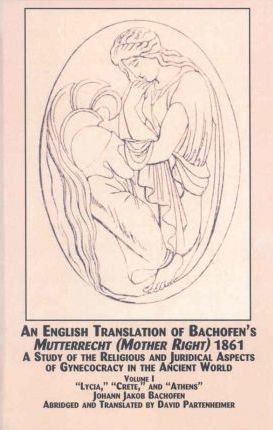
Mutterrecht (Mother Right): A Study of the Religious and Juridical Aspects of Gynecocracy in the Ancient World
The era of mother right was a joyless, dark, and wild life of blood revenge, in which each murder generated another one, in which spilt blood was washed off with the blood of another, in which the curse on a family ended only after the death of its final member.
https://archive.org/details/das-mutterrecht-mother-right-johann-jakob-bachofen-berserker-books
Download: An English Translation of Bachofen’s Mutterrecht (Mother Right) [PDF]
English translation published in 2003 by Edwin Mellen Press.
page 7
According to Herodotus, the Lycians emigrated from Crete in ancient times as followers of Sarpedon in his exile. Under Sarpedon’s rule, both his followers and the indigenous people were called Termilae. However, the Termilae acquired their new name, Lycians, from Lycus, son of Pandion, when he fled Athens and joined Sarpedon in exile in the land of the Termilae.
Their customs are partly Cretan and partly Carian. However, they have a strange custom, which no other people practice. They take their names from their mothers rather than their fathers. When one asks a Lycian who he is, he gives the family line of his mother, including the mothers of his mother. If a woman citizen marries a slave, her children are considered of pure blood [γενναῖα]. Even if the noblest Lycian man takes a foreign wife or concubine, the children are considered ignoble offspring deprived of civic rights [ἄτιμα τὰ τέκνα]. (1.173)
This passage is especially significant because it conflates matrilineage with the child’s legal position. In short, matrilineage is a fundamental principle of mother right with social consequences.
Other writers confirm and augment Herodotus’ account.
…
Lycia
page 18
The Lycian men could not persuade Bellerophon to stop the flood. Then the Lycian women approached Bellerophon and pulled up their chitons. Ashamed, Bellerophon returned to the sea, and the flood followed him. (248АВ)
In Plutarch’s “Bravery of Women,” Bellerophon responds to women in radically different ways. On the one hand, he combats and defeats the Amazons. On the other hand, he retreats at the mere sight of womanhood and obeys its demands. His obedience to womanhood makes him the founder of mother right in Lycia. Bellerophon’s victory over women yet his subjection to them is remarkable story illustrating the struggle between mother right and men’s rights.
page 19
In this case, Bellerophon and men’s rights succeed only partially. Bellerophon routs the Amazons, the man-hating, man-killing, bellicose virgins. Amazonianism is the ultimate degenerative form of mother right. However, women representing the higher law of marriage prevail over Bellerophon and male authority. In short, Bellerophon curtails Amazonianism but not mother right itself. Mother right is grounded in the maternal nature of woman. Therefore, woman and the earth are equated. As Bellerophon acquiesces to the Lycian women’s display of maternal fertility, Poseidon withdraws his devastating waves from the fertile land. Masculine procreative power acknowledges the higher rights of the conceiving and bearing substance of earth, the mother of everything.
…
The material principle of maternity prevails over the immaterial vitalizing power of a man. The female κτείς [pudenda] rules over the male phallus, the earth over the sea, and the Lycian women over Bellerophon. Bellerophon’s campaign against the authority of women succeeds only partially. He conquers over the deviant Amazons, but he submits to women who uphold marriage and motherhood.
…
page 28
In Olympian Odes (13.84-90), Pindar presents Bellerophon as a powerful and handsome man. Understandably, Stheneoboea/Antia falls in love with him and invites him to make love. However, Bellerophon is chaste. Out of revenge and self-protection, Stheneoboea accuses Bellerophon of making sexual advances (Apollod., Bibl. 2.3.1-2; Hyg., Poet. astr. 18; and Diod. Sic. 6.9). Both names, Stheneoboea and Antia, entail the sense of longing for the fertilization of maternal earthly matter. In this broader sense, she desires sexual relations with Bellerophon.
Stheneoboea/Antia is much like Plato’s Penia, who incessantly seduces men for procreation. Plutarch explains such female behavior as “the wish of material to join and participate in the Good” (De Is. et Os. 374cd). Both Plato and Plutarch consider the earth and its female surrogates as hetaeristic. Because Bellerophon respects the sanctity of marriage, he rejects Stheneoboea’s licentiousness. Bellerophon combats both extremes of female behavior. At the one extreme, he conquers the perverse, man-hating Amazons. At the other extreme, he defies Stheneoboea’s lusty, unrestrained sexuality. Because Bellerophon was a counterforce to female perversions, Lycians considered him their benefactor. In particular, Lycian women were grateful for his deeds since they most benefited from them. Bellerophon liberated Lycian women from both their excessive relationships with men, viz. Amazonianism and hetaerism. In other words, Bellerophon serves as a counterforce to disorderly, wild, and destructive power.
…
Crete
page 31 – 32
For the sake of contrast, I will cite some ancient accounts of peoples who did not practice matrimonium. Instead, these peoples submitted themselves entirely to ius naturale and engaged in free and unbridled sexual relationships. Furthermore, these accounts show how human beings made the transition from a completely natural life to one of exclusive marriage. I will trace this gradual development of human society from the lowest bestial level of ius naturale to ius civile.
At the lowest level of existence, human beings copulate without restrictions and in public. Like animals, men and women satisfy their natural drives for all to see without ever forming a personal relationship. The Massagetae provide the most salient example of public sexual intercourse with many partners.
According to Herodotus, “each man has a wife but any man may have sexual intercourse with her. The Greeks say this is a Scythian custom but it is actually a custom of the Massagetae. Whenever a man desires a woman, he simply hangs his quiver before her dwelling and has intercourse with her” (1.216). Strabo concurs with Herodotus about the Massagetae: “Each man marries only one wife, but they share them openly with each other. Whenever a man desires sexual intercourse with the wife of another, he hangs his quiver onto her dwelling and has intercourse with her” (11.513).
Herodotus reports of similar behavior among the Nasamones: “Men have several wives, and they copulate with them in common. Like the Massagetae, they thrust their staffs into the ground as a sign of the deed” (4.172). The Massagetae and Nasamones are but two peoples who practiced promiscuous sexual intercourse in public. According to Diodorus of Sicily, the Mosynoeces also practiced public copulation: “The soldiers (of Cyrus II) said they were the most barbarous people they had encountered on their campaign. The men copulated with the women for all to see” (14.30.7). In the Argonautica, Apollonius of Rhodes confirms this practice of copulation among the Mosynoeces: “They have no respect for marriage but copulate with women in the presence of others like swine in their herds” (2.1023-25). According to Herodotus, the Ethiopian Ausians “do not practice marriage but copulate and propagate like cattle in the fields” (4.1080).
…
page 49
The same primordial mother mates with many different men. An example is Socrates’ story of Penia and Plutus, in which the substance of the earth [Penia] is poor, needy, and insufficient. She needs fertilization from a man. Because Penia feels inadequate about herself, she pursues various men, yearns for new mates, and like Smyrna, she seduces her own father and like Phaedra, she seduces her own stepson. Only by continually bearing can Penia secure a long life and immortality for her children. In this situation, a son becomes a father by impregnating his mother. In the Cretan myth, Plutus is Demeter’s son, and in the Platonic myth he is Penia’s husband and father of the visible world. In fact, he is both. As a son, he becomes the inseminator of his mother; the created becomes a creator; the same woman is at once his mother and his wife. The son becomes his own father.
Thus, there is a recurrent theme of the love of a daughter for her own father, as in the myth of Smyrna. In these cases, the child has only a mother, and the father is twice removed as a relative of the mother. Woman is the seductive partner like Eve and Pandora; she lives on, while man succumbs to death.
…
page 51
Furthermore, Zeus is mortal. His grave is on Crete. The feminine side of nature is immortal in contrast to the everchanging masculine side, which can sustain itself only through constant rejuvenation dependent upon persistent death. The dead and buried Zeus represents an existence of perpetual death and resurrection. However, Zeus is also a creator; furthermore, he is simultaneously effect and cause like Plutus and Adonis. He is the masculine foundation of earthly creation that becomes manifest through creation, in the form of mortal men. In Cretan mythology, Zeus is born, dies, and then returns in death to earth, to his mother.
…
Athens
page 59
In the City of God, St. Augustine quotes a passage from Varro about two omens during the reign of Cecrops.
At the same time, an olive tree and a fountain of water sprang from the earth. Frightened, Cecrops asked the oracle at Delphi about the meaning of these phenomena. Apollo replied that the olive tree signified Minerva and the water, Neptune. Furthermore, Apollo stipulated that the citizens of Athens should decide which of these two gods manifested in these natural phenomena should represent their city by name. Therefore, Cecrops called an assembly of citizens, both men and women, for it was the custom at that time for women to participate in public deliberations. At this assembly, the men voted for Neptune and the women voted for Minerva. Minerva won the election because the women outnumbered the men by one person. Neptune became angry and caused the sea to flood the Athenian territory. To placate Neptune, the men imposed a threefold punishment upon the women: the women lost their right to vote; children would no longer take the names of their mothers; and women lost their privilege of being named Athenians. (18.9)
In this myth, Neptune represents father right and Athena [Minerva?], mother right.
…
page 69
The era of mother right was a joyless, dark, and wild life of blood revenge, in which each murder generated another one, in which spilt blood was washed off with the blood of another, in which the curse on a family ended only after the death of its final member. In this era of mother right, the Erinyes served merely as blood hungry agents of revenge. As a vehicle of the law of substance, mother right inflicted such great suffering and trials on mankind that mankind sought a higher law with hope of peace, happiness, and prosperity. Aeschylus’ Eumenides dramatizes this transition from mother right to father right.
…
page 72
Maternal mother right is the bloodiest of all laws. It sanctions acts of revenge that are themselves crimes from the perspective of higher conceptions of justice. Whereas Apollo expiates and absolves guilt for crimes, Nemesis and the Erinyes thirst for blood. Therefore, the demon haunting the house of Atreus uses women [Helen and Clytemnestra] to exact its revenge for bloodguilt (Ag. 1475-80).
…
page 73
The transition from the old bloody law of the earth to the new pure celestial power of the sun takes place in the heart of women first as in the case of Electra. Women seek a higher law first. They offer men a helping hand. In this fashion, Hypermnestra spares her husband. Women give birth to the rule of men. Both Hypermnestra and Electra willingly violate mother right because they would rather love than seek bloody revenge. They submit themselves to the higher calling of love…
…
Lemnos
page 74
We discussed the atrocity of the Lemnian women earlier in conjunction with Clytemnestra’s murder of Agamemnon. Likewise, the chorus in Aeschylus Choephori [Libation Bearers] equates the two misdeeds:
The Lemnian women committed the most nefarious atrocity. Thus, any new horror is likened to the Lemnian crime. (631-33)
In Library, Apollodorus says of the Lemnian women:
Jason and the Argonauts first sailed to Lemnos. The island was bereft of men and ruled by Hypsipyle, daughter of Thoas. This situation came about because the women of Lemnos had failed to worship Aphrodite. As a punishment, she afflicted them with δυσοσμία [stench]. Repulsed, their husbands captured maidens from nearby Thrace and made them concubines. Angered by this rejection, the Lemnian women murdered their fathers and husbands. However, Hypsipyle hid her father and saved him. Thus, Lemnos was ruled by women when the Argonauts landed. The Argonauts had intercourse with the Lemnian women. Jason slept with Hypsipyle. From this union, she bore two sons, Euneus and Nebrophonus. (1.9.17)
…
page 75
The Lemnian woman failed to obey Aphrodite’s command to dedicate themselves to marriage and childbearing. They preferred to be warriors rather than mothers. They violated the cult of Aphrodite by practicing a life of Amazonianism and neglecting their duties as wives. In short, they alienated their husbands with their Amazonian behavior. Aphrodite punished the Lemnian women by making them sexually repulsive. Δυσοσμία [stench] embodies the forfeiture of beauty and femininity when women behave like men. In other words, the Lemnian women lost their “charms of Pandora” and could no longer sexually attract their men. In a similar vein, Achilles does not realize that the Amazon warrioress, Penthesilea, is beautiful until she lies dying in his arms as a woman.
Achilles falls in love with Penthesilea at her death because her womanhood is restored. Ironically, death makes her desirable but unattainable. Likewise, Perseus does not realize that Medusa is a beautiful woman because she threatens him as a combatant. In general, a woman loses her sexual charms when she becomes a combatant against a man.
…
page 76 -77
the core of a gynecocracy. Women must rule themselves because war and pillage keep the men far away from home and family for a long time. The mothers care for the children, till the fields, manage the house and servants, and even defend their country and homes by taking up arms themselves. A prime example of such a situation is the Lycian women bearing arms as they tilled their fields. As a result of assuming responsibility and control coupled with skill in arms, the Lemnian women became conscious of their worth and power. Ultimately, they surpassed their men.
…
Those who dismiss the murder of the Lemnian men as a fictional story do not understand a woman’s insatiable thirst for blood when provoked (Eur., lon 616 and Med. 263 ff.). We should keep in mind the emotional impact on women of owning property and exercising power at home and in society. Because we live in a more advanced and civilized society, we find such stories mere nonsense. However, the story of the Lemnian women is part and parcel to the history of humanity. Blood and murder were facets of ancient gynecocracies.
…
page 77
Above all else, these women wished to secure their social power and authority. These women sacrificed their maternal instincts at the altar of Amazonianism. Their murder of male offspring is a real and essential aspect of Amazonianism. Such misdeeds among women were a common occurrence in ancient times. Later writers have attenuated these stories.
…
Egypt
page 89
In a gynecocratic society, a woman has a fundamental right to choose her own husband. A woman chooses a man for marriage, then rules over him. In ancient societies, the rule of women began with their right to choose a spouse. A woman initiated marriage, not a man. She could contract a marriage without permission from either her father or an agnate. The rights of choosing a spouse and of contracting a marriage led to the exclusive property rights of women in a gynecocratic society. According to mother right, a daughter could inherit property but the male offspring could not. Because a woman possessed a dowry of her own, she was in a financial position to contract a marriage without the consent of her father or brother. Herodotus’ report of ancient Lydian women confirms this state of affairs: [All daughters of the common people of Lydia prostitute themselves in order to accumulate a dowry so that they can offer themselves in marriage on their own.] (1.93). Herodotus calls these women “working girls”. Because women of Lydia had their own resources, they could select their husbands and contract marriages. Plautus says much the same about the Tuscan women in his play, Cistellaria [Casket Comedy]: [“in the vile Tuscan fashion you would have to earn your dowry by selling yourself”] (562-63).
…
page 90
According to Sextus Empiricus, hetaerism served as the source of a dowry for Egyptian women as well: [“Moreover, for women to prostitute themselves is considered shameful and disgraceful among us, but among many Egyptians, prostitution is highly esteemed some of their girls marry after collecting a dowry before marriage by means of prostitution] (Pyr.3.201).
…
Orchomenus and the Minyans
page 169
The only salvation for women from Amazonian misandry and wild propagation is strict preservation of monogamy in marriage.
Lesbos
page 238
As a representation of the sexual act, cloak pins were used to etch in lambda shaped marks. This form of stigma is related to the cross, and it is one of the most widespread symbols of the sexual act among the majority of both ancient and modern people. Orpheus opposed this lower level of religion. As a priest of Apollo, Orpheus proclaimed the doctrine of pure light and provoked the women to vengeance and murder. All sources corroborate that women resisted this purified doctrine. Every version of the legend indicates an intense conflict between the new religion and the ancient rights of women (Paus. 9.30.5 ff.; Conon, Narr. 45; Ov., Met. 10.80; and Hyg..Poet. astr. 2.7). From the perspective of the higher doctrine, tattooing of women came to represent their punishment for resistance. Though originally a sign of noble birth, the tattoo became a mark of shame for an offense.
…
this explains the polarity between αρρενες έροτες [male eros] and the purely sensual and sexual desires of women. Orpheus redirected these powerful sexual desires toward something nobler. As an Apollinian prophet, Orpheus raised the human race out of the swamp of hetaeric sensual pleasure to a higher level of existence based on ἄρῥενες ἔροτες [male eros]. In Metamorphoses (10. 83 ff.), Ovid, a poet of a decadent age, inappropriately ascribes the sensuality of love to Orpheus. In fact, Orpheus supplants such vulgar love with a higher eros. The purpose of male love in its original purity is to affect a sense of moral shame (Pl., Symp. 182b). Male love is very significant in the history of religion. Earlier, we discussed male love and Pelops, who is linked to Mytilene of Lesbos.
…
[JohnP: Google translates ἄῤρενες ἔροτες as “unrequited love”. But it translates ἄῤρενες as “free”.]
page 243
Socrates presents both Sappho and Diotima as sublime, perceptive, prophetic, and priestly personages. Sappho and Diotima possess religious knowledge. They reveal a mysterious god; the transport of their words is mysterious, as is the source of their inspiration. The grandeur of womankind results from an intimacy with the mysteries as I elucidated earlier. The mysteries are entrusted to the care and administration of a woman, who imparts them to a man. Sappho’s role as priestess is most obvious in her relationship to Socrates.
…
English translation by David Partenheimer, publication history
- Vol 1. Lycia, Crete, and Athens, 30 January 2008
- Vol 2. Lemnos and Egypt, 1 April 2007
- Vol 3. Orchomenus, the Minyan’s, India, and Central Asia, 30 June 2006
- Vol 4. Elis, The Epizephyrian Locrians, and Lesbos, 1 June 2005,
- Vol 5. Mantinea; Pythagoreanism and Subsequent Doctrines, the Cantabri, 1 January 2003
Vol III Orchomenus And the Minyan’s And India And Central Asia https://archive.org/details/englishtranslati0000bach/mode/2up
Download: Das Mutterrecht (Mother Right)– Johann Jakob Bachofen –(Berserker Books)_