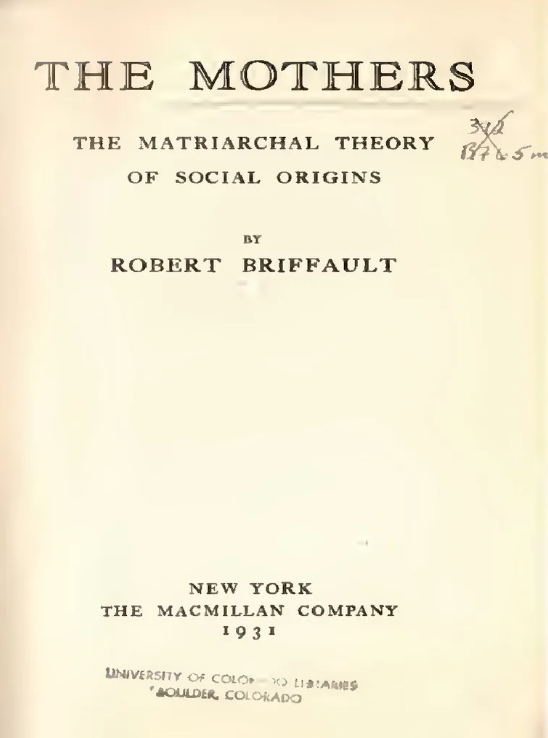
Robert Briffault – 1931 Macmillan version.
PREFACE
In response for the demand for an edition of my work, The Mothers, in one volume it was originally contemplated to Issue an abridgement of the book. In order to bring the whole work within the compass of a volume salable at a popular price, so many portions of it would, however, have had to be sacrificed, that I have deemed it preferable to confine myself to the discussion of the main thesis which chiefly attracted attention in the original work. This is accordingly indicated by the title of the present volume. Although its material is for the most part extracted from The Mothers, I have felt free to treat it as an independent work. I have used the opportunity to endeavour to set forth as clearly as possible those portions of the argument which experience had shown to be liable to misunderstanding. For a critical survey of the evidence and for biographical references, the student must, of course, refer to the larger work.
Kindle notes from original 3-vol version here
Page numbers are from PDF attached below
P9
Dr. G. V. Hamilton has made detailed observations on the sexual habits of monkeys and baboons living in a natural state in a forest reserve. The males, he found, are allured at all times by any adolescent or adult female. The females never refuse themselves to a male, at any period. Copulation takes place daily at any time and in all seasons. The sexual activity of both males and females is markedly diminished if they are both confined in pairs, but is at once restored when a change of partners is supplied.
P45 – 46
The association of sexual attraction with tenderness and affection is not, as is generally assumed, an intrinsic constituent of that relation, but is a comparatively late psychological product which owes a great deal to particular social and cultural factors…
P46 The primitive, and by far the most prevalent, association of the sexual impulse is not with love, but with the opposite feelings of callous cruelty and delight in the infliction and spectacle of pain.
P51
“Il n’y a rien de si loin de la volupté que l’attendrissement,” [There is nothing so far removed from voluptuousness as tenderness] observes Lamartine, and shrewd voluptuaries, such as Sheikh Nefzawi, dwell upon the importance for the greater enjoyment of sexual gratification of not loving a woman too tenderly. Although cultural and social causes have led to the association in the male of the two forms of sexual attraction, that which views the woman as a sexual prey and that which regards her as a surrogate for the mother, they are distinct in origin and function, and remain essentially opposed.
Love, tender emotion, is a common cause of ‘psychical’ impotence, and we read of great lovers the longed-for consummation of whose romantic passion turns out to be a failure. It has been suggested that the high development of sentimental love is really a manifestation of diminished reproductive power and would ultimately tend towards the extinction of the race.
The two constituents of sexual attraction, the sexual impulse and ‘love,’ or the mating impulse, remain, as will be seen later, essentially distinct in primitive human societies. Sexual relations do not imply sexual association, and sexual association is not primarily regarded as a sexual relation. Tender emotions and affection have then their origin not la sexual attraction, but in maternal reactions. Apart from the relation between mother and offspring there is in competitive animality no germ of that order of feelings. Just as the transferred affection of the female for the male is a direct derivative of maternal feelings, so all feelings of a sympathetic, compassionate, altruistic character, which are in direct contrast to biological impulses, are almost entirely absent in animals, and are specific characters of human psychology, are extensions of the maternal reaction. They owe the mere possibility of their existence to the development of maternal feelings.
P57
“In primitive culture” , observes Dr Brinton, “there is a dual system of morals: the one kindness, love, help and peace, applicable to the members of our own clan, tribe, or community; the other of robbery, hatred, enmity, and murder, to be practiced against all the rest of the world; and the latter is regarded as quite as much a sacred duty as the former”.
P65
The development of those individual interests has taken place only when the individual has held property apart from the group and has become separated from it both economically and psychologically.
P71
According to the rule of exogamy every member, male or female, of the group, whatever its size, must seek a sexual partner in an altogether different group.
P88 – 89
…the
sexual appetites of primitive man are almost entirely devoid of discrimination, and are
fully satisfied by objects which would excite in us as much repugnance and horror as the offal filth which be relishes as food. Sexual selection and the discrimination of the qualities that govern it play scarcely any part in either the sexual relations of uncultured peoples or in their marriage associations. The latter are, as an almost universal rule, predetermined by quite other circumstances and considerations, and the sexual instincts of primitive males are unaffected by relative value of attractiveness far grosser and more concrete than those between associate and stranger.
The purely relative effects of habitual association upon the sexual instincts have, in point of fact, no more bearing upon the operation of those instincts in savage humanity than among animals. The Australian native ravishes every woman whom opportunity places in his power; the only check on his conduct in this respect is his dread of infringing a tabu, and he previously enquires whether she belongs to a forbidden class. Far from being enforced by the operation of spontaneous instincts, the observance of the prohibition against incest is in most uncultured societies secured by the most elaborate separation of brothers and sisters, who often are not so much as permitted to converse with one another.
P90
The mothers are the basis and the bond of the primitive social group…In a group thus constituted, to permit the women to follow strange men, to sever their connection with the group and to become scattered amongst diverse other groups, would be to break up the social; unit, and would be opposed to all the sentiments and conceptions which constitute its existence as a social entity…few things to which primitive peoples who have retained the matriarchal constitution are so profoundly averse as to allowing any of their girls or women to leave the group.
P92 – 93
But in all the lower stages of human culture the sexual life begins as soon as sexual maturity is reached, which is much earlier among savages than in civilised races. And even long before actual maturity all savage children are known to indulge, almost, so to speak, from the cradle, in sexual play, imitating the sexual act years before they are able to perform it.
The rule of exogamy and the prohibition of incest are not therefore, in their origin, regulations bearing primarily on the conduct of adult young men, able to fight their fathers, or susceptible to the wiles of strange women, or procreating unhealthy offspring, hut are in their first application literally rules of nursery discipline. In the lower cultures, as among the Melanesians or the Australian natives, no reprobation attaches on the part of the elders to the sexual play of children, who are even encouraged to practice what is regarded as the most important function of their mature life.
For example, Mr. D. Collins, commenting on the prevalence of rape among the Australian aborigines, refers to the common occurrence of such violence even among young children. “Even children,” he says, “make it a game or exercise, and I have often, on hearing the cries of the girls with whom they were playing, run out of my house thinking some murder was committed, hut have found the whole party laughing at my mistake.” But in those same communities the strictest regulations forbid all familiarity and even ordinary intercourse and speech between brothers and sisters. And that is in fact the earliest and most conspicuous form of the prohibition of incest among savage people.
P94
In like manner they honour their elder sisters, who stand with them on the same level as their mother. But with the younger sisters they never stay together in the same room, and they observe the utmost reserve. For they say that dangerous situations might else arise, the younger sisters being thoughtless.
P100
The term [matriarchy] is not very fortunate, for it implies a principle of domination…It is not, as is often imagined in popular references to the theory, an hypothesis concerning a form of society existing at some undetermined period of the past in which women, instead of men, ruled.
P101
As Professor Malinowski very clearly expresses the postulate [patriarchal theory], “according to this view the earliest form of family or social life consisted of small groups led and dominated by a mature male who kept in subjection a number of females and children.”
P106
Among the Chinooks a prosperous man often has a large number of wives, “but the wives do not at all times remain together – indeed, this would be utterly impossible – but at different camps where their relatives are; so that the husband goes from camp to camp occasionally to visit them.
P109
It was often found difficult to identify the husband in a group, partly because he is as a rule incongruously younger than the mistress…
P110
Male chiefs are elected, mainly for leadership in war, but they are also supposed to control the weather….one of the main considerations in the election of a chief is the magical powers of his principal wife….a man generally marries all the sisters in one family…
P118
The Tibhu [Eastern Sahara] ladies do not even allow their spouses to enter the house without previously sending word to announce their visit….”The Tibhu women, indeed, are everything and their men nothing – idling and lounging their time, and kicked about by their wives as so many drones of society.”
P120
the Dutch Controller [Verkerk Pistorius] describes the ‘chassez-croisez’ which takes place at dusk when the husbands walk across the village from their homes to join their wives.”
P123
..as is the rule with matrilocal peoples, the husband fought with his wife’s clan and not his own.
P124
A man is usually to be found dwelling in a hut with one woman; but he has other wives in some neighboring village or island, and divides his time between the several households with which he is connected by marriage.
P125
“In New Zealand a young man on marriage ‘continued to live with his father-in-law, being looked on as one of the tribe of ‘hapu’, to which his wife belonged, and in case of war the son-in-law was often obliged to fight against his own relations.” [says Mr Taylor]
P131
The grandmother is called the ‘young grandmother’ to distinguish her from the grandmother who is the ancestress of the family and its protecting goddess.
P133
As with most other primal institutions of human society an attenuated relic of matrilocal marriage survives in our own usages as the custom of partaking of the wedding lunch at the bride’s house; the bridegroom thus begins his married life as a guest of his wife’s family.
P175
The economic dependence of women, which is the ultimate foundation of the patriarchal constitution of advanced societies, does not exist in any of the lower phases of culture.
Patriarchal marriage… rests originally… upon economic rather than upon sexual factors.
P180
…there is nothing in the lower phase of culture corresponding to the domination of one sex over the other which characterises patriarchal societies.
P184
The power of the ‘headman’ or ‘chief’, when it exists, is thus unattended with any form of domination, but is exercised at the discretion of the community, for its own purposes, and often at the peril of those who unwillingly exercise it. The primitive headman possesses executive power only, that is, the delegated function of coordinating any collective action which the group as a whole has decided to take…
The place of enforced tasks and duties is occupied by spontaneous psychological sentiments which need no theoretical sanctions and no compulsory enforcement.
P185
It cannot be supposed that in those communities the nebulous authority of the ‘chiefs’ has been forcibly and arrogantly seized by the men; the women’s authority and influence is paramount, they command every means and every avenue of power.
P189
…so long as women remained economically productive it was impossible for complete patriarchal superiority to be established. The primitive women is independent because, not in spite of her labour.
P196
If the husband gives his wife any cause, real or fancied, of offence, she packs up the tent and its furniture, appropriates even the canoe, and takes everything away; the children follow her, and the husband and father is left with the clothes (?) he stands in and his weapons as his only possession.
P205
A defiant and rebellious attitude is found in women only where they already occupy a position of considerable vantage and influence; it is not found where their status is really one of oppression.
P212
The sex relations of uncultured human societies are not founded on marriage.
…marriages are contracted with some pomp and ceremony by the aristocratic class. Before the introduction of Christianity, the practice was extremely rare, the majority of people did not marry, but contracted loose unions “which followed one another in disorder”.
P213
Islands of Pageh, off the southern coast of Sumatra [a form of sexual association] is only contracted by men in advanced life who wish to provide a home for their old age. “Marriage plays a far less important part in their social customs than free love”.
Caroline Islands…it is not until a man has bidden farewell to the youthful passions that he makes up his mind to enter the married state.
Alfurs of Ceram think of marrying only when age is beginning to make itself felt and they are tired of promiscuous love.
The Andamanese were formerly reported to live promiscuously. But it has been discovered that individual associations do take place amongst them; they are, however, not entered into until very late in life, and after the men have retired from a career of free love.
[and many more examples]
P220
In all uncultured societies where advanced propriety and retrospective claims have not developed, girls and women who are not married are under no restriction as regards their sexual relations, and are held to be entirely free to dispose of themselves in this respect. To that rule there does not exist any authenticated exception. Elaborate attempts have been made, notably by Professor Westermarck, to show that pre-nuptial chastity is required among some peoples in low stages of culture… I have shown that there is not one [case] that will bear investigation…
P227
[exogamy] was probably the earliest to become established, and for a long time the only restrictive regulation bearing upon sexual regulation. And there is ample evidence in every part of the uncultured world that, outside the group of tabu clan-relatives, no sexual restrictions obtained throughout earlier social phases.
P230
Marriage, which in most uncultured social phases does not constitute the chief form of sex relations and which is not called for by the offspring’s need for paternal care or protection, is regarded almost exclusively in the light of economic considerations. Throughout the greater part of its historical development the institution and the various changes it has undergone have been likewise conditioned by economic causes.
P232
Although the capture of women in the course of warfare and raids is known to have occurred amongst the great majority of peoples, women so captured are usually distinguished from regular wives and are treated differently.
P240
One of the most familiar usages that have suggested an attenuated survival of ‘marriage by capture’ is the practice of lifting the bride over the threshold of her husband’s house.
P242
It is not the superior physical force of the male which has brought it about, but the development of economic conditions.
P244
The purchasing power acquired by men in pastoral and higher cultural stages, which has enabled them to buy off the services which in earlier stages obliged to furnish to the relatives of their wives, has been the chief and most general cause of the change from matrilocal to patrilocal forms of marriage.
P257
Pleasurable gratification is in all stages of culture thought to arouse the envy of supernatural powers, ghosts or gods. And the theory of renunciation or asceticism, which in savage cultures is part of the magic ritual precautions designed to conciliate and control supernatural powers, became in higher religious phases a ritual requirement constituting the state of ‘purity’ demanded of persons entering into special relations with supernatural powers.
P258
The sexual tabus of Christian morality are thus in their intention ritual, religious, or, what is originally the same thing, magic.
…Those anthropologists who are concerned with upholding the patriarchal theory of social origins show an anxiety to trace sexual prohibitions and restrictions arising from social and magical principles to biological or natural ‘instincts’ or dispositions.
P259
The fears which arouse the sentiment [jealousy] have no reference to sexual infidelity, but to the loss of a wife, and what is often referred to as ‘adultery’ in ethnological reports and discussions is properly speaking abduction.
P263
Superstitious practices of ritual continence have become adapted to the claims of patriarchal morality and confounded with those claims.
P269
In the year 285 BC a temple was erected to Venus out of the proceeds of fines imposed upon Roman matrons for adultery.
P279
The readiness, and even eagerness, which Egyptian husbands appear to have shown in making over their property to their wives was in all probability due in part to the fact that the property was thus transmitted to their children, for according to matriarchal usage, it would otherwise have passed not on to their own, but to their sister’s children. Thus, by a curious paradox, the anxiety to secure patriarchal succession greatly contributed to accentuate the economic power of women.
P281
“No people, ancient or modern,” says W.Max Muller, “has given women so high a legal status as did the inhabitants of the Nile valley.“
P283
[Lykians] As in Egypt, birth out of wedlock did not constitute illegitimacy and entailed no civil disability. The women had the right of divorce, and appeared to have freely used it.
…it was amongst them a prevalent custom to build monumental tombs for themselves and their husbands during their lifetimes.
P289
Spartan marriage customs hark back to some of the most primitive forms of sexual organisation. The women and girls were entirely unrestricted both in social and sexual relations, and were free to dispose of themselves as they pleased before marriage; virginity, consequently, was not demanded of a bride… Spartans practiced fraternal polyandry.
P291
Aeschylus, in his ‘Eumenides,’ assumes the [matrilinial] tradition, and represents the change from the ‘ancient law’ to that of the ‘new gods’ as chiefly manifested in the different way of viewing the relation of maternal and paternal kinship.
[contest between Athene and Poseidon preserved by St Augustine – women outvoted men so Poseidon floods the land] “Athene,” comments St Augustine to point out his moral as to the impotence of pagan deities, “afforded no assistance to her votaries; they henceforth lost the power of voting, and their children ceased to assume the name of their mothers.”
P292
a theory of primitive matriarchy which many modern scholars, in spite of the strongest evidence, have shown the utmost reluctance to accept.
P297
The position of women in historical [ 700 BC c/f Homeric or Bronze Age] Greece was, beyond all comparison, the most degraded and abject to be found in any civilized country of the Western world.
P303
[Etruscans] Girls were unrestrained before marriage, and were said to earn their dowry by prostitution. Their freedom of disposing themselves was scarcely more restricted after marriage. “It is a custom instituted by law among the Etruscans,” says Theopompus. “that wives should be in common.” In their frequent feasts or banquets, the married women lay with men on rich couches; not, however, with their husbands, but with any man they chose, and had freedom of intercourse with him. Paternity was, we are told, unknown.
P305
The elder Cato refers in pretty clear terms to the establishment of male supremacy. “Our fathers,” he says in his defence of the Lex Oppia, “have willed (uoluerunt) that women should be in the power of their fathers, of their brothers, of their husbands. Remember all the laws by which our fathers have bound down the liberty of women, by which they have bent to the power of men. As soon as they are our equals, they become our superiors.“
Download: the_mothers__matriarchal_theory_social_origins__robert_briffault_1931