Patterns of Sexual Behavior
by Clellan S. Ford and Frank A. Beach.
As long as the adult members of a society permit them to do so, immature males and females engage in practically every type of sexual behaviour found in grown men and women.
https://archive.org/details/patternsofsexual0000clel_d2x3
Ford and Beach employ a “cross-cultural correlational method” in exploring sexual behavior, a statistical approach suitable for distinguishing behavioral trends and making generalizations. They integrate information from 191 cultures: 47 from Oceania, 28 from Eurasia, 33 from Africa, 57 from North America, and 26 from South America. Much of their data was collected in the Human Relations Area Files, a cross-institutional organization co-founded by Ford. They offer information on such topics as “sexual positions, length (time) of intercourse, locations for intercourse, orgasm experiences, types of foreplay, courting behaviors, frequencies of intercourse [and] methods of attracting a partner.”
…
Anne Bolin and Patricia Whelehan identified Patterns of Sexual Behavior as a book that was highly influential in the study of sexual behavior in Perspectives on Human Sexuality (1999). They wrote that it provided the intellectual foundation for the later research of Masters and Johnson.
Extracts
Page 2
Men and women do not develop their individual patterns of
sexual behaviour simply as a result of biological heredity.
Human sexual responses are not instinctive in the sense of be-
ing determined excfusively by the action of genes or chromo-
somes. On the contrary, from the first years of life every child is
taught about sex, either directly or indirectly. And most signi-
ficant is the fact that different societies teach different lessons
in this regard. In some cultural settings children learn that sex
is a subject to be avoided and that any form of sexual expression
during childhood is wrong. In other societies boys and girls are
taught that certain sexual activities are permissible whereas
others are not. As the result of such divergent experiences in
early life, the adult members of different societies have quite
different opinions as to what is proper or normal in sexual
relations, and what is immoral or unnatural.
…
Page 22
Between the labia minora lie the vaginal opening, the
urinary opening, and the clitoris. The clitoris is the feminine
counterpart of the masculine penis. It is a miniature phallus,
having a shaft, a glans, a prepuce or foreskin, and sometimes
showing the capacity for erection. In five of the 100 women
examined by Dickinson the clitoris measured 1 inch in height.
In 75 cases the dimension was from i’g to 1 inch. And in the
remaining 20 women the range was from 1a to } inch in length.
Dickinson states that the size of this organ is not necessarily any
index to its sensitivity.
The clitoris is located in front of or, if the woman is lying on
her back, above the urinary opening which in turn is above the
vaginal opening. In most women the distance from the meatus
(external opening of the urinary tract) to the clitoris is less than
14 inches. The location varies in different individuals; too high
a clitoris is believed by some investigators to reduce the capa-
city for orgasm during intercourse. Landis measured the
meatus-clitoris distance in several hundred women and con-
cluded that individuals in whom this distance is greater than
I2 inches are less likely to experience orgasm than are women in
whom it is less. This opinion is not shared by all investigators.
Dickinson, for example, believes that the location of the clitoris
is much less important than its susceptibility to displacement.
He says that the most reliable index to clitoral function is the
extent of its displacement under appropriate conditions of stimulation.
…
Page 23
It is probably of considerable behavioural significance that
neither monkeys nor apes possess a hymen. This potential
obstruction to successful initial intercourse is found only in
our own species.
It is well known that at least the majority of women derive
sexual excitement from clitoral stimulation. During intercourse
this structure may be stimulated in several ways, but the most
common sources of excitation involve rhythmic pressures ex-
erted upon the clitoris as it is seized between the pubic bones
of the man and woman, and the displacements induced in it by
rubbing against the upper surface of the male organ. It is
obvious that the amount and intensity of stimulation that occur
depend in part upon the positions assumed during copulation.
…
In women, on the contrary, the sensory basis for satisfaction
in intercourse is much less obvious. There is considerable
evidence to support the belief that distention of the vaginal
walls resulting from penile insertion is an important factor.
Although the sensory supply to the interior vagina is scant,
some women describe distinct sensations referable to the an-
terior wall. There is some question as to whether clitoral
stimulation is usually necessary for complete climax. Certainly
Page 24
this is not the case for every human female. Nevertheless, as
noted above, there is no doubt that for a large proportion of
women the clitoris serves as one important locus of sexual
stimulation. This being the case, it is worth while to examine
the kinds and degrees of clitoral stimulation that are likely to
occur when different positions are adopted during sexual intercourse.
Possibilities for Clitoral Stimulation. The pubic bone, or sym-
physis, is located directly above the base of the penis in men and
beneath the fatty mound of tissue that lies above the vulva in
women. When a man and woman lie or sit in a face-to-face posi-
tion with their bodies pressed tightly together, the pubic bones
of the pair are more or less in opposition. In most women the
clitoris is situated slightly below or to the rear of the symphysis.
But during the act of intercourse in the positions mentioned
there is a very high probability that the clitoris will be subjected
to rhythmic pressures as the fatty tissue above it is alternately
compressed and released. In addition, if the man moves back-
wards and forwards while executing copulatory thrusts, the
upper surface of the penis is likely to rub against the clitoris,
displacing it first in one direction and then in another. As the
woman lies beneath the man, appropriate movements on her
part can increase the amount of friction exerted upon her cli-
toris. Even greater control over clitoral stimulation is possible
when the woman lies upon her partner or kneels over his body.
Under such conditions the intensity of pressure and the magni-
tude of the displacements are or can be made maximal.
When intercourse is practised in any position other than
some variant of the face-to-face relationship, the possibilities
for stimulation of the clitoris are greatly reduced. Particularly
is this true of those positions in which the woman’s back is to-
wards the man and he achieves intromission from the rear.
Here the pubic bones of the male and female are widely separ-
ated and the clitoris is subjected to no pressure whatsoever.
Furthermore, since the clitoris lies above the vagina, it will not,
under such circumstances, come into contact with the male organ.
There are, to be sure, a few variants of the rear entry method
that do provide for clitoral pressure and friction. One of these
occurs when the man lies on his back and the woman sits above
Page 25
him with her face towards his feet. In this instance the woman,
leaning forward and moving back and forth, can cause the cli-
toris to rub heavily against the underside of the penis. The
masculine organ is forced flat against the male’s abdomen and
thus offers some resistance to the pressure of the feminine
sexual parts.
With few exceptions, however, face-to-face copulation un-
doubtedly affords the greatest opportunity for the woman to
derive stimulation of the clitoris. Now, if such stimulation is
satisfying and desirable, it might be expected that this type of
coital position would be preferred by most people in most
societies. It does not follow, of course, that a demonstrated
preference for this sort of copulation, if it exists, is to be ex-
plained solely in terms of the kinds of stimulation it makes
possible. Nevertheless, an examination of the cross-cultural
evidence on this subject is worth while.
Preferred Positions in Human Intercourse. In our own
society the most common coital position is one in which the
woman lies upon her back while the man lies above and facing
her. Kinsey, Pomeroy, and Martin estimate that 70 per cent of
American couples have never experimented with any other
method. When any alternative is tried, the most popular posi-
tion is that in which the man lies on his back and the woman
sits or lies above him in a face-to-face position. Kinsey and his
collaborators found that their subjects considered this position
the one most likely to produce orgasm in the woman; as noted
earlier, it is one that affords the greatest opportunity for clitoral
excitation. Still other positions such as lying side by side, stand-
ing face to face and various forms of rear entry are, of course,
known in this society. But they are practised sparingly and by
relatively few couples.
Coitus in which the woman lies upon her back with the man
above and facing her is the usual pattern in many societies
other than our own.1 In some of these societies2 the man squats
Page 26
or kneels before the supine woman and draws her towards him
so that her legs straddle his thighs. As the act proceeds the man
may pull the woman up so that they embrace one another in a
semi-erect squatting or kneeling position. It is interesting that
this particular variation is predominantly an Oceanic pattern.
The anatomical relationship in such a position is such as to re-
sult in vigorous clitoral stimulation.
Lying side by side, face to face, is the preferred position
among the Goajiro, Kwakiutl, and Masai. Intercourse in the
sitting position, the woman squatting over the man, is the
dominant pattern only on Palau and Yap. An alternate form of
this occurs among the Pukapukans, in which the man folds his
legs under him and the woman faces him with her legs on his
thighs. Coitus with the man entering the woman from the rear
does not occur as the usual practice in any of the societies in our
sample, and this may well be due in part to the fact that stimula-
tion of the clitoris is minimal when this pos
is position is employed.
Although one position for coitus is preferred and dominant,
in most of these societies other postures are used under certain
circumstances. The variant with the woman squatting upon the
man is a secondary position for a number of peoples,1 and it is
significant that they describe this method of copulation as the
one which brings the greatest satisfaction to the woman. Quite
a few people2 have intercourse in the side-by-side position
either when being discreet or when the woman is pregnant.
Usually intercourse occurs face-to-face, but occasionally in
some of these societies intercourse may take place while lying
side by side, the man entering the woman from the rear. In
some societies coitus occasionally occurs with the man standing
behind the woman while she bends over or rests on her hands
and knees. This method is apparently confined to brief and
sudden encounters in the woods. On Truk for quick copulation
a standing position is used in which the woman is said to ‘rest
her foot on the man’s shoulder’.
Page 27
It is a stereotype of our society that during copulation the
male is active and the female plays a relatively passive role.
Any woman who takes too active a part in coitus may be accused
or feel guilty of displaying a masculine trait, and the man who
is relatively passive during the sex act is likely to be considered
somewhat feminine. The extent to which these matters are cul-
turally conditioned is made clear by data on other societies.
Several peoples in addition to ourselves consider the appropriate
sexual role for the female to be a passive one, the male being
supposed to be active and aggressive. The Chiricahua, for ex-
ample, feel not only that a woman should not be forward, but
she must not even display any emotion during intercourse. The
Colorado Indian woman always plays a passive role during
coitus. And among the Kaingang and the Lepcha women take
no initiative in sexual activity, but submissively respond to the
man’s desires. However, in other societies such as the Hopi,
Trukese, and Trobrianders passivity is not demanded of the
woman, and under these conditions she is far from relaxed and
suppliant. Among these peoples, both partners are equally
aggressive and vigorous; an inactive woman is considered
apathetic and undesirable as a sex partner.
…
Page 35
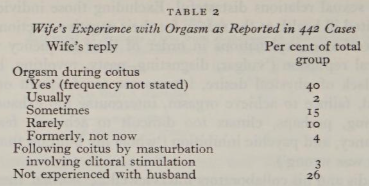
Landis and his collaborators interviewed 44 ‘normal’ married
women and found that 3 in this group had never experienced
orgasm. An additional 10 women rarely or never reached
orgasm, but ‘carried on sexual relationships because they felt
this was expected of them’. Fourteen others regarded sexual
relations as pleasant, sometimes had orgasm but most of the
time did not. And only 17 of the 44 wives described sexual re-
lationships as satisfying experiences usually accompanied by
orgasm. Dickinson and Beam gathered evidence on this point
from several hundred married women. The results are incor-
porated in Table 2. (Dickinson and Beam, 1931, p. 63.)
Attitudes of people in other cultures towards this problem
are of interest. But references to orgasm in the female in societies
Page 36
other than our own are relatively rare. This probably reflects a
failure on the part of investigators to obtain such information,
since no statements could be found which indicate that the
women of any society fail to experience a sexual climax.
Crow Indian women expect and desire orgasm and are reported to
achieve one more often while sitting on top of the man, whereas
when the man lies on top he usually ejaculates before the woman
reaches a climax. On Truk and on many of the other Caroline
Islands the woman is expected to have an orgasm as the conse-
quence of coitus. If a Trukese man reaches climax before his
partner, she may laugh at him and request him to try again.
It is stated that the woman is relatively unlikely to attain a
climax unless she adopts the superior position, squatting upon
the man. In this coital position women achieve an orgasm which
is said to be accompanied or preceded by urination on their part.
…
Page 66
As propounded by certain of its adherents, psychoanalytic theory classifies masochistic tendencies as normal and useful components of feminine sexuality. Dr Helene Deutsch has written as follows concerning this subject:
Women’s entire psychologic preparation for the sexual and reproductive functions is connected with masochistic ideas. In these ideas, coitus is closely associated with the act of defloration, and defloration with rape and a painful penetration of the body. The sexual readiness, the psychologic pleasure-affirming preparation for the sexual act draws its masochistic components from two sources- one infantile, regressive and dispositional, and the other real. For defloration is really painful and involves the destruction of a part of the body …. Acceptance of pain associated with pleasure, or of pleasure associated with pain, may result in such a close connection between the two that the sexual pleasure becomes dependent upon pain. Thus feminine sexuality acquires a masochistic character. Actually a certain amount of masochism as psychologic preparation for adjustment to the sexual functions is necessary in woman …. (Deutsch, 1945, Vol. II, p. 277.)
…
Page 68
A second general point concerning human behaviour is that
widespread habits of inflicting pain upon the sexual partner
appear to be formed in certain societies and not in others. And
societies in which intercourse is regularly associated with biting,
scratching, or hair pulling prove inevitably to be ones in which
children and adolescents are allowed a great deal of sexual freedom.
There are, to be sure, some ‘permissive’ societies whose
coital techniques involve no painful stimulation. But wherever
this kind of stimulation is considered normal and desirable by
the group as a whole, the regulations governing the behaviour of
immature persons are always found to be relatively free and
non-restrictive. Furthermore, if the cultural stereotype of satisfactory
intercourse includes a considerable amount of moderately painful interaction,
it also represents the woman as an active, vigorous participant in all things sexual – she is accorded
equal rights of initiative and is expected to experience orgasm as a result of coitus.
…
Page 71
One final type of stimulation associated with sexual excite-
ment involves the infliction of physical pain. The occurrence
of such activities is regular and characteristic in many human
societies. There are a number of peoples whose stereotype of
intense love-making includes scratching, biting, and pulling the
hair of the sexual partner. In contrast, there are other societies
in which these forms of stimulation appear to be totally lacking.
It is our conclusion that for most people high levels of erotic
arousal tend to generate moderately assaultive tendencies. And,
furthermore, that for the majority of human beings painful
stimulation which is not too intense is likely to increase rather
than decrease the level of sexual excitement. The inherited
capacity to derive satisfaction from this kind of stimulation is
greatly modified by learning and experience. Our cross-cultural
evidence strongly suggests that societies which incorporate
painful stimulation in the approved forms of foreplay also pro-
vide ample opportunity for the developing individual to learn
the facilitative effects of the resulting sensations.
The evolutionary background for assaultive behaviour asso-
ciated with sexual arousal is clear in some ways but not in
others. Male mammals of many species attack and injure the
receptive female before or during coitus. The female’s response
in such cases usually indicates that the pain which she experi-
ences actually increases the level of her arousal. There is, how-
ever, one important difference between men and all other ani-
mals in this connexion. All human societies that encourage the
infliction of mild pain in connexion with intercourse take the
attitude that such behaviour should be bilateral or mutual. If
the man bites the woman, she is permitted and expected to bite
in return. If the girl scratches her lover, he retaliates. This is not
true of the lower animals. In their case it is almost always the
male who wounds the female, very rarely the reverse.
Page 84
A belief that very frequent sexual intercourse is weakening or
debilitating exists in a few societies. In our sample this notion is
confined to a few American Indian groups, the Trukese, and the
Seniang of Malekula. The Seniang give the following advice to
young men: A man with only one wife should copulate once a
night for three successive nights and then rest for two nights.
If a man has two wives and copulates twice nightly, he should
do so only on two successive nights, then abstain during the
third night. Despite such suggestions men frequently have in-
tercourse two or three times each night, once with each wife.
The oldsters who offer the advice maintain that it is entirely
permissible for a man with white hair to copulate every night.
…
Page 91
Some peoples single out the external genitals as important
contributors to sexual attractiveness. It is probably significant
that in all of these societies the genitals figure importantly as
zones of stimulation in erotic foreplay. In some societies elon-
gated labia majora are considered sexually attractive and it is
often the practice to pull and otherwise manipulate the vulvar
lips and sometimes the clitoris of the young girl in order to
enhance her value as a sexual partner. Elongated labia majora
among Nama women are considered a mark of beauty and are in
many cases so prominent as to have been named ‘Hottentot Schurzen’ by early white explorers.
One interesting side-light is thrown upon this practice by Dickinson’s observations to the
effect that prolonged, habitual manipulation of the labia may
result in an increased nerve supply to those regions. If this is the
case it is conceivable that a woman with hypertrophied labia
might develop a heightened vulvar sensitivity and therefore be
more likely to react intensively to genital stimulation before and
during intercourse. This responsiveness, in turn, could con-
ceivably render such individuals particularly attractive as sexual partners.
…
Page 98
METHODS OF INVITING INTERCOURSE
Exposure of the Genitals. Deliberate exposure by a woman of her
genitalia to a man’s gaze is a common form of sexual invitation
in a few societies. The Lesu woman, for example, may attempt
to seduce a man by displaying her sexual organs. Young men
of Tikopia occasionally take the initiative by flipping up a girl’s
skirt so that her genitals are exposed. Among the Dahomeans,
women who belong to the serpent cult wear a short skirt; and if
Page 99
one of them is desirious and meets a man alone, she drops the
skirt, thus exposing her genitals to him. Blackwood describes
the situation among the Kurtatchi as follows:
A woman desiring sexual intercourse with a man who does not make
advances to her will, when opportunity arises, lie down in his presence
with her legs apart, a position otherwise regarded as indecent ….
If a woman exposes her genitals, even unwittingly, as in sleep, the
situation is liable to be taken advantage of by any man whose passions
may thereby be aroused. Both types of incident figure frequently in
my collection of tales, as well as in village gossip. The proper be-
haviour for a woman is to sit or lie with her legs stretched out in front
of her, keeping them close together. This is still the rule, although
every adult now wears a loin-cloth. (Blackwood, 1935, p. 125.)
The provocative gesture of exposing the genitals has become
the subject of widespread social control in every human society.
There are no peoples in our sample who generally allow women
to expose their genitals under any but the most restricted circumstances.
The wearing of clothing by women appears to have
as one important function the prevention of accidental exposure
under conditions that might provoke sexual advances by men.
…
Page 113
In cross-cultural perspective this formal attitude towards
sexual partnerships is exceedingly rare. To be sure, there are a
great many societies in which the majority of the population
form single mateships, but most of these groups permit any man
to take more than one mate (either wife or concubine) if he can
support them. Examination of societies in our sample reveals
that formal restriction to single mateship characterizes 29 (less
than 16 per cent) of the 185 groups on whom this information
Page 114
could be obtained. Furthermore, of these 29 societies, less than
one-third wholly disapprove of both premarital and extramarital
liaisons.
Sociologists have sometimes asserted that monogamous mate-ship represents a peak of social evolution and that our own ideal
form of marriage is a criterion of advanced civilization. Insistence upon monogamous unions is unquestionably a product
of social evolution, but it is not always correlated with other criteria of advanced cultural status.
Some of the most ‘primitive’ peoples are strictly monogamous in their ideals.
…
Page 118
Incestuous Liaisons. In all human societies every mated man
or woman is limited by custom in the establishment of sexual
liaisons. In a few societies like our own no liaisons are condoned,
although this is not the rule for most peoples. However, even
the most lenient codes involve certain basic restrictions. Among
all peoples both partners in a mateship are forbidden to form
sexual liaisons with their own offspring. This prohibition char-
acterizes every human culture. This generalization excludes
instances in which mothers or fathers are permitted to mastur-
bate or in some other sexual manner to stimulate their very young children.
…
Page 119
Societies Approving Certain Liaisons. We stated above that all
societies prohibit sexual liaisons in accordance with the prevail-
ing incest regulations. However, unlike our own society, which
will be given special consideration below, there are a number of
Page 120
peoples in our sample (39 per cent of 139 groups) that approve
of some type of extra-mateship liaison. In a very few societies
the customary incest prohibitions appear to be the only major
barrier to sexual intercourse outside of mateship. Men and
women in these societies are free to engage in sexual liaisons
and indeed are expected to do so provided the incest rules are observed.
Among the Toda of India, for example, mated men and
women are generally allowed to form liaisons. A woman may
have one or more recognized lovers as well as several husbands.
There is no censure of adultery. In fact, the Toda language includes
no word for adultery. As far as these people are concerned,
immorality attaches to the man who begrudges his wife to another.
There is evidence, however, that men in Toda society do
occasionally resent sharing a mate with a second man. The Toda
are polyandrous and each woman usually has more than one
husband. But even within these mateships there is sometimes
friction between the husbands with respect to sexual matters. It
is interesting that this type of disagreement is much more
pronounced in instances when the husbands are not brothers.
…
Page 121
In some societies extra-mateship liaisons take the form of
‘wife lending’ or ‘wife exchange’. Generally, the situation is one
in which a man is granted sexual access to the mate of another
only on special occasions. If the pattern is reciprocal an exchange of wives occurs.
Both wife lending and wife exchange may be involved in patterns of hospitality. A visiting male guest
may be invited to form a sexual liaison with the mate of his host, and when the host is himself a guest at the other man’s home
the favour is returned. It is noteworthy that in most such instances permission of both spouses is necessary before the liaison
can occur legitimately. Moreover, in many such societies if the men who thus share the same women are not genealogically related they establish some artificial kinship bond, such as ‘blood brotherhood’.
…
Another type of permission in respect to extra-mateship
liaisons appears in some societies in the form of ceremonial or
festive licence. Sexual liasons may be generally prohibited, but
on certain special occasions the prohibitions are lifted for a short
time and everyone is expected to have sexual intercourse with
someone other than the spouse. The occasions for sexual
licence usually appear to have religious significance and may
range from harvest festivals to mortuary feasts.
Societies Disapproving Liaisons. Sixty-one per cent of the 139
societies in our sample for whom evidence is available forbid a
mated woman to engage in extra-mateship liaisons.
…
Page 124
It has not been demonstrated that human females are necessarily
less inclined towards promiscuity than are males. What the evi-
dence does reveal is that in a great many societies the woman’s
tendencies to respond to a variety of sexual partners are much
more sharply restricted by custom than are comparable ten-
dencies in the man. And most important is the additional fact
that in those societies which have no double standard in sexual
matters and in which a variety of liaisons are permitted, the
women avail themselves as eagerly of their opportunity as do the men.
…
Page 163
American Women. Self-stimulation is not limited to the mas-
culine sex in our society. Landis and his co-workers questioned
295 American women and found that 54 per cent of them had
indulged in masturbation at one time or another. One quarter
of these individuals practised the habit at least once per week
during the period when they were masturbating, and 25 per
cent of the positive cases had indulged in genital stimulation
regularly ‘over a period of time’. The majority of masturbators
had begun self-stimulation early in life and tended to cease
after adolescence when heterosexual interests became pre-
dominant. Hamilton found that 74 per cent of a selected group
of married women had some experience in masturbation, and
Dickinson found the habit to be almost universal in widows
over 40 years of age. Davis examined 1,183 unmarried women
with college education and discovered that two-thirds of this
number had masturbated at one time or another, although many
of these had never induced orgasm in this fashion.
…
Page 167 – 168
Powdermaker makes the following interesting statement concerning Lesu women, the one society in which
there appears to be no sanction levied against female masturbation:
A woman will masturbate if she is sexually excited and there is no man to satisfy her. A couple may be having intercourse in the same house, or near enough for her to see them, and she may thus become aroused. She then sits down and bends her right leg so that her heel presses against her genitalia. Even young girls of about six years may do this quite casually as they sit on the ground. The women and men talk about it freely, and there is no shame attached to it. It is a customary position for women to take, and they learn it in childhood. They never use their hands for manipulation. (Powdermaker, 1933, pp. 276-7.)
In this connexion it is interesting to note that similar be-
haviour sometimes occurs in American society. After describing
certain physical changes in the sexual organs that he considers
reliable proof of habits of self-stimulation, R. L. Dickinson
adds that puzzling exceptions sometimes occur. Extreme en-
largement of the labia minora, which he regards as a sign of
masturbatory habits, may occur in female patients who cate-
gorically deny that they have ever handled the sex organs or
inserted anything in the vagina. The solution is sometimes
fairly simple. ‘For example, there was the patient who con-
stituted a baffling problem because of the extreme frequency of
reported orgasm, but without pressure by finger, thighs, pillow
or mattress; she was finally observed at one visit to the office to
be sitting on her heel.’ (Dickinson, 1949, p. 55-)
…
Page 188
Before puberty, girls on Ponape undergo treatment designed to lengthen the labia
minora and to enlarge the clitoris. Old impotent men pull,
beat, and suck the labia to lengthen them. Black ants are put in
the vulva; their stinging causes the labia and clitoris to swell.
These procedures are repeated until the desired results are
attained. At the age of about 15 Jukun girls have their ears
pierced during a minor ceremony. Prior to this time and for 3
weeks thereafter they may not indulge in sexual intercourse.
When Venda girls attain the age of 10 to 12 years they begin to
practise the custom of pulling out and lengthening the labia
minora. Girls who fail to do so are criticized as being lazy. ‘You
will remain nothing better than a post one smears one’s dirt on.
You are a tree that lends no hold. Just a hole without anything.’
…
Page 191
In grown men orgasm and ejaculation usually occur together
but they are not necessarily mutually dependent. As a matter of
fact, it is reported that sexual climax or orgasm can be produced
in very young human infants of either sex. Kinsey, Pomeroy,
and Martin state that male infants less than one year of age
respond to manipulation of the genitals by making thrusting
movements with the pelvic muscles; and if the stimulation is
continued the baby’s movements become more rapid and vigorous
and culminate in a general spasm quite similar to that which
characterizes climax in most adults.
…
Page 193 – 194
Some peoples make a sharp distinction between socially immature and mature persons with respect to permissible sexual
activity. These societies take the attitude that sexual intercourse
before adulthood must be avoided; but once the person is
mature by their standards, considerable freedom in sexual matters may be allowed.
For the most part these peoples seem particularly concerned with the pre-pubescent girl, believing that
intercourse before the menarche may be injurious to her. Girls
of the east central Carolines are strictly forbidden intercourse
before puberty, but after that they enjoy almost complete sexual
freedom. After menarche Ao girls begin to sleep in dormitories
where they indulge in intercourse with partners of their choice.
Among the Siriono intercourse before puberty is forbidden, but
premarital affairs are customary once the girl has menstruated.
The Chukchee believe that intercourse will harm a girl until
her breasts are fully developed or until she begins to menstruate.
However, immature girls often engage in coitus despite this belief.
In this society it is considered proper for a girl to carry
on serious love affairs between the time of the first menstruation
and marriage. The Ashanti are convinced that sexual intercourse
with a girl who has not undergone the puberty ceremony
is so harmful to the community that the offence is punishable by
death for both partners. Premarital intercourse is also forbidden
to the postpubescent Ashanti girl, but this rule is not nearly so
strictly enforced.
…
Page 201
In a few permissive societies adults participate actively in the
sexual stimulation of infants and young children. Hopi and
Siriono parents masturbate their youngsters frequently. And in
these societies self-masturbation passes practically unnoticed
during early childhood, adults taking a tolerant and permissive
attitude towards all sexual behaviour at least until the age of
puberty. Among the Kazak, adults who are playing with small
children, especially boys, excite the young one’s genitals by
rubbing and playing with them. In this society autogenital
stimulation on the part of young children is accepted as a nor-
mal practice. Mothers in Alorese society occasionally fondle the
genitals of their infant while nursing it. During early childhood
Alorese boys masturbate freely and occasionally they imitate
intercourse with a little girl. As the children grow older, how-
ever, sexual activity is frowned upon and during late childhood
such behaviour is forbidden to both boy and girl. Actually,
however, they continue their sexual behaviour, but in secret.
Among the Pukapukans of Polynesia where parents simply
ignore the sexual activities of young children, boys and girls
masturbate freely and openly in public. Among the Nama Hot-
tentot no secret is made of autogenital stimulation in early
childhood. Young Trobriand children engage in a variety of
sexual activities. In the absence of adult control, typical forms
of amusement for Trobriand girls and boys include manual and
Page 202
oral stimulation of the genitals and simulated coitus. Young
Seniang children publicly simulate adult copulation without
being reproved; older boys masturbate freely and play sexual
games with little girls, but the boys are warned not to copulate
on the grounds that this behaviour would weaken them. Lesu
children playing on the beach give imitations of adult sexual
intercourse, and adults in this society regard this to be a natural
and normal game. On Tikopia small boys induce erections in
themselves through manual manipulation, and this is ignored
or at most mildly reproved by adults. Little girls also may mas-
turbate in this society without being punished for such behaviour.
Most of the societies that permit children free sex play (and
some that are semi-restrictive) also allow them opportunity to
observe adult sexual behaviour and to participate in discussions
of sexual matters.1 Among the Alorese sex knowledge is com-
pletely accessible to young children and by the age of five they
are well informed on all details of the entire reproductive act.
All members of the Pukapukan household sleep in the same
room under one mosquito net; and although some parents wait
until they think the children are asleep, there are frequent op-
portunities for youngsters to observe adult sexual activities and
sexual matters are often talked about. Lesu children are free to
observe adults copulate, with the specific exception that they
may not watch their own mothers having intercourse. On Pon-
ape children are given careful instruction in sexual intercourse
from the fourth or fifth year. Trukese children receive no
formal tutelage, but they learn a great deal by watching adults
at night and by asking their elders about sexual matters. Among
the Wogeo sexual matters are freely discussed by adults in the
presence of children. In this society, however, parents take
some precautions against their own children observing them in
intercourse.
In the societies where they are permitted to do so, children
gradually increase their sexual activities both as they approach
puberty and during adolescence. There are, indeed, some
Page 203
societies in which enforcement of the prevailing incest regula-
tions is the only major restriction on sexual activity among
adolescents.1 As in the case of very young children, their sex
play first includes autogenital stimulation and mutual mastur-
bation with the same and opposite sex, but with increasing age
it is characterized more and more by attempts at heterosexual
copulation. By the time of puberty in most of these societies
expressions of sexuality on the part of older children consist
predominantly of the accepted adult form of heterosexual inter-
course, the pattern which they will continue to follow through-
out their sexually active years of life.
Among the Chewa of Africa parents believe that unless chil-
dren begin to exercise themselves sexually early in life they will
never beget offspring. Older children build little huts some
distance from the village, and there, with the complete appro-
val of their parents, boys and girls play at being husband and
wife. Such trial matings may extend well into adolescence, with
periodic exchanges of partners until marriage occurs. The
Ifugao head-hunters of the Philippines maintain a similar atti-
tude towards the sex play of older children and adolescents. In
this society unmarried individuals live in separate dormitories
from early childhood. It is customary for each boy to sleep with
a girl every night. The only check on promiscuity is that im-
posed by the girls themselves. Usually a girl is unwilling to
form too prolonged an attachment to one boy until she is ready
to be married. Boys are urged by their fathers to begin sexual
activities early, and a man may shame his son if the latter is
backward in this respect. Even after puberty there seem to be
relatively few instances of conception resulting from this free
sexual activity. Pregnancies do occasionally occur, however,
and in that event one of the girl’s lovers must marry her.
The Lepcha of India believe that girls will not mature with-
out benefit of sexual intercourse. Early sex play among boys
and girls characteristically involves many forms of mutual
Page 204
masturbation and usually ends in attempted copulation. By
the time they are 11 or 12 years old, most girls regularly en-
gage in full intercourse. Older men occasionally copulate with
girls as young as 8 years of age. Instead of being regarded as a
criminal offence, such behaviour is considered amusing by the
Lepcha. Sexual life begins in earnest among the Trobrianders
at 6 to 8 years for girls, 10 to 12 for boys. Both sexes receive
explicit instruction from older companions whom they imitate
in sex activities. Sex play includes masturbation, oral stimula-
tion of the genitals of the same and opposite sex, and hetero-
sexual copulation. At any time a couple may retire to the bush,
the bachelor’s hut, an isolated yam house, or any other con-
venient place and there engage in prolonged sexual play with
full approval of their parents. No marriage is consummated in
Trobriand society without a protracted preliminary period of
sexual intimacy during which both sincerity of affection and
sexual compatibility are tested. Premarital pregnancy is said to
be rare in this society, despite postpuberal sexual intercourse
over a period of 3 years or more before marriage. This experi-
ence has led the Trobrianders to doubt a causal relationship
between coitus and conception. Instead, they consider supernatural
influences to be far more significant in causing a child to be conceived.
In this instance, as in other cases of frequent but infertile
coitus among postpubescent males and females, the phenomenon
of adolescent sterility would appear to be particularly pertinent.
It may well be that although they have passed the menarche,
the girls involved in this activity are not yet ovulating, or at least
are incapable of carrying a foetus to term. Any such interpretation
must remain speculative, however, until there is more satisfactory proof for the absence of any form of contraception.
An interesting attitude towards the sexual activity of adolescents is taken by the Ila-speaking peoples of Africa. Childhood
is regarded as a time of preparation for adult life and mature
sexual functions. At harvest-time each girl is given a house to
which she takes a boy of her choice, and there they play as man
and wife. It is reported that there are no virgins among these
people after the age of 10. On Easter Island children from the
age of 6 on imitate the sexual behaviour of adults without censure;
Page 205
and young people among the Maori play together at being
husband and wife at night in the bush. Full copulation fre-
quently occurs before puberty. Lesu adults regard as natural
the attempts at intercourse in which children engage, and they
give full approval to free sexual activity on the part of adolescents.
Page 210
The points that seem worth making are:
(1) that satisfactory sex adjustment appears to increase the likelihood of successful marriage,
(2) that ignorance and lack of preparation reduce the probability that such adjustment will occur, and
(3) that a society which permits extensive sex play in childhood and adolescence may thereby increase the chances that sexual relations in marriage will be pleasant and mutually satisfying.
…
Page 211
As far as actual sexual behaviour is concerned, it develops
somewhat more rapidly in certain societies than in others. Some
cultures fully approve of a variety of sexual practices among
young boys and girls and between adolescents of both sexes.
When there is any difference in treatment, the behaviour of
girls is more carefully controlled than is that of boys. As long
as the adult members of a society permit them to do so, im-
mature males and females engage in practically every type of
sexual behaviour found in grown men and women.
There are other societies, including that of the United States,
which attempt to restrict severely the sexual activities of pre-
pubescent and adolescent individuals. Cultural ideals may in-
clude disapproval of any sexual life whatsoever for all unmarried
persons. However, even under the most severe restrictions some
individuals do engage in a certain amount of erotic play.
…
Page 221
Many women in American society experience regular cycles
of sexual desire that appear to be correlated with the rhythms of
ovarian hormone secretion. Various investigators who have
questioned hundreds of married women report that for most
of the wives who recognize such cycles, the peak of excitability
occurs just before or just after the period of menstrual flow. In
some individuals there are two times at which erotic responsive-
ness is greatest – one just before and one immediately after
menstruation. A much smaller number of women experience the
most intense satisfaction from intercourse during the mid-
interval between two periods of flow, at the time when ovulation
is most likely to occur and when the ovaries are secreting maxi-
mal amounts of oestrogenic hormone.
…
Page 274
The cross-cultural evidence clearly reveals a universal human
tendency for sexual responses to appear in the immature person
long before he or she is capable of fertile coitus. Impulses of this
nature are condoned and encouraged in some societies, strictly
forbidden and punished in others. But regardless of the cultural
ideal with respect to sex play in childhood, the underlying drive
towards such activity constitutes one feature of the heredity of
the human species.
Many years before they are fertile, male and female apes and
monkeys indulge in a variety of sexual games which include at-
tempts at heterosexual union. This form of infantile play is no
less natural for the young primate than are the chasing, wrest-
ling, and mock fighting that consume much of his waking life.
Furthermore, these tendencies are not confined to primates.
…
Page 285
The societies that severely restrict adolescent and pre-
adolescent sex play, those that enjoin girls to be modest, retiring,
and submissive appear to produce adult women that are in-
capable or at least unwilling to be sexually aggressive. The
feminine products of such cultural training are likely to remain
relatively inactive even during marital intercourse. And, quite
often, they do not experience clear-cut sexual orgasm. In contrast,
the societies which permit or encourage early sex play
usually allow females a greater degree of freedom in seeking
sexual contacts. Under such circumstances the sexual performance
of the mature woman seems to be characterized by a
certain degree of aggression, to include definite and vigorous
activity, and to result regularly in complete and satisfactory orgasm.
…