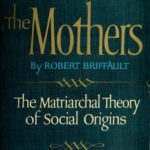
by Robert Briffault.
But the factors which have sublimated primal instincts have also given rise to mephitic [noxious] products as a result of their simultaneous stimulation and thwarting. Restrictive sexual morality, aimed at purity and chastity, has been the source of vice and lubricity [lewdness] . European morality places a tabu upon the sexual instincts at a time when these first develop, and thus indelibly impresses a certain form upon the whole sexual life of the individual, which is poisoned at its source. Thus it is that civilized man imparts to uncultured races morals and vice at the same time. Page 432
https://archive.org/details/mothersmatriarch00brif/mode/2up
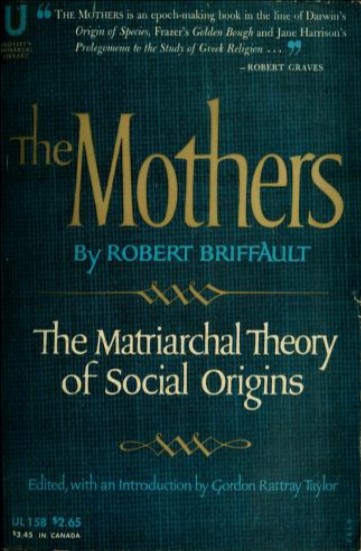
INTRODUCTION by Gordon Rattray Taylor
[Full text on page images below]
Briffault’s Thesis
The form in which Briffault couched his ideas and the relative lack of interest with which they were greeted can only be understood in relation to the controversy of which they formed part.
This controversy was launched in 1851, when the famous jurist, Sir A. Maine, published his Primitive Law, in which he asserted that the patriarchal family was the original unit of society, and that larger social units had been built up by the aggregation of these family units into clan and tribe. In support of this view, he cited chiefly Biblical examples.
In the same year, the Swiss jurist Bachofen was preparing his Das Mutterrecht, asserting that the original state of man had been one of sexual promiscuity, from which had emerged matriarchies, which had only later been replaced by or converted into patriarchies.
This set off a series of attempts to draw up schemes designed to account for the whole development of human society, and represented the application of the idea of evolution, which had proved so fertile in the biological field, to society as a whole.
J. F. McLennan made the most important restatement of the matriarchal view in 1886, citing a great mass of new anthropological evidence.
Early in the nineteenth century, Westermarck – a man without anthropological qualifications – published his History of Human Marriage, in which he attempted to re-establish Maine’s position. Не was not so much concerned to draw a picture of the whole development of human society as to assert that lifelong monogamy was the normal pattern of marriage throughout human society, polygamy representing a degeneration from the original monogamic pattern. This thesis was naturally much to the taste of Christian apologists and traditional moralists generally. Westermarck’s works enjoyed wide acclaim, and he wrote a long series of works embroidering this theme, most of which are still to be found in the majority of public libraries. Largely as a result, this view of marriage is still held by very many laymen, in so far as they concern themselves with the topic at all, and is often given fresh currency by American anthropologists. It is asserted in the new Chambers’s Encyclopaedia.
This view is, in point of fact, wholly untenable, and there can be little doubt that Briffault felt incensed by Westermarck’s scientifically unjustified success, and that his main object in writing The Mothers was to explode this fallacy. This he undoubtedly achieves, adducing such a wealth of material to the contrary, and so decisively convicting Westermarck of manipulating his references and betraying other – signs of bias, that one might have supposed that belief in the universality of monogamic marriage would have been abandoned for ever in a gale of laughter. In fact, as we know, his statement was ignored; and if this new version of his work does something to restore a more detached and speculative approach to the topic, it will have been worth while for this reason alone.
But Briffault was not content simply to destroy-he sought to establish an alternative theory. In contradiction to Maine, he asserted the former existence of a primitive matriarchy universally preceding patriarchy, but, unlike Bachofen, he did not define matriarchy in terms of actual mother-rule or inheritance through the maternal line, but in more general terms as a period in which women were socially predominant.
Patrilocy or matrilocy?
Marriage originally contract between groups.
Change to patriarchy after start of agriculture and private property.
[Animals are] matrilocal in character. More precariously, he argues that the male instinct created the group or herd, while the female instinct created the family. Since he is going on, later in the book, to argue that the family is a feature of patriarchies, the relevance of this section is obscure, to say the least.
[Chapters 17 to 24] Не seeks also to fit the concepts of totemism and taboo into his system, and here he is least successful, though he makes a number of interesting points.
Finally, in Chapters 25 to 30 he attempts to trace the growth of the modern Western conception of marriage as a sacrament, as a cultural remnant of the idea of a holy marriage between a deity and a woman. Ideas of this sort are indeed present in our thinking to a much greater extent than most of us realize, and Briffault’s demonstration is fascinating; but on the sources of this need to preserve a sense of sacredness – so notably absent in many other fields – he has nothing to say.
CRITICISM
…that one could only hope to understand the meaning of a culture item by considering it in relation to the whole culture. A given social action may carry quite a different connotation in one culture from that which it has when part of another. Consequently, to pick out a given pattern – let us say, mother-in-law avoidance – from a number of different cultures and compare them was an unacceptable technique.
This argument was reinforced by another: we cannot assume that societies which are technologically primitive resemble equally primitive societies as they existed thousands of years ago. A long sequence of social changes may have occurred-the marriage customs of the technologically primitive Australian aboriginals are so complex that it seems certain they represent the outcome of a long process of elaboration.
Though anthropologists tended to reject these synoptic attempts on a priori grounds, subsequently the advance of archaeology went far towards confirming their scepticism. It was observed that agricultural peoples, driven by population pressures out of Asia Minor into the steppe country, became pastoral-which is just the contrary of what Briffault asserts to be the normal process. Gordon Childe subsequently showed that various primitive peoples have passed through matriarchal and patriarchal stages in varying orders, and have adopted various methods of subsistence in quite a haphazard way.
It is now past all reasonable doubt that society does not evolve according to one single standard line of development.
But once we admit that matriarchy can follow patriarchy, much of Briffault’s material becomes ambiguous. When he draws attention to signs of an earlier matriarchy in a society which is now patriarchal, he may in reality be observing the signs of a future matriarchy which is only just developing.
A New Assessment
Briffault did himself much disservice by claiming too much: it was in the nature of the man to prefer the sweeping generalization, and he loved to shock the unimaginative out of their preconceptions. His data do not justify him in making the assertion that matriarchy always and everywhere preceded patriarchy, even if we neglect the facts just adduced. Even if in existing patriarchies signs of earlier matriarchy can be detected, this does not prove that a still earlier patriarchy may not have preceded the matriarchal phase.
For the realization that these social patterns are labile is a novel and important one, to which we are only now coming. It never occurred to Maine that the Jewish patriarchy which he so much admired, and thought was fundamental and God-given, had actually developed out of an earlier mother-centred system, as Briffault shows.
Again, Briffault invited ridicule or neglect by grossly over-generalizing his theory of marriage. It is certainly true that monogamy is not the universally preferred pattern; but it is going much too far to assert group marriage as universal. The likelihood is that humanity found a number of different solutions to the problem of regulating the relations between the sexes; group marriage may well have been one, perhaps even the most widespread one. The hypothesis certainly enables Briffault to reduce a great deal of otherwise baffling material to coherence, even if it does not explain quite as much as he claims.
The Psychoanalytic Clue
Briffault’s greatest mistake, one cannot help feeling, was to dismiss as valueless the entire contribution of Freud, for it is precisely Freud who could have helped him to solve the points on which he stumbles most hopelessly. First and foremost, Freud provides a comprehensive and consistent theory of the origin of incest fears. Since, as Briffault accurately notes, the whole system of exogamy rules is simply a system of incest-regulations, it is strongly supportive of his views that Freud attributes this preoccupation with incest to a preoccupation with the mother.
Conversely, the jealousy which Westermarck thought a universal human instinct is revealed by Freudian theory to spring from a preoccupation with the father, and thus to be characteristic of patriarchal but not of matriarchal societies.
…
Similarly, Freud’s account of decomposition-the process by which people sometimes classify people into good and bad figures, and have difficulty in seeing that good and bad aspects can be combined in a single person – is accurately reflected in the way in which some peoples divide their deities into good and bad, God and Devil, while others feel that a deity may have good and bad features simultaneously.
It certainly offers no clue as to why the Australian aborigines should make a long and deep gash on the underside of the penes of these boys, and dress them in women’s clothes-hardly a gesture designed to bring out their manhood. On the contrary, as Bettelheim points out, it is clearly a ceremony designed to turn them into substitute women, and it is the women who insist on this ceremony. [В. Bettelheim: Symbolic Wounds (1955)]
Briffault is in even deeper water when he tries to explain the changes in the status of women. It is when men come to possess so much wealth that they can keep women in idleness that they become sexual playthings and lose status, he declares. Не realizes that this view is quite inconsistent with the depressed status of women among the Australian aborigines, and suggests that this is because the aborigine has used his superior strength to dominate his women. But elsewhere Briffault has argued that women are not only stronger but also fiercer and more cunning than men. And even if this were not so, it would still leave him under the obligation of explaining why, in matriarchal agricultural societies, men do not equally exert their strength. The Celts, too, whom he sees as matriarchal and deferring to women, had notable heroes; why did they tolerate their women’s arrogance and sexual freedom?
But here psychoanalytic theory provides a scheme which, though derived from quite other data, fits the anthropological facts as if it had been made for the purpose. The Oedipal situation, as described by Freud, accounts for men’s fear that women will betray them sexually, and their sense that they are a threat to be kept under control. But the Oedipus situation can only exist where a strong father-figure is present, and is intensified if he is severe or thought to be so.
In making this estimate of Briffault’s work, I am naturally influenced by my own speculations on these matters put forward initially in 1949, and developed in 1953 and 1958;1 in them society is postulated as oscillating irregularly between phases in which the mother-figure is dominant and others in which the father is dominant, with the possibility of a balance between the two. Institutions, such as marriage or the inheritance laws, change so slowly, that institutions appropriate to a father-centred phase may persist into a mother-centred one, and no doubt the reverse also occurs.
Thus, as Margaret Mead has shown, the Tchambuli have all the social features-such as patrilineal descent-associated with a patriarchy, but in fact the women dominate the men.
The Problem Restated
The task which has fascinated so many anthropologists in the last hundred years-the attempt to devise a comprehensive account of the sequences of social development-turns out to be insoluble and perhaps meaningless. But this does not mean that this whole area of inquiry must now be abandoned; it means only that the task must be reformulated. The many extraordinary social phenomena which Briffault chronicles remain for the most part without any satisfactory explanation.
More than this: is it not possible that the explanations of many such cultural features are tied together? To put it differently, is it not possible that there is only a limited number of basic sociocultural patterns, that the almost infinite variety of those we know consists only in variations on a few simple themes?
If the psychoanalytic approach is adopted, we require, in order to account for the social changes which we observe on the historical scale, only to account for the changes in family structure. Perhaps it could be shown that economic factors make it inevitable that a pastoral society should be patriarchal. Perhaps, however, it may be the case that a patriarchally-minded individual prefers to occupy himself with flocks rather than with agriculture.
It must be conceded that he is open to criticism in matters of detail. Не not infrequently contradicts himself, and sometimes uses a fact to prove one thing at one stage and to support an equally plausible but quite different view at a later point. Не is sometimes guilty of selecting his references to prove his point and glossing over those which are incompatible with it.