The dialectic of sex; the case for feminist revolution
by Shulamith Firestone.
“Thus, without the incest taboo, adults might return within a few generations to a more natural “polymorphously perverse” sexuality, the concentration on genital sex and orgasmic pleasure giving way to total physical/ emotional relationships that included that. Relations with children would include as much genital sex as the child was capable of – probably considerably more than we now believe – but because genital sex would no longer be the central focus of the relationship, lack of orgasm would not present a serious problem. “
https://archive.org/details/dialecticofsexth00fire/page/n5/mode/2up
Page 3
Marx and Engels outdid their socialist forerunners in that they developed a method of analysis which was both dialectical and materialistic. The first in centuries to view history dialectically, they saw the world as process, a natural flux of action and reaction, of opposites yet inseparable and interpenetrating.
Because they were able to perceive history as movie rather than as snapshot, they attempted to avoid falling into the stagnant “metaphysical” view that had trapped so many other great minds. (This sort of analysis itself may be a product of the sex division, as we shall discuss in Chapter 9.) They combined this view of the dynamic interplay of historical forces with a materialistic one, that is, they attempted for the first time to put historical and cultural change on a real basis, to trace the development of economic classes to organic causes. By understanding thoroughly the mechanics of history, they hoped to show men how to master it.
…
Page 7
Simone de Beauvoir was the only one who came close to-who perhaps has done-the definitive analysis. Her profound work The Second Sex – which appeared as recently as the early fifties to a world convinced that feminism was dead-for the first time attempted to ground feminism in its historical base. Of all feminist theorists De Beauvoir is the most comprehensive and far-reaching, relating feminism to the best ideas in our culture.
…
She says:
Man never thinks of himself without thinking of the Other; he views the world under the sign of duality which is not in the first place sexual in character. But being different from man, who sets himself up as the Same, it is naturally to the category of the Other that woman is consigned; the Other includes woman. [Italics mine.]
Page 8
The biological family is an inherently unequal power distribution. The need for power leading to the development of classes arises from the psychosexual formation of each individual according to this basic imbalance, rather than, as Freud, Norman O. Brown, and others have, once again overshooting their mark, postulated, some irreducible conflict of Life against Death, Eros vs. Thanatos.
Page 9 – 10
Anyone observing animals mating, reproducing, and caring for their young will have a hard time accepting the “cultural relativity” line. For no matter how many tribes in Oceania you can find where the connection of the father to fertility is not known, no matter how many matrilineages, no matter how many cases of sex-role reversal, male housewifery, or even empathic labor pains, these facts prove only one thing: the amazing flexibility of human nature. But human nature is adaptable to something, it is, yes, determined by its environmental conditions. And the biological family that we have described has existed everywhere throughout time. Even in matriarchies where woman’s fertility is worshipped,
and the father’s role is unknown or unimportant, though perhaps not the genetic father, there is still some dependence of the female and the infant on the male. And though it is true that the nuclear family is only a recent development, one which, as I shall attempt to show, only intensifies the psychological penalties of the biological family, though it is true that throughout history there have been many variations on this biological family, the contingencies I have described existed in all of them, causing specific psychosexual distortions in the human personality.
…
Page 11 – 12
And just as the end goal of socialist revolution was not only the elimination of the economic class privilege but of the economic class distinction itself, so the end goal of feminist revolution must be, unlike that of the first feminist movement, not just the elimination of male privilege but of the sex distinction itself: genital differences between human beings would no longer matter culturally. (A reversion to an unobstructed pansexuality-Freud’s “polymorphous perversity”-would probably supersede hetero-, homo-, bisexuality.) The reproduction of the species by one sex for the benefit of both would be replaced by (at least the option of) artificial reproduction: children would be born to both sexes equally, or independently of either, however one chooses to look at it; the dependence of the child on the mother (and vice versa) would give way to a greatly shortened dependence on a small group of others in general, and any remaining inferiority to adults in physical strength would be compensated for culturally. The division of labor would be ended by the elimination of labor altogether (cybernation). The tryanny of the biological family would be broken.
And with it the psychology of power.
…
Page 14 – 15
tions. We shall see that Freud observed the dynamics of psychology correctly in their immediate social context, but because the fundamental structure of that social context was basic to all humanity – to different degrees – it appeared to be nothing less than an absolute existential condition which it would be insane to question-forcing Freud and many of his followers to postulate a priori constructs like the Death Wish to explain the origins of these universal psychological drives. This in turn made the sicknesses of humanity irreducible and uncurable – which is why his proposed solution (psychoanalytic therapy), a contradiction in terms, was so weak compared to the rest of his work, and such a resounding failure in practice – causing those with a social/political sensibility to reject not only his therapeutic solution, but his most profound discoveries as well.
…
Page 50 – 51
2) Freudianism and Feminism are made of the same stuff. Freud’s achievement was the rediscovery of sexuality. Freud saw sexuality as the prime life force; the way in which this libido was organized in the child determined the psychology of the individual (which, moreover, recreated that of the historic species). He found that in order to adjust to present civilization the sexuate being must undergo a repression process in childhood. While every individual undergoes this repression, some undergo it less successfully than others, producing greater (psychosis) or lesser (neurosis) maladjustment, often severe enough to cripple the individual altogether.
Freud’s proposed remedy is less significant, and indeed has caused actual damage: by a process of bringing to the surface the crippling repressions, of conscious recognition and open examination, the patient is supposed to be able to come to terms with, to consciously reject, rather than subconsciously repress, the troubling wishes of the id. This therapy process is entered into with the help of a psychoanalyst through “transference,” in which the psychoanalyst substitutes for the original authority figure at the origins of the repressive neurosis. Like religious healing or hypnosis (which, indeed, Freud studied and was much influenced by), “transference” proceeds by emotional involvement rather than by reason. The patient “falls in love” with his analyst; by “projecting” the problem onto the supposedly blank page of the therapeutic relationship, he is able to bring it out and be cured of it. Only it doesn’t work .*
…
* R. P. Knight in “Evaluation of the Results of Psychoanalytic Therapy.” American Journal of Psychiatry, 1941, found that psychoanalysis was a failure with 56.7 percent of the patients he studied, and a success with only 43.3 percent. Thus psychoanalysis failed somewhat more often than it succeeded. In 1952 in a different study Eysenck showed an improvement rate in patients who had received psychoanalysis of 44 percent; in patients who had received psychotherapy of 64 percent; and in those who had received no treatment at all an improvement rate of 72 percent. Other studies (Barron and Leary, 1955: Bergin, 196g; Cartwright and Vogel, 1960; Truax, 196g; Powers and Witmer, 1951), confirm these negative results.
…
Page 66
Thus we see that in a family-based society, repressions due to the incest taboo make a totally fulfilled sexuality impossible for anyone, and a well-functioning sexuality possible for only a few. Homosexuals in our time are only the extreme casualties of the system of obstructed sexuality that develops in the family. But though homosexuality at present is as limited and sick as our heterosexuality, a day may soon come in which a healthy transexuality would be the norm.
For if we grant that the sexual drive is at birth diffuse and undifferentiated from the total personality (Freud’s “polymorphous perversity”) and, as we have seen, becomes differentiated only in response to the incest taboo; and that, furthermore, the incest taboo is now necessary only in order to preserve the family; then if we did away with the family we would in effect be doing away with the repressions that mold sexuality into specific formations.
All other things being equal, people might still prefer those of the opposite sex simply because it is physically more convenient. But even this is a large assumption. For if sexuality were indeed at no time separated from other responses, if one individual responded to the other in a total way that merely included sexuality as one of its components, then it is unlikely that a purely physical factor could be decisive.
…
Page 67
At the present time the Oedipus Complex, originating in the now almost universal incest taboo, demands that the child soon distinguish between the “emotional” and the “sexual”: one is considered by the father to be an appropriate response to the mother, the other is not. If the child is to gain his mother’s love he must separate out the sexual from his other feelings (Freud’s “sublimation” and “aim-inhibited” relationships). One cultural development that proceeds directly from such an unnatural psychological dichotomy is the good / bad women syndrome, with which whole cultures are diseased. That is, the personality split is projected outward onto the class “women”: those who resemble the mother are “good,” and consequently one must not have sexual feelings towards them; those unlike the mother, who don’t call forth a total response, are sexual, and therefore “bad.” Whole classes of people, e.g., prostitutes, pay with their lives for this dichotomy; others suffer to different degrees. A good portion of our language is designed to degrade women to the level where it is permissible to have sexual feelings for them. (“Cunt. Your brain is between your legs.”) This sexual schizophrenia is rarely overcome totally in the individual. And in the larger culture, whole historical developments, the history of art and literature itself, have been directly molded by it. Thus the courtly honor of the Middle Ages, exalting women only at the expense of their flesh-and-blood humanity-making sex a lowly act, divorced from true love-developed into Marianism, the cult of the virgin in art and poetry.
…
Page 68
The separation of sex from emotion is at the very foundations of Western culture and civilization. If early sexual repression is the basic mechanism by which character structures supporting political, ideological, and economic serfdom are produced, an end to the incest taboo, through abolition of the family, could have profound effects. Sexuality would be released from its straitjacket to eroticize our whole culture, changing its very definition.
…
CHAPTER 4 Down with Childhood
Page 81 – 82
Women and children are always mentioned in the same breath (“Women and children to the forts!”). The special tie women have with children is recognized by everyone. I submit, however, that the nature of this bond is no more than shared oppression. And that moreover this oppression is intertwined and mutually reinforcing in such complex ways that we will be unable to speak of the liberation of women without also discussing the liberation of children, and vice versa. The heart of woman’s oppression is her childbearing and childrearing roles. And in turn children are defined in relation to this role and are psychologically formed by it; what they become as adults and the sorts of relationships they are able to form determines the society they will ultimately build.
I have tried to show how the power hierarchies in the biological family, and the sexual repressions necessary to maintain it-especially intense in the patriarchal nuclear family-are destructive and costly to the individual psyche. Before I go on to describe how and why it created a cult of childhood, let us see how this patriarchal nuclear family developed.
In every society to date there has been some form of the biological family and thus there has always been oppression of women and children to varying degrees. Engels, Reich, and others point to the primitive matriarchies of the past as examples, attempting to show how authoritarianism, exploitation, and sexual repression originated with monogamy. However, turning to the past for ideal states is too facile. Simone de Beauvoir is more honest when, in The Second Sex, she writes:
The peoples who have remained under the thumb of the goddess mother, those who have retained the matrilineal regime, are also those who are arrested at a primitive stage of civilization …. The devaluation of women [under patriarchy] represents a necessary stage in the history of humanity, for it is not upon her positive value but upon man’s weakness, that her prestige is founded. In woman are incarnated all the disturbing mysteries of nature, and man escapes her hold when he frees himself from nature …. Thus the triumph of the patriarchate was neither a matter of chance nor the result of violent revolution. From humanity’s beginnings their biological advantage has enabled the males to affirm their status as sole and sovereign subjects; they have never abdicated this position; they once relinquished a part of their independent existence to Nature and to Woman; but afterwards they won it back.
Page 83
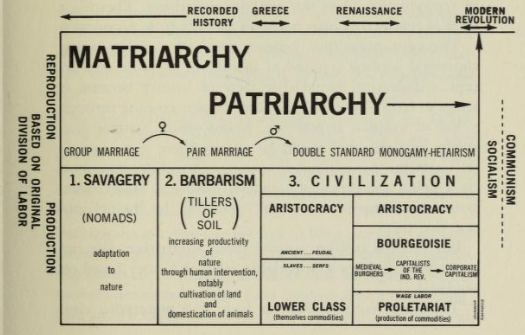
Thus it was woman’s reproductive biology that accounted for her original and continued oppression, and not some sudden patriarchal revolution, the origins of which Freud himself was at a loss to explain. Matriarchy is a stage on the way to patriarchy, to man’s fullest realization of himself; he goes from worshipping Nature through women to conquering it. Though it’s true that woman’s lot worsened considerably under patriarchy, she never had it good; for despite all the nostalgia it is not hard to prove that matriarchy was never an answer to women’s fundamental oppression. Basically it was no more than a different means of counting lineage and inheritance, one which, though it might have held more advantages for women than the later patriarchy, did not allow women into the society as equals.
…
Page 84
However, in order to illustrate the relative nature of children’s oppression, rather than comparing these different forms of the patriarchal family throughout history, we shall examine the development of its most recent version, the patriarchal nuclear family. Even its short history, roughly from the fourteenth century on, is revealing: the growth of our most cherished family values was contingent on cultural conditions, its foundations in no sense absolute. Let’s review the development of the nuclear family -and its construct “childhood”-from the Middle Ages to the present, basing our analysis on Philippe Ariès’ Centuries of Childhood: A Social History of Family Life.
The modern nuclear family is only a recent development. Ariès shows that the family as we know it did not exist in the Middle Ages, only gradually evolving from the fourteenth century on. Until then one’s “family” meant primarily one’s legal heredity line, the emphasis on blood ancestry rather than the conjugal unit.
…
Page 86
THE MYTH OF CHILDHOOD
In the Middle Ages there was no such thing as childhood. The medieval view of children was profoundly different from ours. It was not only that it was not “childcentered,” it literally was not conscious of children as distinct from adults. The childmen and childwomen of medieval iconography are miniature adults, reflecting a wholly different social reality: children then were tiny adults, carriers of whatever class and name they had been born to, destined to rise into a clearly outlined social position. A child saw himself as the future adult going through his stages of apprenticeship; he was his future powerful self “when I was little.” He moved into the various stages of his adult role almost immediately.
Children were so little differentiated from adults that there was no special vocabulary to describe them: They shared the vocabulary of feudal subordination; only later, with the introduction of childhood as a distinct state, did this confused vocabulary separate. The confusion was based on reality: Children differed socially from adults only in their economic dependence.
…
Page 89
Rousseau among others developed an ideology of “childhood.” Much was made of children’s purity and “innocence.” People began to worry about their exposure to vice. “Respect” for children, as for women, unknown before the sixteenth century, when they were still part of the larger society, became necessary now that they formed a clear-cut oppressed group. Their isolation and segregation had set in. The new bourgeois family, childcentered, entailed a constant supervision; all earlier independence was abolished.
…
Page 91
What about girls’ costumes? Here is an astonishing fact: childhood did not apply to women. The female child went from swaddling clothes right into adult female dress. She did not go to school, which, as we shall see, was the institution that structured childhood. At the age of nine or ten she acted, literally, like a “little lady”; her activity did not differ from that of adult women. As soon as she reached puberty, as early as ten or twelve, she was married off to a much older male.
…
Page 92
We can also see the class basis of the emerging concept of childhood in the system of child education that came in along with it. If childhood was only an abstract concept, then the modern school was the institution that built it into reality. (New concepts about the life cycle in our society are organized around institutions, e.g., adolescence, a construction of the nineteenth century, was built to facilitate conscription for military service.) The modern school education was, indeed, the articulation of the new concept of childhood. Schooling was redefined: No longer confined to clerics and scholars, it was widely extended to become the normal instrument of social initiation-in the progress from childhood to manhood. (Those for whom true adulthood never would apply, e.g., girls and working-class boys, did not go to school for many centuries.)
…
Page 93
According to Ariès, literary historians exaggerate the importance of the humanist tradition in the structure of our schools. The real architects and innovators were the moralists and pedagogues of the seventeenth century, the Jesuits, the Oratorians, and the Jansenists. These men were at the origins of both the concept of childhood and its institutionalization, the modern concept of schooling. They were the first espousers of the weakness and “innocence” of childhood; they put childhood on a pedestal just as femininity had been put on a pedestal; they preached the segregation of children from the adult world. “Discipline” was the keynote to modern schooling, much more important finally than the imparting of learning or information. For to them discipline was an instrument of moral and spiritual improvement, adapted less for its efficiency in directing large groups to work in common than for its intrinsic moral and ascetic value. That is, repression itself was adopted as a spiritual value.
Thus, the function of the school became “childrearing,” complete with disciplinary “child psychology.”
…
Page 97 – 98
It became desirable to keep one’s children at home for as long as possible, to bind them psychologically, financially, and emotionally to the family unit until such time as they were ready to create a new family unit. For this purpose the Age of Childhood was created. (Later, extensions were added, such as adolescence, or in twentieth-century American terms,
“teenagerdom,” “collegiate youth,” “young adulthood.”) The concept of childhood dictated that children were a species different not just in age, but in kind, from adults.
An ideology was developed to prove this, fancy tractates written about the innocence of children and their closeness to God (“little angels”), with a resulting belief that children were asexual, child sex play an aberration-all in strong contrast to the period preceding it, when children were exposed to the facts of life from the beginning. For any admission of child sexuality would have accelerated the transition into adulthood, and this now had to be retarded at all cost.
…
Page 102
Likewise children’s liberation would demand an end to all fondling not dictated by the child itself. [This of course would predicate a society in which fondling in general was no longer frowned upon; often the only demonstration of affection a child now receives is of this phony kind, which he may still consider better than nothing.]) Many men can’t understand that their easy intimacies come as no privilege. Do they ever consider that the real person inside that baby or female animal may not choose to be fondled then, or by them, or even noticed?
…
Page 166
1) Eroticism. A prime component of romanticism is eroticism. All animal needs (the affection of a kitten that has never seen heat) for love and warmth are channeled into genital sex: people must never touch others of the same sex, and may touch those of the opposite sex only when preparing for a genital sexual encounter (“a pass”).
Isolation from others makes people starved for physical affection; and if the only kind they can get is genital sex, that’s soon what they crave. In this state of hypensensitivity
the least sensual stimulus produces an exaggerated effect, enough to inspire everything from schools of master painting to rock and roll. Thus eroticism is the concentration of sexuality-often into highly-charged objects (“Chantilly Lace”) – signifying the displacement of other social / affection needs onto sex. To be plain old needy-for-affection makes one a “drip,” to need a kiss is embarrassing, unless it is an erotic kiss.
…
Page 178
Why do women, for example, get aroused by a pornography of female bodies? In their ordinary experience of female nudity, say in a gym locker room, the sight of other nude females might be interesting (though probably only insofar as they rate by male sexual standards), but not directly erotic. Cultural distortion of sexuality explains also how female sexuality gets twisted into narcissism: women make love to themselves vicariously through the man, rather than directly making love to him. At times this cultural barrage of man / subject,
woman / object desensitizes women to male forms to such a degree that they are even orgasmically affected .*
* Female inability to focus on sexual imagery has been found to be a major cause of female frigidity. Masters and Johnson, Albert Ellis, and others have stressed the importance of “sexual focusing” in teaching frigid women to achieve orgasm. Hilda O’Hare in International Journal of Sexology observes that this problem may arise largely because there is no
female counterpart in our society for the countless stimulants of the male sexual urge.
Page 200
This medieval aesthetic culture, composed of the Classical and Christian legacies, culminated in the Humanism of the Renaissance.
Until the Renaissance, then, culture occurred in the Aesthetic Mode because, prior to that time, technology had been so primitive, the body of scientific knowledge so far from complete. In terms of the sex dialectic, this long stage of cultural history corresponds with the matriarchal stage of civilization: The Female Principle-dark, mysterious, uncontrollable-reigned, elevated by man himself, still in awe of unfathomable Nature. Men of culture were the high priests of homage: until and through the Renaissance all men of culture were practitioners of the ideal aesthetic mode, thus, in a sense, artists. The Renaissance, the pinnacle of cultural humanism, was the golden age of the Aesthetic (female) Mode.
And also the beginning of its end. By the sixteenth century culture was undergoing a change as profound as the shift from matriarchy to patriarchy in terms of the sex dialectic, and corresponding to the decline of feudalism in the class dialectic. This was the first merging of the aesthetic culture with the technological, in the creation of modern (empirical) science.
…
Page 236 – 237
These three demands predicate a feminist revolution based on advanced technology. And if the male/female and the adult/child cultural distinctions are destroyed, we will no longer need the sexual repression that maintains these unequal classes, allowing for the first time a “natural” sexual freedom. Thus we arrive at:
4) The freedom of all women and children to do whatever they wish to do sexually. There will no longer be any reason not to. (Past reasons: Full sexuality threatened the continuous reproduction necessary for human survival, and thus, through religion and other cultural institutions, sexuality had to be restricted to reproductive purposes, all non-reproductive sex pleasure considered deviation or worse; The sexual freedom of women would call into question the fatherhood of the child, thus threatening patrimony; Child sexuality had to be repressed because it was a threat to the precarious internal balance of the family. These sexual repressions increased proportionately to the degree of cultural exaggeration of the biological family.) In our new society, humanity could finally revert to its natural “polymorphously perverse” sexuality-all forms of sexuality would be allowed and indulged. The fully sexuate mind, realized in the past in only a few individuals (survivors), would become universal. Artificial cultural achievement would no longer be the only avenue to sexuate self-realization: one could now realize oneself fully, simply in the process of being and acting.
…
Page 239 (footnote)
The evils of this orphanage system, the barracks-like existence, the impersonality, the anonymity, arise because these institutions are dumping grounds for the rejected in an exclusive family system; whereas we want to spread family emotions over the whole society. Thus child institutions and their consequences are at the furthest remove from revolutionary alternatives because they violate almost all of our essential postulates: the integration of children into the total society, and the granting of full economic and sexual freedoms.
…
Page 240
The most important failure of all the modern social experiments was that of the Russian communes. (The failure of the Russian Revolution in general is a thorn in every radical’s side; but its direct relation to the failure of the communes is seldom noted.) It led, ironically, to the assumption of a causal connection between the abolition of the family and the development of a totalitarian state. In this view, the later Russian reinstitution of the nuclear family system is seen as a last-ditch attempt to salvage humanist values-privacy, individualism, love, etc., by then rapidly disappearing.
But it is the reverse: The failure of the Russian Revolution is directly traceable to the failure of its attempts to eliminate the family and sexual repression. This failure, in turn, as we have seen, was caused by the limitations of a male-biased revolutionary analysis based on economic class alone, one that failed to take the family fully into account even in its function as an economic unit. By the same token, all socialist revolutions to date have been or will be failures for precisely these reasons. Any initial liberation under current socialism must always revert back to repression, because the family structure is the source of psychological, economic, and political oppression. Socialist attempts to soften the structure of power within the family by incorporating women into the labor force or army are only reformist. Thus it is no surprise that socialism as it is now constituted in the various parts of the world is not only no improvement on capitalism, but often worse.
…
Page 241
Wilhelm Reich in the Sexual Revolution summarized the specific objective reasons for the failure of the Russian communes in the best analysis to date:
1) Confusion of the leadership and evasion of the problem.
2) The laborious task of reconstruction in general given the cultural backwardness of Old Russia, the war, and famine.
3) Lack of theory. The Russian Revolution was the first of its kind. No attempt had been made to deal with emotional – sexual-familial problems in the formulation of basic revolutionary theory. (Or, in our terms, there had been a lack of “consciousness raising” about female/child oppression and a lack of radical feminist analysis prior to the
revolution itself.)
4) The sex-negative psychological structure of the individual, created and reinforced throughout history by the family, hindered the individual’s liberation from this very structure. As Reich puts it:
It must be remembered that human beings have a tremendous fear of just that kind of life for which they long so much but which is at variance with their own structure.
5) The explosive concrete complexities of sexuality.
Page 249
4) Sexual repression continued, partly as the result of the failure to sever the special connection between women and children and partly because the pioneers were unable to overcome their own “sex-negative” structures .*
[* FOOTNOTE Reich discusses the Russian inability to handle the first signs of a free child sexuality: Child sex was interpreted in Puritan terms as the sign of moral breakdown, rather than as the first stage of the reversion to a natural sexuality.]
I shall add a fifth cause of failure:
5) There was no development of a feminist consciousness and analysis prior to the initiation of the experiment. The best example of this failing is our current American communal experiments, which merely extend the family structure to include a larger number of people. The division of labor remains, because woman’s role in (child) bed or kitchen has not been questioned, nor the role of man as provider. And since the relationship “mother / child” remains intact, it is no wonder that when the commune breaks up, all the “godparents” disappear, as well as the genetic father himself, leaving the mother stuck – without even the protection of an ordinary marriage.
Thus never has there been a true instance of full membership of women and children in the larger society. The modern social experiment, like the matriarchal stage of human history, signifies only a relative loosening within the larger movement toward consolidation of male supremacy through history. It never altered the fundamental condition of sex oppression. …
Page 259
However, after several generations of nonfamily living, our psychosexual structures may become altered so radically that the monogamous couple, or the “aim-inhibited” relationship, would become obsolescent. We can only guess what might replace it-perhaps true “group marriages,” transexual group marriages which also involved older children? We don’t know.
…
Page 271 – 272
3) The total integration of women and children into the larger society. This has been fulfilled: The concept of childhood has been abolished, children having full legal, sexual, and economic rights, their educational/work activities no different from those of adults. During the few years of their infancy we have replaced the psychologically destructive genetic “parenthood” of one or two arbitrary adults with a diffusion of the responsibility for physical welfare over a larger number of people. The child would still form intimate love relationships, but instead of developing close ties with a decreed “mother” and “father,” the child might now form those ties with people of his own choosing, of whatever age or sex. Thus all adult child relationships will have been mutually chosen-equal, intimate relationships free of material dependencies. Correspondingly, though children would be fewer, they would not be monopolized, but would mingle freely throughout the society to the benefit of all, thus satisfying that legitimate desire to be around the young which is often called
the reproductive “instinct.”
4) Sexual freedom, love, etc. So far we have not said much of love and sexual freedom because there is no reason for it to present a problem: there would be nothing obstructing it. With full license human relationships eventually would be redefined for the better. If a child does not know his own mother, or at least does not attach a special value to her over others, it is unlikely that he would choose her as his first love object, only to have to develop inhibitions on this love. It is possible that the child might form his first close physical relationships with people his own size out of sheer physical convenience, just as men and women, all else being equal, might prefer each other over those of the same sex for sheer physical fit. But if not, if he should choose to relate sexually to adults, even if he should happen to pick his own genetic mother, there would be no a priori reasons for her to reject his sexual advances, because the incest taboo would have lost its function. The “household,” a transient social form, would not be subject to the dangers of inbreeding.
Thus, without the incest taboo, adults might return within a few generations to a more natural “polymorphously perverse” sexuality, the concentration on genital sex and orgasmic pleasure giving way to total physical/ emotional relationships that included that. Relations with children would include as much genital sex as the child was capable of-probably considerably more than we now believe – but because genital sex would no longer be the central focus of the relationship, lack of orgasm would not present a serious problem. Adult/child and homosexual sex taboos would disappear, as well as nonsexual friendship (Freud’s aim-inhibited love). All close relationships would include the physical, our concept of exclusive physical partnerships (monogamy) disappearing from our psychic structure, as well as the construct of a Partner Ideal.
But how long it would take for these changes to occur, and in what forms they would appear, remains conjecture. The specific need not concern us here. We need only set up the
preconditions for a free sexuality: whatever forms it took would be assuredly an improvement on what we have now, “natural” in the truest sense.
…