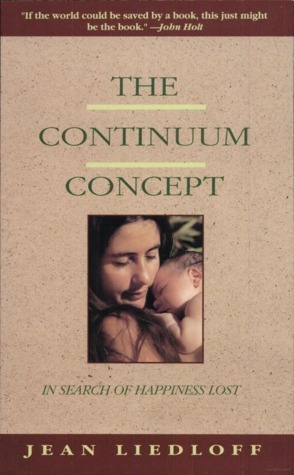
The Continuum Concept: In Search of Happiness Lost
by Jean Liedloff.
https://en.wikipedia.org/wiki/Continuum_concept
For infants, the experiences include:
- Immediate placement, after birth, in their mothers’ arms: Liedloff comments that the common hospital protocol of immediately separating a newborn from its mother may hormonally disrupt the mother, possibly explaining high rates of postpartum depression;
- Constant carrying or physical contact with other people (usually their mothers or fathers) in the several months after birth, as these adults go about their day-to-day business (during which the infants observe and thus learn, but also nurse, or sleep); this forms a strong basis of personal security for infants, according to Liedloff, from which they will begin developing a healthy drive for independent exploration by eventually starting to naturally creep, and then crawl, usually at six to eight months; She calls this the “In-Arms” phase.
- Sleeping in the parents’ bed (called co-sleeping), in constant physical contact, until leaving of their own volition (often about two years);/li>
- Breastfeeding “on cue”—involving infants’ bodily signals being immediately answered by their mothers’ nursing them;
- Caregivers’ immediate response to the infants’ urgent body signals (flaring temper, crying, sniffling, etc.), without judgment, displeasure, or invalidation of the children’s needs, but also not showing any undue concern or focusing on or overindulging the children;
- Sensing (and fulfilling) elders’ expectations that the infants are innately social and cooperative and have strong self-preservation instincts, and that they are welcome and worthy (yet without making them the constant center of attention)
Jean Liedloff, an American writer, spent two and a half years in the South American jungle living with Stone Age Indians. The experience demolished her Western preconceptions of how we should live and led her to a radically different view of what human nature really is. She offers a new understanding of how we have lost much of our natural well-being and shows us practical ways to regain it for our children and for ourselves.