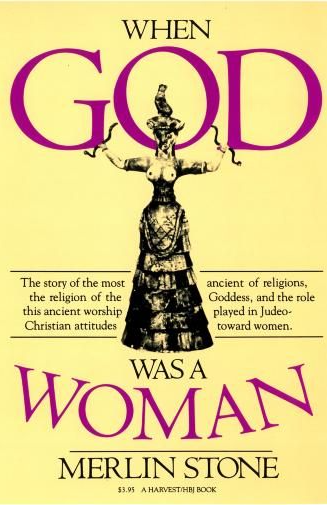
When God Was a Woman
by Merlin Stone. Published 1976, New York: The Dial Press.
Professor R. K. Harrison wrote of the Goddess religion, “One of its most prominent features was the lewd, depraved, orgiastic character of its cultic procedures.”
…Professor W. F. Albright, one of the leading authorities on the archaeology of Palestine, wrote of the female religion as “orgiastic nature worship, sensuous nudity and gross mythology.”
Paying closer attention to semantics, subtle linguistic undertones and shades of meaning, I noticed that the word “cult,” which has the implicit connotations of something less fine or civilized than “religion,” was nearly always applied to the worship of the female deities, not by ministers of the Church but by presumably objective archaeologists and historians. The rituals associated with the Judeo-Christian Yahweh (Jehovah) were always respectfully described by these same scholars as “religion.” It was upon seeing the words “God,” and even “He,” each time carefully begun with capital letters, while “queen of heaven,” “goddess” and “she” were most often written in lower case, that I decided to try it the other way about, observing how these seemingly minor changes subtly affected the meaning as well as the emotional impact.
Within descriptions of long-buried cities and temples, academic authors wrote of the sexually active Goddess as “improper,” “unbearably aggressive” or “embarrassingly void of morals,” while male deities who raped or seduced legendary women or nymphs were described as “playful,” even admirably “virile.” The overt sexual nature of the Goddess, juxtaposed to Her sacred divinity, so confused one scholar that he finally settled for the perplexing title, the Virgin-Harlot. The women who followed the ancient sexual customs of the Goddess faith, known in their own language as sacred or holy women, were repeatedly referred to as “ritual prostitutes.” This choice of words once again reveals a rather ethnocentric ethic, probably based on biblical attitudes. Yet, using the term “prostitute” as a translation for the title of women who were actually known as qadesh, meaning holy, suggests a lack of comprehension of the very theological and social structure the writers were attempting to describe and explain.
…
CHAPTER 2 Who Was She?
Theories on the origins of the Goddess in this period are founded on the juxtaposition of mother-kinship customs to ancestor worship. They are based upon three separate lines of evidence.
The first relies on anthropological analogy to explain the initial development of matrilineal (mother-kinship) societies. Studies of “primitive” tribes over the last few centuries have led to the realization that some isolated “primitive” peoples, even in our own century, did not yet possess the conscious understanding of the relationship of sex to conception. The analogy is then drawn that Paleolithic people may have been at a similar level of biological awareness.
Jacquetta Hawkes wrote in 1963 that “… Australian and a few other primitive peoples did not understand biological paternity or accept a necessary connection between sexual intercourse and conception.”
…
“James Frazer, Margaret Mead and other anthropologists,” writes Leonard Cottrell, “have established that in the very early stages of man’s development, before the secret of human fecundity was understood, before coitus was associated with childbirth, the female was revered as the giver of life. Only women could produce their own kind, and man’s part in this process was not as yet recognized.”
…
The second line of evidence concerns the beginnings of religious beliefs and rituals and their connection with matrilineal descent.
…
Ancestor worship occurs among tribal people the world over. Maringer states that even at the time of his writing, 1956, certain tribes in Asia were still making small statues known as dzuli. Explaining these he says, “The idols are female and represent the human origins of the whole tribe.”
Thus as the religious concepts of the earliest homo sapiens were developing, the quest for the ultimate source of life (perhaps the core of all theological thought) may have begun. In these Upper Paleolithic societies—in which the mother may have been regarded as the sole parent of the family, ancestor worship was apparently the basis of sacred ritual, and accounts of ancestry were probably reckoned only through the matriline—the concept of the creator of all human life may have been formulated by the clan’s image of the woman who had been their most ancient, their primal ancestor and that image thereby deified and revered as Divine Ancestress.
The third line of evidence, and the most tangible, derives from the numerous sculptures of women found in the Gravettian-Aurignacian cultures of the Upper Paleolithic Age. Some of these date back as far as 25,000 BC. These small female figurines, made of stone and bone and clay and often referred to as Venus figures, have been found in areas where small settled communities once lived.
…
worship of the female deity survived into the classical periods of Greece and Rome. It was not totally suppressed until the time of the Christian emperors of Rome and Byzantium, who closed down the last Goddess temples in about 500 AD.
…
Though at first the Goddess appears to have reigned alone, at some yet unknown point in time She acquired a son or brother (depending upon the geographic location), who was also Her lover and consort. He is known through the symbolism of the earliest historic periods and is generally assumed to have been a part of the female religion in much earlier times. Professor E. O. James writes,
“Whether or not this reflects a primeval system of matriarchal social organization, as is by no means improbable, the fact remains that the Goddess at first had precedence over the Young-god with whom she was associated as her son or husband or lover.”
It was this youth who was symbolized by the male role in the sacred annual sexual union with the Goddess. (This ritual is known from historic times but is generally believed to have been known in the Neolithic period of the religion.) Known in various languages as Damuzi, Tammuz, Attis, Adonis, Osiris or Baal, this consort died in his youth, causing an annual period of grief and lamentation among those who paid homage to the Goddess. The symbolism and rituals connected with him will be more fully explained in the chapter on the male consort, but wherever this dying young consort appears as the male deity, we may recognize the presence of the religion of the Goddess, the legends and lamentation rituals of which are extraordinarily similar in so many cultures. This relationship of the Goddess to Her son, or in certain places to a handsome youth who symbolized the son, was known in Egypt by 3000 BC; it occurred in the earliest literature of Sumer, emerged in later Babylon, Anatolia and Canaan, survived in the classical Greek legend of Aphrodite and Adonis and was even known in pre-Christian Rome as the rituals of Cybele and Attis, possibly there influencing the symbolism and rituals of early Christianity.
…
The similarities of statues, titles, symbols such as the serpent, the cow, the dove and the double axe, the relationship of the son/lover who dies and is mourned annually, eunuch priests, the sacred annual sexual union and the sexual customs of the temple, each reveal the overlapping and underlying connections between the worship of the female deity in areas as far apart in space and time as the earliest records of Sumer to classical Greece and Rome.
…
Scholars such as Johann Bachofen, Robert Briffault and Edward Hartland accepted the idea of ancient matriarchy and polyandry, substantiating their theories with a great deal of evidence, but they regarded these systems as a specific stage in evolutionary development. They suggested that all societies had to pass through a matriarchal stage before becoming patriarchal and monogamous, which they appear to have regarded as a superior stage of civilization.
…
In the early periods of Elam the deities appear to have been served by female and male clergy, the men appearing naked before the high priestess, as was the custom in early Sumer.
…
The renowned temple of the Goddess in the city of Ephesus was the target of the apostle Paul’s zealous missionary efforts (Acts 19:27). This temple, which legend and classical reports claim was founded by “Amazons,” was not completely closed down until AD 380.
…
Charles Seltman wrote in 1952 of this highly developed culture of Crete, whose beginnings preceded biblical times by many centuries. He stated that, upon Crete, matriarchy had been the way of life. He discussed the sexual freedom of women, matrilineal descent and the role of the “king,” pointing out the high status of women in and around the land in which the Goddess appears to have been the very core of existence.
“Among the Mediterraneans,” wrote Seltman, “as a general rule society was built around the woman, even on the highest levels where descent was in the female line. A man became king or chieftain only by a formal marriage and his daughter, not his son, succeeded so that the next chieftain was the youth who married his daughter … Until the northerners arrived, religion and custom were dominated by the female principle.”
…
In 1958 Jacquetta Hawkes presented some perceptive observations on the status of women on Crete, commenting that, although one may consider the possibility that the Goddess may have been a masculine dream, “Cretan men and women were everywhere accustomed to seeing a splendid goddess queening it over a small and suppliant male god, and this concept must surely have expressed some attitude present in the human society that accepted it.” She continued by pointing out that the self-confidence of women and their secure place in society was perhaps made evident by another characteristic. “This is the fearless and natural emphasis on sexual life that ran through all religious expression and was made obvious in the provocative dress of both sexes and their easy mingling—a spirit best understood through its opposite: the total veiling and seclusion of Moslem women under a faith which even denied them a soul.”
…
In the classical age of Sparta, where the veneration of the Goddess as Artemis continued to thrive, women were extremely free and independent. According to both Euripedes and Plutarch, young Spartan women were not to be found at home but in the gymnasia where they tossed off their restricting clothing and wrestled naked with their male contemporaries. Women of Sparta appear to have had total sexual freedom, and though monogamy was said to be the official marriage rule, it was mentioned in several classical accounts that it was not taken very seriously. Plutarch reported that in Sparta the infidelity of women was even somewhat glorified, while Nicholas of Damascus, perhaps as the result of some personal experience, tells us that a Spartan woman was entitled to have herself made pregnant by the handsomest man she could find, whether native or foreigner.
…
CHAPTER 3 Women — Where Woman Was Deified
[Sir James ] Frazer suggested that the high status of women led to the worship of the Goddess as supreme being, basing his conclusions on years of study of “primitive” and classical societies. But as a result of this research, he also connected the worship of the female deity to a mother-kinship system and ancestor worship, explaining that, “Wherever the goddess is superior to the god, and ancestresses more reverently worshipped than ancestors, there is nearly always a mother-kin structure.”
…
This man was known as Diodorus Siculus, Diodorus of Sicily. Many statements reporting the high or even dominant status of women were included in his writings. We may question why he, more than any other classical writer, recorded so much information about women warriors and matriarchy in the nations all about him. He did not belittle the men who lived in such social systems; that did not appear to be his aim. Indeed, he seemed to be rather admiring and respectful of the women who wielded such power.
It was Diodorus who reported that the women of Ethiopia carried arms, practiced communal marriage and raised their children so communally that they often confused even themselves as to who the natural mother had been. In parts of Libya, where the Goddess Neith was highly esteemed, accounts of Amazon women still lingered even in Roman times. Diodorus described a nation in Libya as follows:
All authority was vested in the woman, who discharged every kind of public duty. The men looked after domestic affairs just as the women do among ourselves and did as they were told by their wives.. They were not allowed to undertake war service or to exercise any functions of government, or to fill any public office, such as might have given them more spirit to set themselves up against the women. The children were handed over immediately after birth to the men, who reared them on milk and other foods suitable to their age.
…
ELAM — NAKED BEFORE THE HIGH PRIESTESS
In 1973 Dr. Walther Hinz suggested that the original supremacy of the Goddess in Elam (slightly east of Sumer and in close contact by 3000 BC), indicated a “matriarchal approach” in the devotees of Her religion. He explained that, though She was supreme in the third millenium, She later became secondary to Her consort Humban; She was then known as the Great Wife. In Susa, at the northern end of the Elamite territories, the male consort was known as In Shushinak. In earliest times he was known as Father of the Weak, by mid-second millenium he was called King of the Gods and in the eighth century BC he was invoked as Protector of the Gods of Heaven and Earth.
In the early periods of Elam the deities appear to have been served by female and male clergy, the men appearing naked before the high priestess, as was the custom in early Sumer. Hinz explains that in Elam, much like the naditu women of Sumer, “One special group among the priestesses was formed by those women or maidens who had dedicated their lives to the Great Goddess.” These women were primarily involved in the buying, selling and renting of land.
Legal documents from Elam, primarily from after 2000 BC, reveal that women were often the sole heirs. One married woman refused to make her inheritance joint with her husband and intended to pass the inheritance along to her daughter. Another tablet stated that a son and a daughter were to share equally; the daughter was mentioned first. Several tablets described situations where the husband was leaving everything he owned to his wife and insisted that their children would inherit only if they cared for their mother with the greatest respect.
…
It is possible that at the time of the Hittite invasions many of the Goddess worshiping peoples may have fled to the west. The renowned temple of the Goddess in the city of Ephesus was the target of the apostle Paul’s zealous missionary efforts (Acts 19:27). This temple, which legend and classical reports claim was founded by “Amazons,” was not completely closed down until AD 380.
…
Greece was invaded by northern peoples several times. Robert Graves, in his introduction to The Greek Myths, wrote in 1955, “Achaean invasions of the thirteenth century BC seriously weakened the matrilineal tradition … when the Dorians arrived, towards the close of the second millenium, patrilineal succession became the rule.” With these northern people came the worship of the Indo-European Dyaus Pitar, literally God Father, eventually known in Greece as Zeus and later in Rome as Jupiter. This transitional period of the change from the worship of the Goddess to the male deity, the change most intensively brought about by the Dorian invasions, was the subject of E. Butterworth’s Some Traces of the Pre-Olympian World, written in 1966.
Butterworth managed to accomplish with Greece what Murray had done with Egypt. By carefully tracing the lineage of the royal houses, he ultimately showed that many of the greatest pre-Greek cities, which were essentially small nations, were originally matrilineal. He pointed out that Argos, Thebes, Tiryns and Athens, as well as other cities, at one time followed matrilineal customs of descent. He explains that this was the result of the worship of the Goddess and Her Cretan origins, stating that Crete itself was matrilineal and possibly even matriarchal.
His primary interest was in the patrilineal revolution, the time at which the patrilineal clans violently set about superimposing their customs upon all those around them:
Matrilineality, though not universal in the Greek and Aegean world, was widely spread … the effect of the system of succession to the kingship and to the inheritance of property on the life of the times was immense. The majority of the clans were matrilineal by custom, and the greatest revolution in the history of early Greece was that by which the custom was changed from matrilineal to patrilineal succession and the loyalty to the clan destroyed.
…
Yet, according to Hawkes, many of the attitudes about the lowly position of the women of classical Greece were greatly exaggerated by “the bias of nineteenth century scholarship.” She suggests that, even in the classical period of Greece, women retained some of their Cretan predecessors’ freedom:
Just as in Crete, women shared the power of the Goddess both psychologically and socially; priestesses were of high standing and priestly associations of women were formed round temples and holy places. There was an influential one for example associated with the famous temple of Artemis (Diana) at Ephesus. At this city and indeed in Ionia generally, women and girls enjoyed much freedom. While women certainly won influence and responsibility by serving at the temples and great state festivals of the goddesses, there was also the liberation of the ancient cults.
Respectable matrons and girls in large companies would spend whole nights on the bare hills in dances which stimulated ecstasy, and in intoxication, perhaps partly alcoholic, but mainly mystical. Husbands disapproved, but, it is said, did not like to interfere in religious matters.
In the classical age of Sparta, where the veneration of the Goddess as Artemis continued to thrive, women were extremely free and independent. According to both Euripedes and Plutarch, young Spartan women were not to be found at home but in the gymnasia where they tossed off their restricting clothing and wrestled naked with their male contemporaries. Women of Sparta appear to have had total sexual freedom, and though monogamy was said to be the official marriage rule, it was mentioned in several classical accounts that it was not taken very seriously. Plutarch reported that in Sparta the infidelity of women was even somewhat glorified, while Nicholas of Damascus, perhaps as the result of some personal experience, tells us that a Spartan woman was entitled to have herself made pregnant by the handsomest man she could find, whether native or foreigner.
…
according to Hebrew law a woman had no right to money or property upon divorce and since her vow was invalid, presumably she could not engage in business. Perhaps the most shocking laws of all were those that declared that a woman was to be stoned or burned to death for losing her virginity before marriage, a factor never before mentioned in other law codes of the Near East, and that, upon being the victim of rape, a single woman was forced to marry the rapist; if she was already betrothed or married she was to be stoned to death for having been raped.
…
The second incident is dated at about 842 BC, when Athaliah, daughter of Queen Jezebel, claimed the throne of Judah as her own. According to Hebrew law, women were not allowed to reign alone. Yet it required a violent revolution to dethrone her. Jezebel herself was closely identified with the ancient religion.
Jezebel’s parents, Athaliah’s grandparents, were the high priestess and priest of Ashtoreth and Baal in the Canaanite city of Sidon, reigning there as queen and king. The murder of Jezebel, who had reigned alongside Ahab as queen in the northern kingdom of Israel, was actually a political assault upon the religion of the Goddess. This is made clear in the events that followed her murder in the biblical account in Kings I and II. So it is worth noting that it was Jezebel’s daughter who ascended to the royal throne of Judah, the only woman ever to rule the Hebrew nation alone. Most significant is the fact that, once Athaliah secured her rights to the throne, she reigned for about six years, re-establishing the ancient “pagan” religion throughout the nation, much to the distress of the Hebrew priests.
…
A consciousness of the relationship of the veneration of the Goddess to the matrilineal descent of name, property and the rights to the throne is vital in understanding the suppression of the Goddess religion. As I shall explain, it was probably the underlying reason for the resentment of the worship of the Goddess (and all that it represented) by the patriarchal invaders who arrived from the north.
Judging by the continued presence of the Goddess as supreme deity in the Neolithic and Chalcolithic societies of the Near and Middle East, Goddess worship, probably accompanied by the matrilineal customs, appears to have existed without challenge for thousands of years. It is upon the appearance of the invading northerners, who from all accounts had established patrilineal, patriarchal customs and the worship of a supreme male deity sometime before their arrival in the Goddess-worshiping areas, that the greatest changes in religious beliefs and social customs appear to have taken place.
…
CHAPTER 4 The Northern Invaders
These northern peoples are referred to in various contexts as Indo-Europeans, Indo-Iranians, Indo-Aryans or simply Aryans. Their existence, once it surfaced in historical periods, portrays them as aggressive warriors riding two abreast in horse-drawn war chariots; their earlier more speculative appearances in prehistoric times, as big sailors who navigated the rivers and coastlines of Europe and the Near East.
Discussing their origins, Hawkes writes of the Mesolithic and Neolithic groups known as the “battle axe cultures.”
…
The invasion by the northern peoples was not a single major event but rather a series of migrations which took place in waves over a period of at least one thousand and possibly three thousand years. The invasions of the historical period, which began at about 2400 BC, are attested by literature and surviving artifacts and are agreed upon by most historians and archaeologists.
…
Historical, mythological and archaeological evidence suggests that it was these northern people who brought with them the concepts of light as good and dark as evil (very possibly the symbolism of their racial attitudes toward the darker people of the southern areas) and of a supreme male deity. The emergence of the male deity in their subsequent literature, which repeatedly described and explained his supremacy, and the extremely high position of their priestly caste may perhaps allow these invasions to be viewed as religious crusade wars as much as territorial conquests.
The arrival of the Indo-Aryan tribes, the presentation of their male deities as superior to the female deities of the indigenous populations of the lands they invaded and the subsequent intricate interlacing of the two theological concepts are recorded mythologically in each culture. It is in these myths that we witness the attitudes that led to the suppression of Goddess worship.
…
It is in these accounts of the Indo-European people that we may find the origins of many of the ideas of the early Hebrews. The concept of the god on the mountain top, blazing with light, the duality between light and dark symbolized as good and evil, the myth of the male deity’s defeat of the serpent as well as the leadership of a supreme ruling class, each so prevalent in Indo-European religion and society, are to be found in Hebrew religious and political concepts as well. This influence or possible connection with the Indo-European peoples may provide the explanation for the extreme patriarchal attitudes of the Hebrews.
…
In Sanskrit the word sat means to destroy by hewing into pieces. In the myth of Osiris, who is Horus after his death (though also known as the father of Horus at the same time), it was Set who killed Osiris and cut his body into fourteen pieces. But it may be significant that the word set is also defined as “queen” or “princess” in Egyptian. Au Set, known as Isis by the Greeks, is defined as “exceeding queen.” In the myth of the combat Set tries to mate sexually with Horus; this is usually interpreted as being an insult. But the most primitive identity of the figure Set, who is also closely related to the serpent of darkness known as Zet, and often referred to by classical Greek writers as Typhon, the serpent of the Goddess Gaia, may once have been female, or in some way symbolic of the Goddess religion, perhaps related to Ua Zit, Great Serpent, the Cobra Goddess of Neolithic times.
…
Once more we find the myth of the defeat of the dragon. The Hittite king Mursilis II wrote of having to celebrate the festivals of the storm god in several cities. In this same letter he referred to the major festival of this nature being celebrated at the capital at Hattusas, at the mausoleum of the Goddess known as Lilwanis. At these festivals a ritual combat was either recited or enacted, perhaps much like the one between Hor and Set in Egypt. This combat was between the storm god and the dragon Illuyankas. It seems that Mursilis, as king, may even have played a role in the drama, possibly as the storm god. But the other figure involved in the story, that of a young man named Hupisayas, who upon sleeping with the Goddess known as Inara gained enough strength to help the storm god defeat the dragon, seems a more likely role.
The story of Hupisayas gaining strength by making love with the Goddess may have been enacted by an annual sacred sexual union, much like those described in the texts of Sumer and Babylon, which will be more thoroughly explained in Chapter Six. In those countries the king played the role of the son/lover to the high priestess of the Goddess, who then endowed him with the rights of kingship. If this is so, it again suggests that the early Indo-European kings may have played this role with Hattian priestesses to legitimatize their position. The name of the dragon Illuyankas may be related to the Goddess Lilwanis. In the end the dragon was killed, just as the Goddess Tiamat, symbolized as a dragon, was killed by Marduk.
…
CHAPTER 5 One of Their Own Race
Certainly the Hebrew people have never been thought of as Indo-European, and by the time they were settled in Canaan, after their stay in Egypt, the majority of them may have been Semitic. Yet there is one group that stands apart from the Hebrews and yet is counted as one of their tribes. These are the priestly Levites. This is surely the most controversial hypothesis yet suggested, but at the risk of overwhelming religious, emotional and academic reactions, I suggest that the Levites may have in some way been related to the Indo-Europeans, most especially the Luwians, Luvians, Luwites or Luvites as the various translations will have it. Despite the almost universally accepted belief that the Hebrews were always a totally Semitic people, there are many curious pieces of evidence that suggest that their connections with the Indo-Europeans should at least be considered in this context.
…
In Job 26:13 and in Psalm 104 we may still read that Yahweh destroyed the primeval serpent. In Psalm 74 we also find, “By Thy power Thou didst cleave the sea monster in two [just as Marduk did] and break the sea serpent’s head above the waters. Thou didst crush Leviathan’s many heads.”
…
Another text in the Pahlavi books deals with the Indo-Iranian view of the first woman. She was known as Jeh, “queen of all whore demons.” The story takes on the characteristics of the legend of Adam and Eve in that it relates that Jeh arrived at the Creation in the company of the devil (Ahriman). In this account she does not converse with him, but relates to him sexually instead. It is then stated that she was joined with the devil so that she might afterward defile all women, who in turn would defile all men. We are then told, “Since women are subservient to the devil, they are the cause of defilement in men.”
…
CHAPTER 6 If the King Did Not Weep
Judging from the mythological accounts of the Goddess (with the high priestess understood to be Her incarnation upon earth), we are presented with the image not of a celibate woman, nor of one who took a permanent husband, as queens did in historic periods, but of a woman who chose annual lovers or consorts, as she retained the more permanent position of highest rank for herself.
The symbolism of her yearly, youthful consorts, the dying son/lover of the Goddess, occurs and recurs throughout the legends of the Goddess religion, probably recording Neolithic and earliest historic periods. It is found in the most ancient legends of both Sumer and Egypt and survives in all historic periods of the Near East until the first centuries of Christianity, in which it may have been retained in the annual mourning for the death of Jesus.
Sir James Frazer, author of The Golden Bough, explored this subject more extensively and thoroughly than any other scholar of comparative religion. Though some of his conclusions and theories have been questioned by later writers, the major body of material in his twelve extensive volumes even today holds a great deal of valuable information—and perhaps more pertinent, still raises some interesting points. The subject of the annual death of the son/lover of the Goddess interests us here because it appears to be a direct outgrowth of the original rituals and customs of the early female religion. It symbolizes one of the most ancient practices recorded — the ritual sacrifice of an annual “king,” consort of the high priestess.
Several accounts of tribes in Africa describe queens who remained unmarried, while taking lovers of lesser rank. Records from Nigeria report that a male was the consort of the queen until she found herself pregnant, at which time he was strangled by a group of women — he had fulfilled his earthly task.
…
This material suggests that the high priestess, as the incarnation of the Goddess, chose a lover, probably much younger than herself, since he was so often referred to as the son of the Goddess. Numerous accounts tell of the sexual union that took place between them, often referred to as the hieros gamos, the sacred marriage. This sacred marriage or sexual union is attested to in the historic periods of Sumer, Egypt, Babylon and even in classical Greece. After the sexual ceremony the young man assumed the role as consort of the priestess. He was the “king.”
“The inference that seems indisputable,” writes Professor S. Smith, “is that the rite of the sacred marriage goes back to a remote antiquity, and that is the reason why it was included in the cults of distinctly different gods … Its annual nature seems to be connected with the annual reappointment of the king.” Describing the status of the male who related to the high priestess in the Aegean, Butterworth tells us that “Access to the divine was through the queen.”
The sacred sexual union with the high priestess gave the male consort a privileged position. According to Professor Saggs, in historic Sumer and Babylon, after the sacred marriage the Goddess “fixed the destiny” of the king for the coming year. But in earlier days this position of kingship was far from permanent. The male chosen held his royal rights for a specific period of time. At the end of this time (perhaps a year since the ceremony was celebrated annually, but other records seem to suggest possibly a longer period in certain areas), this youth was then ritually sacrificed.
In 1914 Stephen Langdon wrote that “The divine figures of Tammuz, Adonis and Osiris represent a theological principle, the incarnation of religious ideas which were once illustrated in a more tangible form. Not the divine son who perished in the waves, but a human king who was slain …”
In 1952 Charles Seltman of the University of Cambridge described the situation in this way. “The Great Goddess was always supreme and the many names by which she was called were but a variety of titles given to her in diverse places. She had no regular ‘husband’ but her mate, her young lover, died or was killed every autumn and was glorified in resurrection every spring, coming back to the goddess; even as a new gallant may have been taken into favour every year to mate with an earthly queen.”
In 1957 Robert Graves wrote of the ritual regicide as it appeared in pre-IndoEuropean Greece, explaining it as follows: “The Tribal Nymph, it seems, chose an annual lover from her entourage of young men, a king to be sacrificed when the year ended … the sacred king continued to hold his position only by the right of marriage to the Tribal Nymph …” In his introduction to The Greek Myths he explains his theories on how kingship in the Aegean was made a permanent institution, as a gradual extension of the “year” into a “longer year” was introduced by the invading Indo-European Achaeans of the thirteenth century BC and later a permanent kingship instituted by the Indo-European Dorians at about 1100 BC.
Both Frazer and James offer the Shilluk groups of the Upper Nile as a possible analogy. Professor James, writing in 1937, says, “It was the custom in this tribe until recently to put the king to death whenever he showed signs of failing health and virility. Therefore as soon as he was unable to satisfy the sexual passions of his wives, it was their duty to acquaint the elders with the fact, and arrangements were made at once for his demise and the appointment of a vigorous successor to reign in his stead.” Frazer listed Canaan, Cyprus and Carthage as places where in
earliest historic times there was the most certain evidence of the slaying of the king. Frazer, Langdon, James, Seltman, Graves and many others agreed that the legend was enacted and that the male who was slain was the temporary king of the city, the youth who had previously played the role of the son/lover in the sacred sexual union.
…
It is possible that in certain areas one of the substitute rituals that initially replaced the actual death of the temporary king was the act of castration, perhaps the actual origin of the Freudian fantasy fear. The severing of the male genitals appeared in several legends that announced the deposition of the ruling male. These accounts occur in the same general areas that also report the death of the male consort; and in some, such as Osiris and Attis, castration and death are closely intertwined.
Indo-European Hittite mythology related in the story of Kumarbi, who wrested the position of power from the previous reigning god Anu, that Kumarbi castrated Anu as Kumarbi ascended to the superior rank. Greek mythology, probably borrowing from these earlier Hittite stories, told of Cronus castrating his father Uranus and usurping his position at the suggestion of his mother, the Goddess Gaia. Cronus then feared that his son might do the same to him, thus setting off a series of Greek mythological events in which the son, Zeus, did eventually overthrow his father. Both the Hittite and the Greek stories are IndoEuropean. Castration may have been the original Indo-European solution to the ritual regicide.
The Anatolian myth of the Goddess Inara revealed that once a man slept with the Goddess (presumably the high priestess), he might never again sleep with another woman, for fear that he would transfer the sacred powers of the Goddess to her. One Attis legend explained his voluntary castration as a reaction to his fear of being unfaithful to the Goddess. If the consort was not allowed to have sexual relations with anyone after he had been with the high priestess, castration may have been the solution that at first allowed him to remain alive.
…
The element of castration appears in many ancient accounts of the Goddess religion. Repeated references were made to the presence of eunuch priests in ancient Sumer, Babylon, Canaan and most especially in Anatolia, where classical texts report that the number of such men serving in the religion of the Goddess at that time was as high as five thousand in certain cities. The eunuch priests in Anatolia of classical times actually called themselves Attis.
Suggestions have been put forth to explain the evident willingness of these men to castrate themselves, a custom we may find somewhat astonishing today. These explanations are supported by the appearance all through the Near East of representations of priests in female clothing, the costume eunuch priests are said to have worn.
…
CHAPTER 7 The Sacred Sexual Customs
The Canaanites are known throughout the Old Testament as the major element in the population of Palestine dispossessed by Israel in her occupation of the “land flowing with milk and honey.” With great indignation and broad generalization “the abominations of the Canaanites” are stigmatized by Hebrew prophets, reformers and editors of the Old Testament. They roundly condemn their people for going “a whoring after the Baalim” and Ashteroth, the local manifestations of the deities of the Canaanite fertility-cult, which they caricature by referring to one element in it, sexual license…
So commented Professor John Gray in The Canaanites, written in 1964. This “sexual license” described among the Canaanites refers to the sacred sexual customs of the ancient religion, customs also found in many other areas of the Near and Middle East.
During biblical times it was still customary, as it had been for thousands of years before in Sumer, Babylon and Canaan, for many women to live within the temple complex, in earliest times the very core of the community. As we have seen, temples owned much of the arable land and herds of domesticated animals, kept the cultural and economic records and generally appear to have functioned as the central controlling offices of the society. Women who resided in the sacred precincts of the Divine Ancestress took their lovers from among the men of the community, making love to those who came to the temple to pay honor to the Goddess. Among these people the act of sex was considered to be sacred, so holy and precious that it was enacted within the house of the Creatress of heaven, earth and all life. As one of Her many aspects, the Goddess was revered
as the patron deity of sexual love.
Some archaeologists assume that these sexual customs of the temples, so repeatedly attested to in the religion of the female deity throughout the early historic periods of the Near and Middle East, must have been viewed as a type of primitive symbolic magic to invoke fertility in cattle and vegetation as well as in humans. It is my opinion that they may have developed as a result of the earliest consciousness and comprehension of the relationship of sex to reproduction.
Since this connection was probably initially observed by women, it may have been integrated into the religious structure as a means of ensuring procreation among the women who chose to live and raise children within the shrine complex, as well, possibly, as a method of regulating pregnancies.
The concept of reproduction was pictorially explained in a gray stone plaque discovered in the Neolithic shrine of the Goddess at Catal Hüyük, carved there some eight thousand years ago. One side of the relief depicts the bodies of two lovers in a close embrace, the other side, a woman holding an infant.
People today, raised and programmed on the “morality” of the contemporary male religions, may find the ancient sexual attitudes and customs disturbing, shocking or even sacrilegious. Yet we should consider the likelihood that such judgments or reactions are the result of the teaching and conditioning of religious attitudes present in our society, which are themselves based on the ideologies of those who initially and repetitively condemned the sexual customs of the Goddess.
In the worship of the female deity, sex was Her gift to humanity. It was sacred and holy. She was the Goddess of Sexual Love and Procreation. But in the religions of today we find an almost totally reversed attitude. Sex, especially non-marital sex, is considered to be somewhat naughty, dirty, even sinful. Yet rather than calling the earliest religions, which embraced such an open acceptance of all human sexuality, “fertility-cults,” we might consider the religions of today as strange in that they seem to associate shame and even sin with the very process of conceiving new human life. Perhaps centuries from now scholars and historians will be classifying them as “sterility-cults.”
Documentary evidence from Sumer, Babylon, Canaan, Anatolia, Cyprus, Greece and even the Bible reveals that, despite the fact that the concept of marriage was known in the earliest written records, married women, as well as single, continued to live for periods of time within the temple complex and to follow the ancient sexual customs of the Goddess. The Bible itself reveals that these women were free to come and go as they pleased. Women of wealthy and royal families, as well as women of the community, participated in the sexual customs of the Goddess. These women were free to marry at any time, and Strabo tells us that even as late as the first century BC they were considered to be exceptionally good wives. In earliest historic times, never was the question or even the concept of respectability or propriety raised — it was later invented as the new morality.
…
If, as qadishtu, sacred women of the Goddess, women made love to various men rather than being faithful to one husband, the children born to these women would be of questionable paternity. Sumerian and Babylonian documents reveal that these women, through their affiliations with the temple complex, owned land and other properties and engaged in extensive business activities. Various accounts report that they were often of wealthy families, well accepted in the society. Following the original kinship customs of the Goddess religion, children born to qadishtu would probably have inherited the names, titles and property of their mothers; matrilineal descent would have continued to exist as the inherent social structure of the community. Daughters may have become qadishtu themselves. One inscription from Tralles in western Anatolia, carved there as late as AD 200 by a woman named Aurelia Aemilias, proudly announced that she had served in the temple by taking part in the sexual customs, as had her mother and all their female ancestors before them.
The sacred sexual customs of the female religion offer us another of the apparent ties between the worship of the Divine Ancestress as it was known in Sumer, Babylon, Anatolia, Greece, Carthage, Sicily, Cyprus and even in Canaan. Women who made love in the temples were known in their own language as “sacred women,” “the undefined.” Their Akkadian name of qadishtu is literally translated as “sanctified women” or “holy women.” Yet the sexual customs in even the most academic studies of the past two centuries were nearly always described as “prostitution,” the sacred women repeatedly referred to as “temple prostitutes” or “ritual prostitutes.” The use of the word “prostitute” as a translation for qadishtu not only negates the sanctity of that which was held sacred, but suggests, by the inferences and social implications of the word, an ethnocentric subjectivity on the part of the writer. It leads the reader to a misinterpretation of the religious beliefs and social structure of the period. It seems to me that the word “prostitute” entirely distorts the very meaning of the ancient customs which the writer is supposedly explaining.
…
Yet despite the contemporary portrayals of the sexual customs, archaeologists have found accounts of the sacred women in the earliest records of Sumer. The legend of Inanna and Enki listed the sacred sexual customs as another of the great gifts that Inanna brought to civilize the people of Erech. The Queen of Heaven was most reverently esteemed by the sacred women, who in turn were especially protected by Her. At Erech the women of the temple were known as nu-gig, the pure or spotless. One interesting Sumerian fragment recorded the name of Lilith, described as a young maiden, as the “hand of Inanna.” We read on this ancient tablet that Lilith was sent by Inanna to gather men from the street, to bring them to the temple. This same name, Lilith, later appeared in Hebrew mythology as the first wife of Adam, who refused to be sexually submissive to him; and later as the name of the demon who hovered about, waiting to find spilled sperm, of which to make her “illegitimate demon children.” Both these tales may well have developed in reaction to the original Lilith, so closely associated with the sexual customs of the worship of the Goddess.
In the eighteenth century BC in Babylonia, the Akkadian name of Ishtar began to replace the Sumerian name Inanna. One tablet referred to Erech, where Ishtar’s worship eventually superseded that of Inanna, as the city of “courtesans and prostitutes” (a contemporary translation of the words). This same tablet mentioned priestesses who made love with strangers, claiming that they were incarnations of the holy spirit. The women of Ishtar were also known by the Akkadian word qadishtu, while at the important temple in Babylon they were known as ishtaritu, which simply means “women of Ishtar.”
Remnants of these earlier sexual customs were described by Herodotus, who reported that in his era, about 450 BC, women of Babylon made love to a stranger only once in their life, as their initial sexual experience, later marrying and having sex only with their husbands from that time on.
Strabo, born in Anatolia shortly before the birth of Christ, recorded that the sexual customs were followed in the worship of the Goddess in many areas of Anatolia at that time. These were in the names of either Cybele or Anaitis. He reported that these customs were an integral aspect of the worship at Comana and in Lydia as well, which the inscription from Tralles, Lydia, certainly supports. He wrote that in his travels he had witnessed that the children who were born in this way were considered to be legitimate and respectable and simply given the name and social status of the mother. He added that the name and title were then proudly used in all official inscriptions and commented that in Anatolia of his period, “the unmarried mother seems to be worshipped.”
Sacred women served at the temple of Aphrodite in Corinth during the classical period of Greece. Lucian later spoke of the customs in his day, AD 150. He explained that women of that time took strangers as lovers only on the feast day of Adonis. Even when the worship of the Egyptian Isis was brought into Rome, sacred women followed the ancient sexual customs there, at the temple of Isis.
…
I suggest that it was upon the attempt to establish this certain knowledge of paternity, which would then make patrilineal reckoning possible, that these ancient sexual customs were finally denounced as wicked and depraved and that it was for this reason that the Levite priests devised the concept of sexual “morality”: premarital virginity for women, marital fidelity for women, in other words total control over the knowledge of paternity.
Where you stand obviously determines what you see. From the point of view of those who followed the religion of the Goddess, they were simply carrying out the ancient ways. From the point of view of the invading Hebrew tribes, this older religion was now to be regarded as an orgiastic, evil, lustful, shameful, disgraceful, sinful, base fertility-cult. But may we suspect that underlying this moral stance was the political maneuvering for power over land and property accessible to them only upon the institution of a patrilineal system, perhaps a system long known to them in the northern lands of the Indo-Europeans? Was it perhaps for these reasons that the Levite laws declared that any sexual activities of women that did not take place within the confines of the marriage bed were to be considered as sinful, i.e., against the decrees of Yahweh?
…
To fully comprehend the extent of the “anti-sexual” stance of the Hebrews and the attempt of the Levite priests to change the sexual behavior and attitudes of the Hebrew women, we should examine to what extent the religion of the Goddess directly affected the Hebrew people. Were the customs of the Goddess religion a rare diversion, encountered upon aperiodic occasions, or was the religion, despite the inroads of the Indo-Europeans and Levites, still a major factor in the life of those who lived in Canaan?
…
CHAPTER 8 They Offered Incense to the Queen of Heaven
As we shall see in the following chapter, the insistent and repetitious sexual imagery allows us to observe the Levite attitudes toward the sexual customs of the Goddess religion and the sexual autonomy of women generally, autonomy that had for thousands of years helped to allow women to retain their independence economically, socially and legally. Thus into the laws of the Levites was written the destruction of the worship of the Divine Ancestress, and with it the final destruction of the matrilineal system.
…
CHAPTER 9 And the Men of the City Shall Stone Her with Stones
So antagonistic were the Levite priests toward the religion of the Goddess in Canaan (though the term “other gods” is evasively used in each passage) that laws were written prohibiting the worship of these “other gods.” The laws were so severe that they commanded the members of the Hebrew religion to murder even their own children if they did not worship Yahweh. The Levite laws of the Bible ordered: “If your brother or son or daughter or wife or friend suggest serving other gods, you must kill him, your hand must be the first raised in putting him to death and all the people shall follow you” (Deut. 13:6).
This order was obviously directed only toward men, for the one relative it did not suggest killing was the husband. Not only relatives were to be kept under watchful surveillance, for the Levites also wrote, “If the inhabitants of a town that once served the Lord your God, now serve other gods, you must kill all the inhabitants of that town” (Deut. 13:15).
Once aware of the identity of the Queen of Heaven and the extent of Her worship as it existed in Canaan, even among the Hebrew royalty, we may gain a deeper insight into the political motivations of the Levites by becoming more familiar with the imagery of women in the Bible and the specific laws concerning them. The Hebrew prophets and priests, the Levites, wrote with open and scornful contempt of any woman who was neither virgin nor married. They insisted that all women must be publicly designated as the private property of some man, father or husband. Thus they developed and instituted the concept of sexual morality — for women.
…
It was surely apparent to Levite leaders that if a religion existed alongside their own, a religion in which women owned their own property, were endowed with a legal identity and were free to relate sexually to various men, it would be much more difficult for the Hebrew men to convince their women that they must accept the position of being their husband’s property. Hebrew women had to be taught to accept the idea that for a woman to sleep with more than one man was evil. They had to be taught that it would bring disaster, wrath and shame from the almighty—while it was simultaneously acceptable for their husbands to have sexual relationships with two, three or fifty women.
…
Most revealing was the symbolic analogy they drew between any women who refused to abide by the laws of the new morality — continually referred to as harlots and adulteresses — and the waywardness and defection of the entire Hebrew people in their constant lack of fidelity to Yahweh. The use of female sexual infidelity as the ultimate sin — so serious that it was regarded as analogous to the betrayal of Yahweh — affords us some insight into the Levite attitude toward the sexually autonomous woman.
…
Jeremiah, Isaiah, Ezekiel, Hosea and Nahum all used the sexual metaphor extensively. Jeremiah, a Levite priest, put it this way: “They say if a man put away his wife and she goes from him and becomes another man’s shall he return to her again? Shall not that land be greatly polluted? But thou hast played the harlot with many lovers; yet return again to me saith the Lord.” In another passage he again compared the defection of the Hebrews to an unfaithful woman, saying, “Surely as a wife treacherously departeth from her husband, so have ye dealt treacherously with me, O House of Israel, saith the Lord.” In yet another tirade he accused the Hebrews of “playing the harlot on every high mountain or under every green tree.”
…
In Lev. 20:10 we read that if a woman committed adultery, both she and her lover were to be put to death. In Deuteronomy the Levites wrote of the Israelite bride: “But if this thing be true and tokens of virginity not found for the damsel: then they shall bring out the damsel to the door of her father’s house and the men of the city shall stone her with stones that she die because she hath wrought folly in Israel to play the whore in her father’s house, so shall thou put away evil from among you” (Deut. 22:20–22). Thus a young Hebrew girl might be dragged from the house and brutally stoned to death—for having made love, or even for having lost her virginity through some other activity or accident, while her Canaanite contemporaries would have been considered holy for taking part in the sacred sexual customs.
So determined were the Levites that a reverent regard for the paternity of children be developed that among them even violent rape was equated with marriage, much as it was among the Indo-European-controlled Assyrians. In Levite law, the rape of a virgin was honored as a declaration of ownership and brought about a forced marriage.
…
In 1971 R. E. Witt wrote Isis in the Graeco-Roman World. In it he points out that the worship of the Goddess as Isis and Artemis, names that had become widely used by the time of Christ, was the target of the apostle Paul. He explains that
Both in Palestine and in Syria, as in Asia Minor on which so much of Paul’s apostolic zeal was concentrated, the cult of the female deities was deep rooted and very old … the sermon attacking the idolatry shown by the Ephesians towards the Great Goddess Artemis has not survived in detail. We need not doubt that Paul had taken the measure of the female deities of whose influence he had had long experience, especially Artemis and Isis … Paul could tell that here was a dangerous rival … Clearly the Pauline view of Isiacism [the worship of Isis] was penetratingly critical. Paul’s world was a patriarchy, his religion was Christological and monotheistic, and God was found in fashion as a man. Isis was female … The obvious foe of the Church in its early ecumenical struggles was the cult of Isis and her temple companions. This is made clear even before the death blow which paganism received from Theodosius.
Witt also quotes perhaps the most revealing line in the story of the destruction of the Goddess religion, telling us that “Clement of Alexandria reproduces a saying from The Gospel according to the Egyptians. Christ’s words are interesting and in such a context they are almost certainly directed against the current worship of Isis: ‘I have come to destroy the works of the female.’ ”
In about AD 300 the Emperor Constantine brought an end to the ancient sanctuary of Ashtoreth at Aphaca and generally suppressed the worship of Ashtoreth throughout Canaan, claiming that it was “immoral.” He is said to have seen a vision of Christ during a battle and to have heard the words. “In this sign, conquer.” Strange words for the Prince of Peace.
In AD 380 the Emperor Theodosius closed down the temple of the Goddess at Eleusis, the temples of the Goddess in Rome and the “seventh wonder of the world,” the temple of the Goddess then known as Artemis or Diana at Ephesus in western Anatolia. It was said that he despised the religion of women. This great Christian emperor may be better remembered for his massacre of seven thousand people in Thessalonica.
In Athens, the Parthenon of the Acropolis, a sacred site of the Goddess since the Mycenaean times of 1300 BC, was converted into a Christian church in AD 450. In the fifth century the Emperor Justinian converted the remaining temples of Isis into Christian churches.
In Arabia of the seventh century, Mohammed brought an end to the national worship of the Sun Goddess, Al Lat, and the Goddess known as Al Uzza, whose name might have been related to the ancient Ua Zit. Professor J. B. Pritchard writes that Al Lat was originally much the same deity as Asherah in Arabic
…
As late as the sixteenth century AD, Hebrew scholars compiled a text known as the Kabbalah. The name of Lilith, once described in a Sumerian tablet as “the hand of Inanna” who brought men into the temple, a name also found in some Hebrew literature as the first wife of Adam who refused to lie beneath him and to obey his commands, appeared once again. In the Hebrew Kabbalah, Lilith was presented as the symbol of evil, the female devil. G. Scholem wrote that in the Zohar, a part of the Kabbalah, it was stated that “Lilith, Queen of the demons, or the demons of her retinue, do their best to provoke men to sexual acts without benefit of a woman, their aim being to make themselves bodies from the lost seed.”
It gave the warning that Lilith hovered about, just waiting for available sperm from which she created demons and illegitimate children. The Kabbalah cautioned that, with the help of Lilith, the illegitimate children come. Was this a remote reference to the ancient qadishtu, their image now embodied in the wicked demon Lilith? The major factor in avoiding the dangerous Lilith was once again a matter of inheritance. This is apparent in the description of the actions of the illegitimate children, once their father has died.
…
The Divine Ancestress was identified as She who brought life as well as She who decreed the destinies and directions of those lives, a not unnatural combination. Hathor was credited with having taught people how to procreate. Ishtar, Ashtoreth and Inanna were each esteemed as the tutelary deity of sexuality and new life. The sacred women celebrated this aspect of Her being by making love in the temples.
Considering the hatred the Hebrews felt toward the asherim, a major symbol of the female religion, it would not be too surprising if the symbolism of the tree of forbidden fruit, said to offer the knowledge of good and evil, yet clearly represented in the myth as the provider of sexual consciousness, was included in the creation story to warn that eating the fruit of this tree had caused the downfall of all humanity. Eating of the tree of the Goddess, which stood by each altar, was as dangerously “pagan” as were Her sexual customs and Her oracular serpents.
So into the myth of how the world began, the story that the Levites offered as the explanation of the creation of all existence, they place the advisory serpent and the woman who accepted its counsel, eating of the tree that gave her the understanding of what “only the gods knew”—the secret of sex—how to create life. As the advocates of Yahweh destroyed the shrines of the female deity wherever they could, murdering when they could not convert, the Levite priesthood wrote the tale of creation.
…
The couple so designed was placed in the Garden of Eden—paradise — where the male deity warned them not to eat any of the fruit of the tree of knowledge of good and evil. To the ancient Hebrews this tree was probably understood to represent the sacred sycamore fig of the Goddess, the familiar asherah which stood beside the altars of the temples of the Goddess and Her Baal. The sacred branch being passed around in the temple, as described by Ezekiel, may have been the manner in which the fruit was taken as “communion.” According to Egyptian texts, to eat of this fruit was to eat of the flesh and the fluid of the Goddess, the patroness of sexual pleasure and reproduction. According to the Bible story, the forbidden fruit caused the couple’s conscious comprehension of sexuality. Upon eating the fruit, Adam and Eve became aware of the sexual nature of their own bodies, “And they knew that they were naked.” So it was that when the male deity found them, they had modestly covered their genitals with aprons of fig leaves.
…
It can hardly have been chance or coincidence that it was a serpent who offered Eve the advice. For people of that time knew that the serpent was the symbol, perhaps even the instrument, of divine counsel in the religion of the Goddess. It was surely intended in the Paradise myth, as in the Indo-European serpent and dragon myths, that the serpent, as the familiar counselor of women, be seen as a source of evil and be placed in such a menacing and villainous role that to listen to the prophetesses of the female deity would be to violate the religion of the male deity in a most dangerous manner.
The relationship between the woman and the serpent is shown to be an important factor, for the Old Testament related that the male deity spoke directly to the serpent, saying, “I will put enmity between you and the woman and between your seed and her seed.” In this way the oracular priestesses, the prophetesses whose advice and counsel had been identified with the symbolism and use of the serpent for several millenia, were now to be regarded as the downfall of the whole human species. Woman, as sagacious advisor or wise counselor, human interpreter of the divine will of the Goddess, was no longer to be respected, but to be hated, feared or at best doubted or ignored. This demand for silence on the part of women, especially in the churches, is later reflected in the passages of Paul in the New Testament. According to the Judaic and Christian theology, woman’s judgment had led to disaster for the whole human species.
We are told that, by eating the fruit first, woman possessed sexual consciousness before man and in turn tempted man to partake of the forbidden fruit, that is, to join her sinfully in sexual pleasures. This image of Eve as the sexually tempting but God-defying seductress was surely intended as a warning to all Hebrew men to stay away from the sacred women of the temples, for if they succumbed to the temptations of these women, they simultaneously accepted the female deity—Her fruit, Her sexuality and, perhaps most important, the resulting matrilineal identity for any children who might be conceived in this manner. It must also, perhaps even more pointedly, have been directed at Hebrew women, cautioning them not to take part in the ancient religion and its sexual customs, as they appear to have continued to do, despite the warnings and punishments meted out by the Levite priests.
…
In A Cauldron of Witches, Clifford Alderman relates that the story of Eve was once again put to use, this time to justify the murder of the many women who defied the Church. In a sixteenth-century Church report we read, “Woman is more carnal than man: there was a defect in the formation of the first woman, since she was formed with a bent rib. She is imperfect and thus always deceives. Witchcraft comes from carnal lust. Women are to be chaste and subservient to men.”
Download: When God was a Woman by Merlin Stone