The Evolution of Human Sexuality
by Donald Symonds, 1979 Oxford University Press.
A central theme of this book is that, with respect to sexuality, there is a female human nature and a male human nature, and these natures are extraordinarily different.
https://archive.org/details/evolutionofhuman00dona/page/n1/mode/2up?view=theater
Back cover
“That individual reproductive ‘interests’ must in some degree conflict with one another may account for
-
the intensity of human sexual emotions,
-
the pervasive interest in other people’s sex lives,
-
the frequency with which sex is a subject of gossip,
-
the universal seeking of privacy for sexual intercourse,
-
the secrecy and deception that surround sexual activities and make the scientific study of sex so difficult,
-
the universal existence of sexual laws or rules,
-
and the fact that in our own society ‘morals’ has come to refer almost exclusively to sexual matters.
Neither adaptation to monogamous pair-bonds nor a history of noncompetetive promiscuity can easily account for the above facts about human sexuality and these facts also constitute a challenge to group selection theories and to theories in which society is the source of human emotion.”
Preface
…evolutionary perspective on human beings as well as the concept of human nature are intensely controversial. A central theme of this book is that, with respect to sexuality, there is a female human nature and a male human nature, and these natures are extraordinarily different, though the differences are to some extent masked by the compromises heterosexual relations entail and by moral injunctions. Men and women differ in their sexual natures because throughout the immensely long hunting and gathering phase of human evolutionary history the sexual desires and dispositions that were adaptive for either sex were for the other tickets to reproductive oblivion.
page 30
Following a tradition that probably began with Plato’s Republic, and continued in the writings of Radcliffe-Brown (1935) and later social science functionalists (Jarvie 1964), Campbell assumes that culture and society promote the material well-being of the collective. Durkheim, on the other hand, held that “social facts” do not serve the needs of human beings at all, either as individuals or as groups; rather they make possible “the persistence or existence of the system of collective representations” (Hatch 1973:201). And Dawkins (1976), following F. T. Cloak, proposes a similar notion, except that he does not view society as a system, but instead argues that beliefs, values, ideas, and the like are selected in the same way that genes are, on the basis of their ability to perpetuate themselves. These “memes”- the basic components of culture and society-can best be understood as parasites on human beings. Finally, Sahlins (1976), in criticizing sociobiology, repeatedly refers to human traditions as “arbitrary.” Thus human society is variously regarded as: promoting individual interests; promoting the interests of genes; promoting the collective good; promoting its own existence as a “system”; consisting of innumerable discrete “memes,” each of which promotes its own existence; or being largely arbitrary. (See Richerson and Boyd 1978 for references to the recent literature)
page 46
The Oxford English Dictionary identifies “emotions” as feelings, to be distinguished from other mental events such as cognitions, but the obsolete meaning-to move from place to place-clearly remains alive, since we are moved by emotions, both figuratively and literally.
“Motive” and “emotion” are very close in derivation and in meaning.
page 59
The emphases in evolutionary biology on individuals as the primary units of selection and on the likelihood of, and empirical evidence for, competition among individual animals for food, space, and mates are profoundly at odds with the idea of a unity and harmony in nature. This idea is as old as Western history: it was explicit in Sumerian, Greek, and Judeo-Christian cosmologies (Glacken 1967), and it is implicit today in some biology and social science. No doubt much of the reaction against sociobiology stems from the threat sociobiology constitutes to the myth of the peaceable kingdom.
…
And Ghiselin (1973) suggests that Darwinian theory did not become a dominant force in psychology owing to “the radical departure from the Western intellectual tradition that was implicit in Darwin’s new cosmology. A world populated by organisms striving to no end but rather playing ridiculous sexual games, a world in which the brain is an extension of the gonads simply cannot be reconciled with the old way of thinking” (p. 968).
…
attempts at social reform are doomed. But perhaps a more serious problem is that in folk tradition the creator of organic entities also is the source of morality, hence difficulties arise when natural selection replaces God as the creator.
page 66
Mead (1967), for example, castigates Kinsey for “allowing” his studies of sexual behavior to become best sellers. Mead believes that Kinsey acted unethically in that, by revealing how frequently behavior fails to conform to cultural norms, he undermined those norms and interfered with young people’s efforts to resist their nonconforming impulses.
…
Vague language about roles or militant pluralism or social forces makes it impossible to think.” To “roles,” “militant pluralism,” and “social forces” one might add “culture,” “society,” “system,” and “nature,” insofar as these notions are reified as explanatory causal agents. These too make it impossible to think and conceal the sources of oppression.
…
The scientific literature on human sexuality probably is unmatched in the extent to which descriptive statements are intertwined with advice-giving and unabashed moralizing.
page 67
Human beings almost always seek whatever privacy is available to engage in sexual activities.4 Thus investigators must rely on reported, not observed, sexual behavior.
4 Ultimately, this probably is the outcome of reproductive competition. Where food is scarce, and the sight of people eating produces envy in the unfed, eating is often conducted in private. While there are many societies in which everyone normally has enough to eat, there are no societies in which everyone can copulate with all the partners he or she desires. Furthermore, humans are unprecedented among animals in the subtlety with which they control and manipulate each other’s sexuality, and it is often adaptive to keep sexual activities secret. The seeking of privacy for sex probably has been uniformly adaptive and hence is virtually universal among humans.
page 76
At the opposite pole are theories that assume orgasm to be normal or at least not uncommon-among female mammals, and the frequent nonoccurrence of orgasm among modern women to be abnormal and to require explanation. The most extreme form of this position is Sherfey‘s (1972), which integrates Freudianism and Masters and Johnson’s work on orgasmic physiology. Masters and Johnson (1966) showed that, unlike males, females do not necessarily experience a refractory period following orgasm during which they are resistant to sexual stimulation; if stimulation continues, females may experience multiple orgasms. Sherfey (1972:4-5) considers this physiology to constitute evidence for “the existence of the universal and physically normal condition of women’s inability ever to reach complete sexual satiation in the presence of the most intense, repetitive orgasmic experiences, no matter how produced.”
In contrast to proponents of the pair-bond theory of female orgasm, Sherfey contends that monogamy is unnatural and that the orgasmic capacity of the human female is an adaptation to a lascivious, preagricultural past: “Primitive woman’s sexual drive was too strong, too susceptible to the fluctuating extremes of an impelling, aggressive eroticism to withstand the disciplined requirements of a settled family life (p. 138). Like Wilhelm Reich, Geza Roheim, Herbert Marcuse, and Norman О. Brown, who regard sexual repression as a principal mechanism of political domination in Western societies (Robinson 1969), Sherfey concludes that the rise of patriarchy and “civilization” in post agricultural times required the ruthless subjugation of female sexuality. In order to evaluate these disparate views, it is necessary to consider the available evidence on nonhuman and human female orgasm in some detail.
page 90
To Sherfey (1972), adaptation is revealed not only in the existence of female orgasm but in the possibility of multiple orgasms: “That the female could have the same orgasmic anatomy (all of which is female to begin with) and not be expected to use it simply defies the very nature of biological properties of evolutionary and morphogenetic processes” (p. 113), and the female’s theoretical capacity to experience an indefinite number of successive orgasms without being satiated indicates an erotic adaptation so deeply rooted, so potent, and so anarchic as to constitute the primary impediment to the development and continuity of civilization.
To my knowledge, Sherfey’s argument has not been taken seriously by evolutionary biologists, but her work is cited so frequently by scholars unacquainted with evolutionary theory that a brief consideration of it may be of some use.
page 100
Some recent reviews go beyond Zuckerman and suggest not only that nonreproductive sexuality is a cause of primate society but that it is an adaptation whose function is to maintain troop cohesion and reinforce social bonds (for example, Rowell 1972b, Saayman 1975).
page 103
Permanent social life almost certainly represents a basic adaptation evolved very early in primate history. Once developed, it may have permitted the occasional decoupling of sexual activity and ovulation without lessening the probability of conception.
…
I have argued elsewhere (Symons 1978b) that the study of function in primatology has been impeded in part by the influence of social science concepts of function. In social science functionalism, the behavior of individuals is thought to function to promote the welfare of a superindividual entity or system with needs of its own.
This view has been remarkably unproductive in the social sciences, and when applied to nonhuman primates it is disastrous. As long as “society” is thought to be the beneficiary of animal behavior, the ultimate causes of nonreproductive sexuality will remain obscure.
Hints about possible benefits to individuals of nonreproductive sexuality already exist in the nonhuman primate literature. For example, as mentioned above by Butler (1974), there are indications that females of some species may solicit a hostile male to avoid being attacked.
…according to Hrdy (1974), it is possible that a usurping male will not kill infants born subsequent to his takeover if he has consorted with the infants’ mothers during pregnancy. Hrdy suggests that “one of the most effective counter-infanticide tactics may be post-conception estrous behavior. That is, if males are actually able to evaluate past consort relationships
page 104
… a pregnant female may induce a male to tolerate her subsequent infant (not necessarily his) by soliciting this male in the months before her infant is born” (p. 51). These suggestions are highly speculative and rather Machiavellian, but cynicism may be a useful antidote to current tendencies in primatology to explain non-reproductive sexuality as functioning to cement social bonds and maintain troop cohesion.
…
Perhaps primatology has been influenced by changing intellectual perspectives on human sexuality. During the last decade sexuality has been gradually, if unevenly and inconsistently, politicized. The vaginal orgasm was shown by Masters and Johnson to be a myth, and the penis-Goliath was slain by the clitoris-David; female sexual insatiability was found to be restrained only by the veneer of civilization, yet at the same time males were discovered to be basically monogamous (although frequently prone to compensate for sexual insecurities with extramarital adventures) and to be so vulnerable that only the greatest female understanding, patience, and tact could achieve potency; rape was revealed to be a political act that indicated nothing about male sexuality; and the sexual revolution foundered when it was exposed (somewhat inconsistently) as a revolution by and for males.
To some extent the other recent influential academic view – that sexuality does not exist except insofar as it is arbitrarily scripted by societies and cultures (Gagnon 1973, 1977, Simon 1973)-has been eclipsed by the view that sexuality does exist sui generis and is important, not in the sense of an anarchic Freudian “id,” or a libertine Kinseyian “outlet,” but a cozy Masters-and-Johnsonian “marital unit.” I shall return to these issues, but raise them now to call attention to the possibility that primatological thinking is swept along with strong intellectual currents when it implies that cohesive, intimate, intense, orgasmic, noncompetitive sexuality is fundamental to primate nature.
page 109
Stephens concludes that the family is universal, or at least almost universal, and that “everywhere, or almost everywhere, these three elements-nuclear family, extended kinship, and incest taboos – run through human societies like a scarlet thread, giving some degree of sameness, everywhere, to the conditions of mating, child rearing, and social placement” (p. 30). The family unquestionably is universal among living hunter/gatherers, and almost certainly existed among our ancestors for a very long time.
[NB: The Mothers by Briffault is not included in references, but mentioned in text]
page 110
Needless to say, debates about the relations between sexuality and marriage have a long history. Elwin (1968) reviews the disagreements on this matter in the early 20th century between Ellis and Westermarck, on the one hand, and Briffault, on the other. Ellis and Westermarck argued that boys and girls who are brought up together from infancy develop feelings of affection for one another that inhibit sexual arousal, hence the failure of the “pairing instinct” to manifest itself in these circumstances. Briffault did not deny that familiarity dulls the edge of lust, but he contended that to believe that marriage is founded on sexual feelings is to confound the “mating instinct” with the sexual impulse: “it is on companionship and affection, and not on sexual desire, that the success of permanent sexual association depends” (cited in Elwin 1968:196).
page 112
Malinowski (1929) discusses the relations between sex and marriage in the Trobriand Islands, a coral archipelago in Melanesia. Trobriand boys and girls spend most of their time playing, without adult supervision or interference, and are unrestricted in sexual activity. Girls begin copulating between the ages of six and eight, boys between ten and twelve. Malinowski comments that “everyone has a great deal of freedom and many opportunities for sexual experience. Not only need no one live with impulses unsatisfied, but there is also a wide range of choice and opportunity” (p. 236).
page 113
But why, asks Malinowski, “in a society where marriage adds nothing to sexual freedom, and, indeed, takes a great deal away from it, where two lovers can possess each other as long as they like without legal obligation, [do] they still wish to be bound in marriage” (p. 78)?
page 114
Elwin’s (1968) classic study of the ghotul (village dormitory) of the Muria, a people living in Bastar, central India, provides another well documented example of the possible relations among sex, affection, and marriage. Muria boys and girls live in the ghotul from six or seven years of age until they are married. There are two types of ghotul: in the older type, boys and girls pair off and are more or less sexually faithful to one another; in the newer type, sleeping partners rotate, and a boy is fined if he sleeps with the same girl for more than three nights in succession.
page 116
Muria wives are said to desire sexual intercourse daily until the first child is born, after which twice a week is enough; nevertheless, when a husband is more ardent it gives his wife great satisfaction, and she may brag of this to her friends.
With respect to the debate discussed above between Ellis and Westermarck, on the one hand, and Briffault, on the other, the Muria provide some support for both sides. Marriage does not seem to be threatened by childhood association per se, since divorce is very rare among couples who have lived in the same ghotul without being sexual partners, but marriage does seem to be threatened by childhood romance, as attested by the high divorce rate among former ghotul partners. The Muria are sexually excited by unfamiliar members of the opposite sex, “But this is nothing to do with the mating impulse which, for the Muria, is normally divorced from sexual desire. …”
page 126
Where human females are taught to view sexuality with disgust, the sexual duties marriage imposes are an unwelcome burden (see, for example, Messenger 1971); where females are more open to sexual feelings, their interest in, and desire for, sexual intercourse are likely to increase with age, whereas male interest and capacity decrease with age (Kinsey, et al. 1953). Furthermore, the existence of adultery in all human societies-despite the extreme risks that adulterous women may face-suggests that women are often sexually attracted to men other than their husbands.
page 128
Throughout evolutionary history one of the most important environmental features affecting selective pressures on hominid sexuality was the sexual nature of conspecifics: to some extent the evolution of human sexuality can be considered to be a continuous dialogue between males and females, a change in the nature of one sex producing an adaptive reaction in the other. Furthermore, the evolution of sexuality influences and is influenced by nonsexual aspects of the social and physical environment.
page 129
Five or six million years ago chimpanzeelike ancestral hominids began to invade the savannah, and cooperative hunting by males became frequent and intense enough to produce substantial surpluses of meat, which set up the following selection pressures: to facilitate cooperation in the hunt, males had to reduce their sexual rivalries and to develop strong tendencies to bond with one another; at the same time, individual male-female pairs had to develop bonding
page 130
The basic social unit of human hunter/gatherers is the nuclear family in which men hunt, women gather vegetable foods, and the results are shared and given to their offspring. No nonhuman primate regularly provisions another weaned animal; among mammals, systematic male provisioning of females is found only in Homo sapiens and in group-hunting canids.
page 131
The human male’s intuitive assumption that constant copulability and attractivity are desirable in a wife is the result of a male psyche that is adapted to an environment in which ovulation is not advertised; ancestral male hominids, before the loss of estrus, would not necessarily have shared this assumption. If marriage did develop while estrus was being lost, young males may have pined for an old-fashioned girl who was not in estrus all the time.
page 135
Bygott suggests that the much greater testes/body ratio of chimpanzee males compared with males of other primate species indicates that males compete via “sperm competition,” the reproductive edge going to the male who deposits the greatest number of sperm in the female’s vagina during promiscuous mating.
page 138
Ancestral male hominids lost the ability to detect ovulation, not because the loss was to their advantage, but because it was to the females’ advantage to conceal ovulation. It seems likely that selection would penalize a female who stopped advertising altogether, and, therefore, I assume that initially estrus was “lost” when females began to advertise continuously.
Perhaps female sexual attractivity was based on the production of a pheromone under the influence of estrogen, as it seems to be in rhesus monkeys and perhaps in other nonhuman primates. If so, the loss of estrus may have begun with the continuous production of this pheromone. Once males were no longer able to detect ovulation by smell, selection would have favored males who were able to discriminate and to be sexually aroused by other indices of female reproductive value, an assessment males almost certainly made visually. In the absence of selection pressure to maintain it, the old, olfactory signaling system would have degenerated. Recent in vitro experiments demonstrate the existence of detectable changes in the odor of vaginal secretions during the menstrual cycles of some (but not all) women, but there is little evidence that such changes have behavioral significance.
page 139
[scenario A] …meat from males. When hunting became a dominant male economic activity, as it did during human evolution, perhaps the costs (in terms of fitness) to females of constant sexual activity were outweighed by the benefits of receiving meat, hence selection favored females who advertised continuously and thus were continuously attractive to males.
…
…but perhaps receptivity had more to do with day-to-day fluctuations in male hunting success, as is the case in some human societies (Siskind 1973a), and female sexual overtures may have been motivated more often by pragmatism about protein than by sexual emotion.
…
If ovulation could not be detected, however, a successful male might be better off acquiring permanent sexual rights to a female or females, resulting in relatively high confidence in paternity, male provisioning of his mate’s offspring, and the evolution of other kinds of paternal behaviors and dispositions. In this scenario the loss of estrus is a precipitating cause of the evolution of marriage and the family.
[Scenario В. In another scenario, the family evolved before the loss of estrus, because of the advantages to both males and females in the division of labor once intensive male hunting was established.
page 140
… but estrus may have been lost anyway, after the evolution of the family, because the loss was advantageous to females in an environment in which physical and political power was wielded by males.
Lawick-Goodall (1973:1) writes that “In the wild, chimpanzees probably always live in male-dominated societies,” and in all known human societies political power is normally wielded by adult males.
page 141
By not advertising ovulation, females may have minimized their husbands’ abilities to monitor and to sequester them, and maximized their own abilities to be fertilized by males other than their husbands.
…
Thus, in Scenario A the loss of estrus is in part a cause of marriage, in Scenario В it is in part a result of marriage. I have little confidence in these scenarios; probably both are wrong, but they need not be right to be useful or interesting, they need only be as good as, or better than, competing explanations.
…
Not infrequently ethnographers report that husbands and wives are genuinely fond of each other, and there may well have been selection during human evolution for the capacity to develop tender, specifically marital emotions. But intuitions about marriage based on the extremely artificial circumstances of modern industrial societies may be somewhat misleading, since in industrial societies, unlike the face-to-face, kin-based societies in which the overwhelming majority of human evolution occurred, one’s mate is often one’s only hope for establishing an intimate, durable relationship with another adult. Whatever their short comings, the scenarios I have presented are compatiable with a good deal of evidence about human behavior and do not require the leap of faith that sexually insatiable females or gibbonlike pair-bonds require, nor do the proposed scenarios require the belief that natural selection acts to promote human happiness.
page 145
On the basis of archaeological evidence and the record of living hunter/gatherers and preliterate agriculturalists not under the control of a national power, Livingstone (1967) estimates that in a state of nature approximately 25 percent of human males die in fighting, and he concludes that human warfare has been a major agent of natural selection.
page 146
(For example, in primatology fighting has been said to maintain the fabric of primate society, play-fighting has been said to constitute the mechanism whereby monkeys learn how to avoid harming each other, and harassment of copulators has been said to function to direct the copulating male’s aggression away from his partner and thereby assist him in fertilizing her.)
page 149
In this view, intergroup aggression arises from competition over scarce resources that promote fitness, and warfare is prevalent among human societies because of the prevalence of circumstances in which the benefits of initiating violence outweigh the costs, not because humans are “innately” aggressive.
page 150
Lévi-Strauss does not consider the male desire for many wives to be primarily sexual. Не points out that marriage is economic, not erotic, that wives provide many nonsexual services, and that an adolescent’s sexual “discomfort” while waiting for a wife can be assuaged by such practices as homosexuality, polyandry, wife-lending, and premarital sexual freedom. Nevertheless, I shall suggest that the human male’s desire for sexual variety also is “natural and universal,” and may in part motivate the accumulation of wives.
page 152
Among preliterate peoples male competition for females is a major theme of life; nowhere are the relations between male and female reversed. Mead‘s (1935) description of three New Guinea peoples, Sex and Temperament in Three Primitive Societies, is regularly cited as evidence for unlimited human plasticity, although Mead herself makes no such claim.1 Even this work, however, does not contradict the notion that women are universally a scarce resource.
page 153
Since it is possible for a man to impregnate a woman at little cost to himself in terms of time and energy, women need never compete among themselves to be fertilized; a woman is more likely to be prevented from copulating with the man of her choice by the threat her husband and/or male kinsmen pose to herself and to her intended partner than by competing women. Neither need women in preliterate societies compete to obtain a husband. Wives are always in short supply among preliterate peoples, and although some males may never acquire a wife, girls will almost always be married by the time they become fertile .
…
Although ethnographic reports may sometimes have an androcentric bias that obscures the subtleties of female-female competition, it is certain that intense competition evidenced by organized fighting and killing-as is common among men-occurs nowhere among women.
page 157
but by their desire for prestige. But as noted above, Lévi-Strauss (1969) also has called attention to the human male’s desire for a multiplicity of wives, and it is hard to imagine that during the course of human history men failed to notice that positions of leadership were rewarded with women.
…
Fod prestige to have evolved as an autonomous human motive – which it undoubtedly has – the effort and risk that achieving high status entails must have been recompensed with reproductive success.
page 167
In short, mind is usually about the rare, the difficult, and the future; the everyday becomes unconscious habit. Proust remarked that love, “ever unsatisfied, lives always in the moment that is about to come,” and Montaigne observed that “Nature makes us live in the future, not the present.” It is the “us,” which is living in the future, rather than the observable body, which is behaving in the present, that is of primary importance in understanding human sexuality.
page 170
Kinsey et al. (1948, 1953) reported that men are sexually aroused far more easily and frequently by visual stimuli than women are, and they pointed out that everywhere and always, pornography is produced for a male audience. Furthermore, Kinsey et al. found that males almost universally fantasize visually during masturbation, and require visual fantasy to orgasm, whereas two-thirds of their female informants did not fantasize during masturbation. But recently, a number of investigators have challenged Kinsey’s conclusions: the current trend in the literature on human sexuality is to minimize sex differences in visual arousal and to attribute Kinsey’s findings to the sexual repression of women in that era and to Kinsey’s reliance on retrospective reports instead of immediate reports or physiological measurement.
page 176
about the nature of the male genitals, cross-cultural evidence suggests that the tendency of human males to be sexually aroused by the sight of females – especially the female genitals – and to make great efforts to see female genitals (and any other part of the female body that is typically concealed), simply has no parallel among human females, and is often intuitively incomprehensible to women.
page 177
male genitals. Ford and Beach (1951:102) write: “There are no peoples in our sample who generally allow women to expose their genitals under any but the most restricted circumstances. The wearing of clothing by women appears to have as one important function the prevention of accidental exposure under conditions that might provoke sexual advances by men.”
…
and women always sit so that their vaginas are not exposed. Mead (1967) points out that in all societies girls are permanently clothed before boys, and that a little girl is taught to cross her legs, or to tuck her heels under her, or to sit with her legs parallel: “Older boys and men find little girls of four and five definitely female and attractive, and that attractiveness must be masked and guarded just as the male eye must be protected from the attractiveness of their older sisters and mothers” (p. 105).
page 178
literary exegesis, I believe that an unbiased reading of Erica Jong‘s Fear of Flying, for example, will reveal that although Isadora Wing, the protagonist, and presumably the author, are able to entertain the notion of a “zipless fuck”- -intercourse unencumbered by zippers or personal relationships-and to imagine in a rather detached way that such intercourse might eliminate the trauma usually associated with heterosexual relations, the zipless fuck is not primarily an emotionally based fantasy in that it is not what the protagonist really wants, although it is perhaps what she would like to want. Indeed, she does not really feel strongly about this fantasy in the sense, for example, that she obviously feels strongly about Germans. Taken as a whole, Fear of Flying reflects fairly typical female sexual desires, not because the protagonist eventually returns to her husband, which is irrelevant, but because strongly felt sexuality always is imagined in the context of relationships with specific men who are more than sex objects.
…
On the other hand, individuals like Brownmiller (1975), who imply that human sexuality is basically a female sexuality, and that liberated men will act and feel as women do, generally interpret heterosexual interactions in political rather than in sexual terms; thus Brownmiller avoids directly confronting the challenge pornotopia poses to her theoretical position, yet indirectly acknowledges the difficulties when she states that pornography is inherently sexist, and advocates a political solution, viz., the total elimination of pornography.
page 179
One observation of the Committee on Obscenity and Pornography may be especially relevant in the present context: “When viewing erotic stimuli, more women report the physiological sensations that are associated with sexual arousal than directly report being sexually aroused” (Report 1970:24). Obviously this finding is subject to a number of possible interpretations,2 but I believe that the most parsimonious interpretation also is the most likely: I suggest that during such experiments some women experience the physiological changes that prepare their bodies for sexual intercourse without, in fact, experiencing emotional sexual arousal, and that this ability is the result of the unprecedented independence of receptivity and proceptivity in the human female.
2 The usual, quasi-political, interpretation is that women are sexually aroused but do not recognize their arousal. On the other hand, Rossi (1973), in criticizing studies of women’s genital responses to visual stimuli, writes: “many women experience clitoral engorgement in situations of stress and tension without sexual stimuli or association. The physiological manifestation may appear sexual, but the emotions associated with it are not” (p. 165).
page 180
The basic female “strategy” is to obtain the best possible husband, to be fertilized by the fittest available male (always, of course, taking risk into account), and to maximize the returns on sexual favors bestowed: to be sexually aroused by the sight of males would promote random matings, thus undermining all of these aims, and would also waste time and energy that could be spent in economically significant activities and in nurturing children. A female’s reproductive success would be seriously compromised by the propensity to be sexually aroused by the sight of males.
page 182
I believe that women’s magazines provide vivid, albeit grossly exaggerated, evidence of a basic human female adaptation, which Colette referred to as women’s “instinct for spontaneous comparison”: viz., to learn from observing other females how to stimulate, and use to advantage, male desire.
page 202
Dawkins’s discussion does, however, raise some interesting questions about the peculiar circumstances of modern societies. Although Western women’s concern with physical attractiveness doubtless does in part reflect female intrasexual competition, I trust no one believes that women compete for opportunities to copulate. In the West, as in all human societies, copulation is usually a female service or favor; women compete for husbands and for other relationships with men, not for copulation.
page 206
Scientists’ tendencies to emphasize behavior, typical events, and “mating systems” promote neglect of the emotions and cerebration which make human conduct intelligible. I have argued that a human being is a feeler, an assessor, a planner, and a calculator, that the proximate goal of mental activities always is the attainment of emotional states, and that mind is adapted to cope with the rare, the complex, and the future: what is ordinary, predictable, or simple ceases to take up valuable space in awareness. Jesus said “Whosoever looketh on a woman to lust after her hath committed adultery with her already in his heart” because he understood that the function of mind is to cause behavior; even if only one impulse in a thousand is consummated, the function of lust nonetheless is to motivate sexual intercourse.
page 212
advantage to copulate with any woman. Hence, where a fertile woman can be had at little or no effort or risk, it is adaptive for a man to experience lust for her without respect to her physical attractiveness or other personal attributes; that is, it is adaptive for males to be able to be “blinded” by lust. For men, celibacy of relatively brief duration appears to be a powerful aphrodisiac which profoundly affects the perception of female beauty.
page 214
The findings that men have a greater variety of sex partners than women do can be explained in three ways: (1) prevarication; (2) male and female samples have not been drawn from the same populations; (3) most females have fewer partners than most males but a few females have a very large number of partners. It is not certain that the last explanation is the correct one, but Ehrmann (1963) suggests that the existence of prostitutes and non-prostitutes with reputations for having sex with many partners makes it likely.
page 242
wife will conceive one’s own rather than someone else’s child does not imply that this is a conscious male motive, any more than it is a motive of any sexually jealous male animal. The often vitriolic debate in the literature over whether the members of any human group are really ignorant of the male’s role in procreation is fascinating; the reader of this debate gradually abandons the naïve notion that a given people either are or are not ignorant of paternity, and ultimately confronts the questions: What constitutes ignorance or awareness of paternity? and, How can ignorance or awareness be determined?
…
In modern Western societies it seems fairly clear that some, perhaps even many, married men can learn to overcome sexual jealousy in order to participate in spouse exchanges and group sex. These sexual arrangements are carefully structured to minimize romantic involvements that might disrupt marriages, and the possibility of conception is eliminated by modern contraceptive technology.
page 244
Happily promiscuous, nonpossessive, Rousseauian chimpanzees turned out not to exist; I am not convinced by the available evidence that such human beings exist either.
page 249
Bartell notes that 92 percent of the women at swingers’ parties are sexually active with other women, that the likelihood of such activity is a direct function of the length of time the woman has been swinging, and that such activity is encouraged by husbands, who invariably find watching it to be sexually arousing. Bartell writes: “the fact that women who are not lesbians greatly enjoy sex with other such women was plainly evident at every party we observed. Each would enjoy numerous orgasms, and the activity ceased only when all were exhausted”
In contrast, tension and anxiety may render men impotent in group sex, and in order to satisfy their desire for variety men must husband their semen, moving from woman to woman without ejaculating; in general, men frequently find themselves unable to live up to their own expectations, and may say that swinging is “unfair” to men. Thus if human emotional life operated according to Satan’s naïve rationalism, women could be expected to be the driving force behind swinging, but clearly they are not. Furthermore, women’s motives for swinging apparently are not the same as men’s motives. Bartell notes that although both husbands and wives may be bored with marital sex, men swing for sexual variety while women swing in part to be reassured of their sexual desirability; also, women’s satisfaction in group sex seems to have more to do with sexual satiation than with sexual variety.
page 253
Blau assumes that the specific form the exchange takes varies with culturally determined sex roles, yet underlying his analysis is the assumption that sexual access to a woman is a commodity, which she can bestow or withhold to maximize its value, and the ethnographic record shows that this aspect of the relations between men and women is universal.
page 254 [Malinowski re Trobriand Islands]
In the course of every love affair the man has constantly to give small presents to the woman. To the natives the need of one-sided payment is self-evident. This custom implies that sexual intercourse, even where there is mutual attachment, is a service rendered by the female to the male. This rule is by no means logical or self-evident. Considering the great freedom of women and their equality with men in all matters, especially that of sex, considering also that the natives fully realize that women are as inclined to intercourse as men, one would expect the sexual relation to be regarded as an exchange of services itself reciprocal. But custom, arbitrary and inconsequent here as elsewhere, decrees that it is a service from women to men, and men have to pay.
page 256 -257
Male political dominance does not alter the fundamentals of sexual economics. Women always are a scarce sexual resource: where women are free to contract their own relationships, they themselves control this resource; to the extent that men control women, men control this resource:
Custodial rights over sex and reproduction in women in some societies may be regarded as forms of capital assets which can be traded and accumulated. This is notably the case in some Australian Aborigine societies. The custodians are always men, and before marriage they are men of senior generations. Wealthy men are those who, in return for services performed, have received these rights from other men. Put simply, custodial rights over sex in women, in effect, mean the power to grant women in marriage, and in these societies which have very few forms of valuable capital, such rights constitute a source of power and influence. Furthermore, sexual rights in females not yet born are also recognized, and these, too, can be traded, accumulated and inherited. Thus, there is such a thing as sexual futures in these societies. (Davenport 1977:141).
page 262
The gain in power to control heterosexual interactions of all kinds that accompanies the reduction of sexual pleasure probably is one reason (not the only one) that feminism and antisexuality often go together. Writing of the suffragist movement in Edwardian England, Hynes (1968:174) comments that “The woman’s revolution is a dramatic demonstration of the truth that all relations between the sexes will sooner or later be treated as sexual.”
…
This “protest against Maleness and even against sex itself” presaged the “man-hating” of feminists such as Bengis (1973); the suffragette beliefs that “Man, on a lower plane, is undeveloped woman” and “Life is feminine” presaged feminists, such as Sherfey (1972), who see profound political significance in the fact that, in the absence of the male hormone testosterone, the mammalian embryo develops a female morphology.
[ Combat in the erogenous zone : Bengis, Ingrid love, man-hating and lesbianism. ]
page 262
masturbation and lesbianism, which in some respects are politically equivalent to antisexuality. According to the political/economic analysis developed above, writings that call attention to women’s enormous capacity to experience sexual pleasure will tend to reduce female power over sexual transactions and hence might be seen as dysfunctional or irrational. But perhaps: (1) women’s power over heterosexual transactions is so firmly entrenched that women do not foresee significant loss of power as a result of increased sexual pleasure; (2) many women may be glad to give up some power in exchange for sexual pleasure; (3) as women achieve political and economic equality with men there will be less need for women to wield sexual power, and if-as many women believe-liberated men will act and feel as women do, the marketplace analogy will become less meaningful.
…
While there is little or no evidence for female sexual insatiability, in capacity to have orgasms, as well as in capacity to have sex, the typical human female seems to have a definite edge on the typical human male, hence an economic analysis based solely on orgasm scarcity might predict copulation to be a male service. But, in fact, differential sexual capacities seem to become a significant factor in sexual economics only in unusual circumstances, such as swingers’ parties (Bartell 1971); even here, women apparently cope easily with male exhaustion by engaging in sexual activities with other women.
page 268
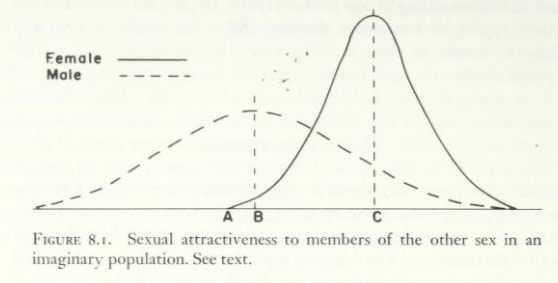
[average male (B) granted favour by most females, average female (C) is granting favour to most males, left of (A) are mostly incels.]
page 278
And among free-ranging Indian rhesus monkeys, Neville (cited in Agar and Mitchell 1975) reports that the alpha male could suppress the sexual activity of any female in the group, and that females rarely rejected the sexual advances of an extremely dominant, aggressive, and feared male. Rhesus males have been observed to attack the female member of a consort pair when the male member was lower-ranking than the attacker (Carpenter 1942,)
…
In Against Our Will, Susan Brownmiller (1975) popularized the view that rape is not motivated by male sexual desire. Perhaps no major work since Lorenz’s On Aggression has so inadequately documented its major thesis (see Geis 1977 for references to critical reviews); William Styron (1977) writes that Brownmiller provides no insight into “the tragic complexities of sexuality, power and the human will.”
page 280
an opportunity of putting them into practice.” While in everyday life few men either commit rape or fantasize about committing it, everyday life almost never provides opportunities to rape without risk; if most men desire no-cost copulation, the high rates of rape during warfare are understandable.
page 284
But rape also is problematical because its existence threatens the foundations of beliefs which many people not only cherish but believe to be integral to the morality which underpins social order. Rape challenges the notion that men and women are fundamentally sexually similar: women not only do not rape but some, apparently, have great difficulty intuitively conceiving that a sexual desire could result in forcible rape. And rape challenges the notion that the living world is naturally harmonious, disrupted only by sin, weakness, or pernicious social systems.
Many feminists call attention to male anger as a motive in some rapes but fail to note what is obvious in many interviews with rapists, that the anger is partly sexual, aimed at women because women incite ungratifiable sexual desire. Deliberately provocative behavior or dress is not the key issue: women inspire male sexual desire simply by existing.
page 285
Given sufficient control over rearing conditions, no doubt males could be produced who would want only the kinds of sexual interactions that women want; but such rearing conditions might well entail a cure worse than the disease.
page 290 -291
In addition, late-treated AGS women reported visual and narrative stimuli to be erotically arousing as often as touching and caressing; such arousal was specifically genital and, in the absence of a partner, frequently led to masturbation (Ehrhardt, Evers, and Money 1968, Money 1973). These women tended to exhibit clitoral hypersensitivity and an autonomous, initiatory, appetitive sexuality which …. investigators have characterized as evidencing a high sex drive or libido (Money 1961, 1965, Ehrhardt, Evers, and Money 1968, Lev-Ran 1974). In some cases, cortisone therapy reduced clitoral hypersensitivity and spontaneous sex drive without reducing sexual responsiveness:
It is noteworthy that none reported a post-treatment cessation of erotic sensitivity in the clitoral zone-only of erectile autonomy and hypersensitivity of the clitoris, or of its amputated stump. What they lost, therefore, was that autonomous initiatory eroticism of the phallus which seems to be so basic in the eroticism of men. The women were all unequivocally pleased to be relieved of clitoral hypersensitivity; it was the pleasure of being able to feel like a normal woman, several of them explained (Money 1961:1392).
page 307
Plasticity is a double-edged sword: the more flexible an organism is the greater the variety of maladaptive, as well as adaptive, behaviors it can develop; the more teachable it is the more fully it can profit from the experiences of its ancestors and associates and the more it risks being exploited by its ancestors and associates; the greater its capacity for learning morality the more worthless superstitions, as well as traditions of social wisdom, it can acquire; the more cooperatively inter dependent the members of a group become the greater is their collective power and the more fulsome are the opportunities for individuals to manipulate one another; the more sophisticated language becomes the more subtle are the lies, as well as the truths, that can be told.
Hence I argued that the evolutionary, elaboration of the cerebral cortical superstructure that makes human plasticity possible entailed a concomitant elaboration of a nonplastic motivational substructure. If selection has always been potent at the level of the individual, individuals must have “innate” mechanisms, probably best conceived as emotional/motivational mechanisms, to recognize and look after their own reproductive “interests.” Thus humans cannot be merely passive vehicles by which society and culture perpetuate themselves, whether society and culture are understood as systems, as they often are, or as collections of discrete components, as Dawkins (1976) understands them. Dawkins argues that bits of culture are, like viruses, self-replicating parasites on human beings, but his analogy shows precisely why this view must be incomplete: in environments containing pathogenic viruses, selection favors the most resistant individuals.
…
Unlike all other mammals, human reproductive competition осcurred in social milieus of enormous complexity. It was, I believe, the complexity of sexual opportunity and constraint in natural human environments that made adaptive a human psyche uniquely informed by sexuality. That individual reproductive “interests” must in some degree conflict with one another may account for the intensity of human sexual emotions, the pervasive interest in other people’s sex lives, the frequency with which sex is a subject of gossip, the universal seeking of privacy for sexual intercourse, the secrecy and deception that surround sexual activities and make the scientific study of sex so difficult, the universal existence of sexual laws or rules, and the fact that in our own society “morals” has come to refer almost exclusively to sexual matters.
page 311
Female sexuality seems to be generally less rigidly channeled than male sexuality. At swingers’ parties in the United States, for example, over 90 percent of the (presumably heterosexual) women find that they enjoy sex with other women, while male swingers almost never have sex with other men (Bartell 1971). Recall, too, that AGS women were unequivocally happy about the changes cortisone therapy induced in their sexuality. They said that they liked being able to feel like normal women, but perhaps they also enjoyed the increased freedom from reflexlike responses to external stimuli and from internal sexual pressures. Neither their clitoral sensitivity nor, presumably, their capacity for sexual pleasure were impaired by cortisone: in essence, they lost sexual compulsion without losing sexual possibility.
Because the sexual variability of the human female far exceeds that of the male it is harder for women than for men to understand intuitively the sexual experiences and feelings of some members of their own sex:
Because there is such wide variation in the sexual responsiveness and frequencies of overt activity among females, many females are incapable of understanding other females. There are fewer males who are incapable of understanding other males. Even the sexually least responsive of the males can comprehend something of the meaning of the frequent and continuous arousal which some other males experience.
But the female who goes through life or for any long period of years with little or no experience in orgasm, finds it very difficult to comprehend the female who is capable of several orgasms every time she has sexual contact, and who may, on occasion, have a score or more orgasms in an hour. To the third or more of the females who have rarely been aroused by psychologic stimuli, it may seem fantastic to believe that there are females who come to orgasm as the result of sexual fantasy, without any physical stimulation of their genitalia or of any other part of their body (Kinsey et al. 1953:538-39).
Perhaps female sexual variability accounts for the fact that one woman psychiatrist can argue, on the basis of the female’s capacity for multiple orgasms, that human females are sexually insatiable (Sherfey 1972), while a second woman psychiatrist can question the very existence of multiple orgasms (Shainess 1976).
page 312
… it is a reasonable hypothesis that the human female’s capacity for orgasm is no more an adaptation than is the ability to learn to read. If, throughout most of human evolutionary history, the potentials of females sexuality were very rarely realized, these potentials would have been largely “invisible” to natural selection, and this may account for the astonishing sexual plasticity of the human female.