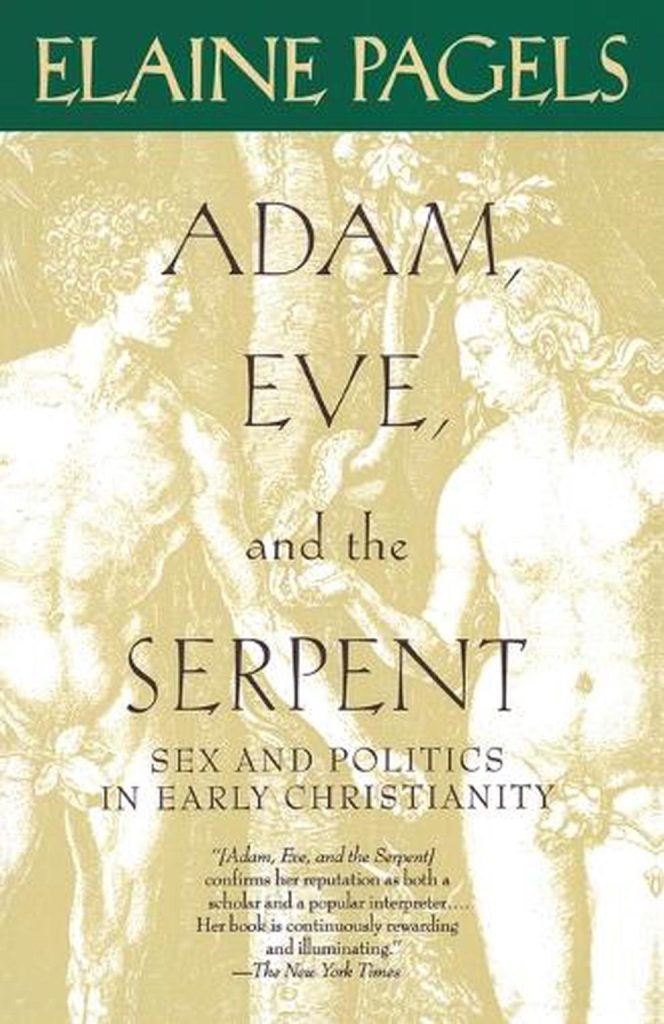
Adam, Eve And the Serpent by Elaine Pagels
Augustine, one of the greatest teachers of western Christianity, derived many of these attitudes from the story of Adam and Eve: that sexual desire is sinful; that infants are infected from the moment of conception with the disease of original sin; and that Adam’s sin corrupted the whole of nature itself.
I soon began to see that the sexual attitudes we associate with Christian tradition evolved in western culture at a specific time — during the first four centuries of the common era, when the Christian movement, which had begun as a defiant sect, eventually transformed itself into the religion of the Roman Empire. I saw, too, that these attitudes had not previously existed in their eventual Christian form; and that they represented a departure from both pagan practices and Jewish tradition. Many Christians of the first four centuries took pride in their sexual restraint; they eschewed polygamy and often divorce as well, which Jewish tradition allowed; and they repudiated extramarital sexual practices commonly accepted among their pagan contemporaries, practices including prostitution and homosexuality.
…
By the beginning of the fifth century, Augustine had actually declared that spontaneous sexual desire is the proof of — and penalty for — universal original sin, an idea that would have baffled most of his Christian predecessors, to say nothing of his pagan and Jewish contemporaries.
…
Augustine, one of the greatest teachers of western Christianity, derived many of these attitudes from the story of Adam and Eve: that sexual desire is sinful; that infants are infected from the moment of conception with the disease of original sin; and that Adam’s sin corrupted the whole of nature itself. Even those who think of Genesis only as literature, and those who are not Christian, live in a culture indelibly shaped by such interpretations as these.
Page 7
Although Paul acknowledged that marriage was not sin (1 Corinthians 7:3), he encouraged those who were able to renounce it to do so. Paul invoked the creation account to urge Christians to avoid prostitution (1 Corinthians 6:15-20), and later to argue that women must veil their heads in church, apparently to acknowledge their subordination to men as a kind of divine order given in nature (“For man was not made from woman, but woman from man. Neither was man created for woman, but woman for man,” 1 Corinthians 11:3-16).
…
On the contrary, said Clement of Alexandria (c. 180 C.E.), conscious participation in procreation is “cooperation with God in the work of creation.” Adam’s sin was not sexual indulgence but disobedience; thus Clement agreed with most of his Jewish and Christian contemporaries that the real theme of the story of Adam and Eve is moral freedom and moral responsibility. Its point is to show that we are responsible for the choices we freely make — good or evil — just as Adam was.
Page 9
for nearly the first four hundred years of our era, Christians regarded freedom as the primary message of Genesis 1-3 — freedom in its many forms, including free will, freedom from demonic powers, freedom from social and sexual obligations, freedom from tyrannical government and from fate; and self-mastery as the source of such freedom. With Augustine, as I show in Chapter 5, this message changed. In the late fourth century, Augustine was living in an entirely different Christian world — one that Justin and his contemporaries could hardly have imagined — for Christianity was no longer a dissident sect.
Page 60
The famous Galen, for example, personal physician to the emperor Marcus Aurelius and the imperial family, admired Christian courage and “abstinence from the use of the sexual organs.”
When the Christian philosopher Justin wrote to the same emperors to defend his fellow Christians, he boasted that they were people who had completely changed their attitudes and behavior in matters of sex, money, and racial relations: We, who used to take pleasure in immorality, now embrace chastity alone; we, who valued above everything else the acquisition of wealth and possessions, now bring what we have into common ownership, and share with those in need; we, who hated and destroyed one another, refusing to live with those of a different race, now live intimately with them.
Page 63
Tertullian, for example, took Genesis 3 as an opportunity to warn his “sisters in Christ” that even the best of them were, in effect, Eve’s coconspirators:
“You are the devil’s gateway. . . you are she who persuaded him whom the devil did not dare attack . . . Do you not know that every one of you is an Eve? The sentence of God on your sex lives on in this age; the guilt, of necessity, lives on too.”
…
the fourth-century Christian ascetic Jerome will insist, as we shall see, that Adam and Eve were originally meant to be virgins, and were joined in marriage only after they sinned and were expelled in disgrace “from the Paradise of virginity.”
Gnostic Christians, on the other hand, castigated the orthodox for making the mistake of reading the Scriptures — and especially Genesis — literally, and thereby missing its “deeper meaning.”
Page 65
The gnostic text called Interpretation of the Soul, for example, tells how the soul, represented as Eve, became alienated from her spiritual nature, and so long as she denied that spiritual nature and distanced herself from it, she fell into self-destruction and suffering. But when she became willing to be reconciled and reunited with her spiritual nature, she once again became whole; the gnostic author explains that this process of spiritual self-integration is the hidden meaning of the marriage of Adam and Eve: “This marriage has brought them back together again, and the soul has been joined to her true love, her real master,” that is, to her spiritual self.
Page 66
According to the gnostic text called Reality of the Rulers, when Adam first recognized Eve, he saw in her not a mere marital partner but a spiritual power:
And when he saw her, he said, “It is you who have given me life: you shall be called Mother of the Living [Eve]; for it is she who is my Mother. It is she who is the Physician, and the Woman, and She Who Has Given Birth.”
Page 67
Some gnostics dared go further: instead of blaming the human desire for knowledge as the root of all sin, they did the opposite and sought redemption through gnosis. And whereas the orthodox often blamed Eve for the fall and pointed to women’s submission as appropriate punishment, gnostics often depicted Eve — or the feminine spiritual power she represented — as the source of spiritual awakening.
…
The Valentinian author of the Gospel of Philip, speaking in mythic language, said, for example, that death began when “the woman separated … from the man” — that is, when Eve (the spirit) became separated from Adam (the psyche). Only when one’s psyche, or ordinary consciousness, becomes integrated with one’s spiritual nature — when Adam, reunited with Eve, “becomes complete again” — can one achieve internal harmony and wholeness.
Page 85
About five years later, a friend traveling from Rome brought to Jerome’s monastic cell in Bethlehem a copy of a writing that challenged the supremacy of asceticism over married life. Its author, Jovinian, himself a celibate Christian monk, argued that celibacy in itself is no holier than marriage and accused certain fanatical Christians of having invented — and then having attributed to Jesus and Paul — this “novel dogma against nature.”
…
Such proposals brought upon their author a storm of abuse. Led by three future saints of the church — Jerome, Ambrose, and their younger contemporary Augustine — Pope Siricius, bishop of Rome, condemned what he called Jovinian’s scriptura horrifica and, to protect innocent believers from what he called this “dangerous heresy,” excommunicated him.
Page 87
Jerome declares that Jesus himself remained “a virgin in the flesh and a monogamist in the spirit,” faithful to his only bride, the church, and adds that “although I know that crowds of matrons will be furious at me,… I will say what the apostle [Paul] has taught me…. indeed in view of the purity of the body of Christ, all sexual intercourse is unclean.” 53 In such passages Jerome expresses a loathing for the flesh, the revulsion of a man ashamed of his own past sexual conduct, as he himself admitted. Other advocates of celibacy, however, from Clement to such married Christians as Tertullian in his early years 54 and Gregory of Nyssa, express no such revulsion. Indeed, much of the evidence we have surveyed suggests that loathing for the flesh was not, as some have tried to argue, the basis for advocating celibacy, although, in cases like Jerome’s, such responses no doubt intensified the inclination toward celibacy.
Page 93
[John] Chrysostom explains specifically what kind of case he has in mind: “If a married man has intercourse with a female slave, it seems to be nothing to pagan laws, nor to people in general.” 15 Most people, he admits, would laugh at anyone who tried to bring such a case to court, and the judge would dismiss it. The same is true for a married man involved with an unmarried woman or with a prostitute.
Page 99
Specifically, Augustine concludes, “the sexual desire [libido] of our disobedient members arose in those first human beings as a result of the sin of disobedience . . . and because a shameless movement [impudens motus ] resisted the rule of their will, they covered their shameful members.”
Page 100
What impresses Augustine most is that such arousal functions independently of the will’s rightful rule: “Because of this, these members are rightly called pudenda [parts of shame] because they excite themselves just as they like, in opposition to the mind which is their master, as if they were their own masters. ” Sexual excitement differs from other forms of passion, Augustine contends, since in the case of anger and the rest, it is not the impulse that moves any part of the body but the will, which remains in control and consents to the movement. An angry man makes a decision whether or not to strike; but a sexually aroused man may find that erection occurs with alarming autonomy. Augustine considers this irrefutable evidence that lust (libido), having wrested the sexual organs from the control of the will, now has “brought them so completely under its rule that they are incapable of acting if this one emotion [libido] is lacking.”
Page 113
certain Christians — including Pelagius, a devout Catholic ascetic from Britain — influenced by Greek science and philosophy, argued in his later teaching that human desires and human will, in themselves, have no effect on natural events — that humanity neither brought death upon itself nor could it, by an act of will, overcome death: death was in the nature of things, despite the clear statement to the contrary in Genesis.
…
During his later years, as we have seen, Augustine argued against those who agreed with John Chrysostom, 2 and then against followers of Pelagius, both of whom insisted that Christians, through their baptism, are free to make moral choices; that, although our will cannot affect the course of nature, it can — and must — effect our moral decisions. By 417, the city of Rome was so divided between the supporters and the opponents of Pelagius that partisans of both sides had actually rioted in the streets.
Page 127
Had Augustine’s theory not met such a need — were it not that people often would rather feel guilty than helpless — I suspect that the idea of original sin would not have survived the fifth century, much less become the basis of Christian doctrine for 1600 years.
Page 128
If guilt is the price to be paid for the illusion of control over nature — if such control is, as Julian argued, in fact, an illusion — many people have seemed willing to pay it.
Second note – some duplication
Paul invoked the creation account to urge Christians to avoid prostitution (1 Corinthians 6:15-20), and later to argue that women must veil their heads in church, apparently to acknowledge their subordination to men as a kind of divine order given in nature (“For man was not made from woman, but woman from man. Neither was man created for woman, but woman for man,” 1 Corinthians 11:3-16)
…
Clement agreed with most of his Jewish and Christian contemporaries that the real theme of the story of Adam and Eve is moral freedom and moral responsibility
..
for nearly the first four hundred years of our era, Christians regarded freedom as the primary message of Genesis 1-3 — freedom in its many forms, including free will, freedom from demonic powers, freedom from social and sexual obligations, freedom from tyrannical government and from fate; and self-mastery as the source of such freedom.
…
Augustine’s theory of original sin not only proved politically expedient, since it persuaded many of his contemporaries that human beings universally need external government — which meant, in their case, both a Christian state and an imperially supported church — but also offered an analysis of human nature that became, for better and worse, the heritage of all subsequent generations of western Christians and the major influence on their psychological and political thinking
…
Other Jewish teachers of Jesus’ time, and for generations before, had pronounced certain pagan sexual practices abominable. … To ensure the stability and survival of the nation, Jewish teachers apparently assumed that sexual activity should be committed to the primary purpose of procreation.
Prostitution, homosexuality, abortion, and infanticide, practices both legal and tolerated among certain of their pagan neighbors, contradicted Jewish custom and law.
…
George Bernard Shaw was wrong when he accused Paul of inventing religious celibacy…necessity to prepare for the end of the world, and to free oneself for the “age to come.”
…
Tertullian boasted, “we hold everything in common but our spouses,” exactly reversing the practice in outside society, where, he said sardonically, most people voluntarily share nothing else! 68
…
Justin, in his Defense of the Christians, complained that “not only the females, but also the males” were commonly raised “like herds of oxen, goats, or sheep,” as a profitable crop of child prostitutes.
…
The casual sexual behavior that many pagans took for granted — homosexual encounters among mentors and friends at the baths, or the sexual use of slaves and prostitutes — were rejected by most Christians, who simultaneously rejected homosexuality, contraception, abortion, and infanticide.
…
Forces conjured by such names as Aphrodite and Eros, who overpowered their multiple human lovers, must now yield themselves, like beasts before a lion tamer, to the rational will.
…
Methodius, a celibate Asian Christian… (martyred c. 260), wrote a famous polemic against the “great lie” of Greek philosophy and education — namely, the conviction that destiny, fate, and necessity are actual, external forces in the universe that control human affairs, and that sexual desire, like destiny, is beyond human control.
Methodius’s polemic was a deliberate parody of Plato’s Symposium, in which Plato praised the power of Eros — sexual desire — as one of the great cosmic forces.
…
For women, as several women historians recently have demonstrated, celibacy sometimes offered immediate rewards on earth, as well as eventual rewards in heaven. We have seen how Thecla’s own story celebrated a young woman’s achievement of autonomy as a “holy woman,”
…
Jovinian, himself a celibate Christian monk, argued that celibacy in itself is no holier than marriage and accused certain fanatical Christians of having invented — and then having attributed to Jesus and Paul — this “novel dogma against nature.”
…
Led by three future saints of the church — Jerome, Ambrose, and their younger contemporary Augustine — Pope Siricius, bishop of Rome, condemned what he called Jovinian’s scriptura horrifica and, to protect innocent believers from what he called this “dangerous heresy,” excommunicated him.
…
Jerome declares that Jesus himself remained “a virgin in the flesh and a monogamist in the spirit,” faithful to his only bride, the church, and adds that “although I know that crowds of matrons will be furious at me,… I will say what the apostle [Paul] has taught me…. indeed in view of the purity of the body of Christ, all sexual intercourse is unclean.” 53 In such passages Jerome expresses a loathing for the flesh, the revulsion of a man ashamed of his own past sexual conduct, as he himself admitted. Other advocates of celibacy, however, from Clement to such married Christians as Tertullian in his early years 54 and Gregory of Nyssa, express no such revulsion. Indeed, much of the evidence we have surveyed suggests that loathing for the flesh was not, as some have tried to argue, the basis for advocating celibacy,
…
Yet as Augustine grew older, he argued that even the most saintly ascetic was not, in himself, capable of self-mastery; that all humankind was fallen; and that the human will was incorrigibly corrupt. This cataclysmic transformation in Christian thought from an ideology of moral freedom to one of universal corruption coincided, as we shall presently see, with the evolution of the Christian movement from a persecuted sect to the religion of the emperor himself.
…
Chapter V
Gregory of Nyssa: Preeminent among all is the fact that we are free from any necessity, and not in bondage to any power, but have decision in our own power as we please; for virtue is a voluntary thing, subject to no dominion. Whatever is the result of compulsion and force cannot be virtue.
…
Yet with Augustine, in the late fourth and early fifth centuries, this message changed. The work of his later years, in which he radically broke with many of his predecessors, and even with his own earlier convictions, effectively transformed much of the teaching of the Christian faith. Instead of the freedom of the will and humanity’s original royal dignity, Augustine emphasizes humanity’s enslavement to sin. Humanity is sick, suffering, and helpless, irreparably damaged by the fall, 6 for that “original sin,”
Augustine insists, involved nothing else than Adam’s prideful attempt to establish his own autonomous self-government. 7 Astonishingly, Augustine’s radical views prevailed…
…
John Chrysostom: But yet to these wise men sexual immorality is unworthy of punishment; at least, none of the pagan laws . . . bring men to trial for this reason.” 14 Chrysostom explains specifically what kind of case he has in mind: “If a married man has intercourse with a female slave, it seems to be nothing to pagan laws, nor to people in general.” 15 Most people, he admits, would laugh at anyone who tried to bring such a case to court, and the judge would dismiss it. The same is true for a married man involved with an unmarried woman or with a prostitute.
…
That semen itself, Augustine argues, already “shackled by the bond of death,” transmits the damage incurred by sin. 54 Hence, Augustine concludes, every human being ever conceived through semen already is born contaminated with sin.
…
Augustine, on the contrary, having denied that human beings possess any capacity whatever for free will, accepts a definition of liberty far more agreeable to the powerful and influential men with whom he himself wholeheartedly identifies.
…
Yet far beyond his lifetime, even for a millennium and a half, the influence of Augustine’s teaching throughout western Christendom has surpassed that of any other church father. There are many reasons for this, but I suggest, as primary among them, the following: It is Augustine’s theology of the fall that made the uneasy alliance between the Catholic churches and imperial power palatable — not only justifiable but necessary — . for the majority of Catholic Christians.
…
In our present state of moral corruption, what we need spiritually is divine grace, and what we need practically is external authority and guidance from both church and state.
…
If not for the restraints imposed by Christian marriage, “people would have intercourse indiscriminately, like dogs.” Julian calls sexual desire “vital fire”; but Augustine admonishes us: Behold the “vital fire” which does not obey the soul’s decision, but, for the most part, rises up against the soul’s desire in disorderly and ugly movements.
…
For quite apart from political circumstances, many people need to find reasons for their sufferings. Had Augustine’s theory not met such a need — were it not that people often would rather feel guilty than helpless — I suspect that the idea of original sin would not have survived the fifth century, much less become the basis of Christian doctrine for 1600 years.
…
such guilt, however painful, offers reassurance that such events do not occur at random but follow specific laws of causation; and that their causes, or a significant part of them, lie in the moral sphere, and
so within human control.
Download: Adam_Eve_and_the_Serpent-Sex_and_Politics_in_Early_Christianity-Pagels_E