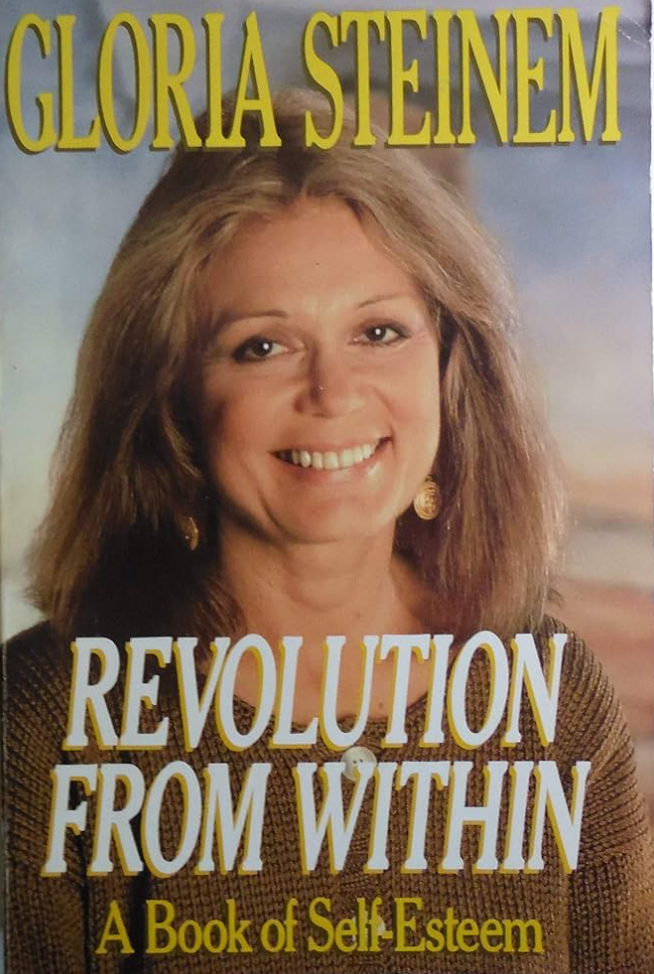
Revolution from within: A book of self-esteem
by Gloria Steinem.
If men had grown up seeing God portrayed only as Mother and She, would they feel an equal godliness within themselves?
https://archive.org/details/revolutionfromwi0000glor_d4m4
page 11
In Romania, where the Communist government had outlawed abortion and contraception in its effort to force women to bear children, “Liberty, Democracy, and Abortion” was the official motto of the revolution, and the banner behind which both men and women marched through the streets. President Ceausescu had inspired this rebellion by declaring, “The fetus is the socialist property of the whole society,” a conviction shared by anti-abortion movements in other countries, and he had required all employed women up to age forty-five to submit to regular fertility exams or be punished like military “deserters.” As we saw so poignantly on television after he was overthrown, the result was nurseries full of malnourished, un-held, unloved children, many of whose mothers had died or been imprisoned because of illegal abortions, thus leaving their other children uncared for. “The state tried to own women, invade their bodies, compel their motherhood, kill their souls,” said Gabriela Bocec, head of the Romanian Nurses’ Association, who had seen the dimensions of suffering among women and children with her own eyes. “We marched out of self-respect.”
…
page 22
But not until sometime in my thirties did I begin to suspect that there might be an internal center of power I was neglecting. Though the way I’d grown up had encouraged me to locate power almost anywhere but within myself, I began to be increasingly aware of its pinpoint of beginning within – my gender and neighborhood training notwithstanding.
…
page 47
She didn’t stay with that first lover, but she did form a loving partnership with another “Lifelong Lesbian,” as Marilyn [Murphy] would say.
In 1976, they were among the founding mothers of Califia Community, named for the goddess of the once-united land of Mexico and California. For a decade, she helped to organize and run week-long women’s retreats on the hard subjects of class, race, homophobia, divisions of age, ethnicity, appearance, and able-bodiedness – all the divisions that keep women from working together. About 4,000 women passed through these Califia sessions over ten years, and they continue to play crucial roles in keeping women’s groups around the country together, in spite of societal pressures trying to break them apart.
As for Marilyn herself, she now travels around the country, speaking, working as a conference organizer with her longtime lover and colleague, Irene Weiss, creating new feminist projects with their vast network of activists and friends, and also visiting Marilyn’s seven grandchildren. Since 1982, she has written warm and wise columns that, in The Lesbian News and in book form, have helped many other women find their true selves. It is from these essays – along with our telephone talks from her stops around the country – that her words here are taken. One of her chief hopes is to help establish bodily integrity as a fundamental human right: a legal umbrella that would guarantee women’s right to make sexual choices without punishment, the right to reproductive freedom, protection for poor women against being used as surrogate mothers, for poor people against pressure to become sources of transplants and transfusions for the well-to-do – all the ways in which bodies are owned or exploited. It would make clear, once and for all, for both women and men, that the power of the state stops a our skins.
Most recently, she has come to see incest and other childhood sexual abuse as, in her words, “a preverbal sexual terrorism that breaks the female spirit, and makes women continue to believe terrible things will happen to them if they tell men’s secrets.”
…
page 73
In For Your Own Good, Alice Miller, a pioneer in tracing the origins of destructiveness to childrearing, writes about what she calls “poisonous pedagogy,” the process of breaking a child’s spirit so that the adult can have easy control – all done supposedly out of love, to save the child from later sufferings due to lack of discipline, and thus, as parents so often say, “for your own good.” She sums up the central tenets of childrearing manuals that were popular in Europe – especially Germany – and much admired in this country as well through the first decades of this century. Some are still alarmingly familiar.
I. Adults are the masters (not the servants!) of the dependent child.
2. They determine in godlike fashion what is right and what is wrong.
3. The child is held responsible for their anger.
4. The parents must always be shielded.
5. The child’s life-affirming feelings pose a threat to the autocratic adult.
6. The child’s will must be “broken” as soon as possible.
7. All this must happen at a very early age, so the child “won’t notice” and will therefore not be able to expose the adults.
…
page 125
“We have long known that rape has been a way of terrorizing us and keeping us in subjection,” writes the distinguished historian Gerda Lerner. “Now we also know that we have participated, although unwittingly, in the rape of our minds.”
…
page 163
Perhaps a third of the children in the United States (and many other countries as well) have been subjected to sexual and other kinds of severe abuse or neglect, and there are many other causes of what is now called posttraumatic stress disorder: serious accidents, domestic violence, political torture, war experiences, rape, and prison abuse – to name a few. Frequently, such memories are so painful that they don’t surface fully until years after the events occurred. The more extreme and erratic these events, the younger we were when we experienced them, and the more dependent we were on the people who inflicted them, the more repressed they are likely to be.
…
page 185
Take language, for instance. Many women feel invisible or aberrant when they are subsumed under a masculine term that is supposed to be universal; yet they are often made to feel trivial and nit-picking if they object. But look at it this way: Would a man feel included in “womankind”? Would he refer to himself as “chairwoman,” “Congresswoman,” or “Mr. Mary Smith”? If a male student earned a “Spinster of Arts” degree, a “Mistress of Science,” or had to apply for a “Sistership,” would he feel equal in academia? If men had grown up seeing God portrayed only as Mother and She, would they feel an equal godliness within themselves?
…
page 187
In societies shaped by patriarchy and racial divisions, the prevailing paradigm comes in three parts.
The first is the either/or way of thinking that divides almost everything in two. “Masculine” and “feminine,” subject and object, light skin and dark skin, dominant and passive, intellect and emotion, mind and body, winner and loser, good and evil, the idea that there are “two sides to every question” – all these are the living results of bipartite thinking. In older and more subtle cultures, each half was equally necessary to the other (as in the yin and yang of Eastern thought), but even that division had its origins in the division of human qualities into “masculine” and “feminine.” The more unequal this genderized dyad became, the more it turned into the next part of the paradigm: linear thinking. Rating and grading people, the notion that all accomplishment lies in defeating others, even a linear view of abstractions like time and history – all these things were organized by the same paradigm. Since a straight line was too simplistic to be practical for most human interactions, however, it split into the third and last part of the paradigm: hierarchy. The pyramid or the classic organizational chart became the grid through which many cultures were to see the world for centuries: from a “male-headed” household to corporate structures in which all authority flows from the top; from hierarchical class-rooms to religions in which God’s will is interpreted by a pope or ayatollah.
…
page 202
SEXUALITY Orgasm and other forms of sexual expression are such a source of self-affirmation that two thirds of psychiatrists believe people “nearly always or often” lose self-esteem when deprived of a “regular outlet for sexual gratification.”4 In fact, it is so central to our being that, as countless studies have shown, masturbation is instinctive from a very early age. In later life, sexuality and sensuality are also ways we express ourselves and “talk” to each other: unlike other animals, for whom sex seems to be focused in times of “heat” or estrus when conception is most likely, human sexual pleasure exists independent of conception, and so is a way we communicate as well as procreate. Given gender politics, however, men may be so genitally focused that they miss whole-body sensuousness, while women may focus so much on sensuous cuddling that the sense of inner power that orgasm brings is underplayed .* Once again, progress lies in completing the circle, exploring in the direction we have not been.
*”The elimination of clitoral sexuality,” as Freud wrote in Sexuality and the Psychology of Love, “is a necessary precondition for the development of femininity.” As in so many areas, women were asked to choose between “femininity” and self-esteem.
…
page 214
What could we become if we had a whole-body, all-five-senses upbringing? Only children of the future may know, but for now, we have an inspiring clue in the life of anthropologist Margaret Mead.
From infancy, she was encouraged – by her mother, a sociologist, and especially by her paternal grandmother, an innovative schoolteacher and free-thinker – to explore the world around her in every way she or they could imagine. Diverse toys and physical challenges, colors and textures, music, art, and perhaps most important, permission to get dirty and make a mess – all these were part of Margaret’s preschool life. Each night her grandmother talked to her about the day’s events while she brushed the little girl’s hair, giving her the experience of being treated as an equal that is a shared theme in the childhoods of many “gifted” children.10 By four, as Margaret later wrote, “I was treated as a full person, whose opinions were solicited and treated seriously.”
…
page 215
And for the rest of her life, she was able to convince both men and women that she herself was “the belle of the season.”
…
With such body-mind unity, she also moved in and out of her unconscious with ease. She might decide what to dream about and then do so, often solving problems in this way. Or she might examine her dreams to see what treasures her creative unconscious had come up with on its own. When planning a speech, she first saw images; and when asked to describe people or a culture, she focused on precisely how they did their work, built their fishing boats, or raised their children – a love of the particular and ordinary that helped make her a brilliant anthropologist.
As her friend and student, futurist Jean Houston, characterized Margaret’s education: “Dualisms were discouraged; she was trained to accept the unity of mind and body, thinking and feeling.”
…
page 259
As four family therapists found in a study of abusive relationships, it is precisely when men and women conform to traditional roles most rigidly that abuse is most likely to occur. In their words: “Abusive relationships exemplify, in extremis, the stereotypical gender arrangements that structure intimacy between men and women generally.”9 And, of course, this violence also has the larger political purpose of turning half the population into a support system for the other half. It polices and perpetuates gender politics by keeping the female half fearful of the moods and approval of the male half. In fact, patriarchy requires violence or the subliminal threat of violence in order to maintain itself.
…
page 264
So I reverted to a primordial skill that I hadn’t used since feminism had helped me to make my own life: getting a man to fall in love with me. As many women can testify, this is alarmingly easy, providing you’re willing to play down who you are and play up who he wants you to be.
…
page 307
I wondered: How many women have been wounded in their souls by religions that believe God is a man, and thus only men are godly? Her story suddenly seemed thousands of years old – with the difference that she was one of the few with enough independence to know it was unjust and say so. Having had the strength to reject the Bible stories that showed Jesus, a Middle Eastern Jew, as snub-nosed and blond, she had acquired the courage to question; yet in her black community, she had support for a rebellion based on race, but not on sex. Her beloved church and preacher, the strongest forces in her life, felt they had the Bible itself behind them when they devalued her as a woman. For every verse she found about women as equal believers, they could find ten preaching female obedience.
…
page 311
I thought: How could we have let body and spirit, sexuality and spirituality, be split apart?
In later temples and tombs, I noticed divinities in human form that were both male and female; for instance, Hapy, god of the Nile itself, who has breasts but wears a male headdress. Some were both animal and human, like Taweret, the Great Feminine One, goddess of pregnancy, who stands upright and has the body and head of a hippopotamus, the feet of a lion, and often the image of a crocodile down her back. It seemed right that pregnancy in both human and animal form should be worshiped as the symbol of creation the moment when there is the first movement of a new life.
I thought: Why should we worship a male-only god who makes women feel ungodly, and men feel they must be godlike? Why have we traded the mystery of birth for life created from dust?
As we continued our journey, I noticed that goddess figures were beginning to give birth only to sons. A little later in historical time, the sons became larger, then larger still as they turned into consorts, and then even larger as they became male rulers seated on the lap of a goddess who had become only a throne.
I thought: It’s beginning; half of humanity is becoming more sacred than the other. Did the mothers rage? Did the daughters mourn?
Soon, there were male gods and kings who were larger than their female consorts. They were still goddesses, but the Great Cosmic Mother had been shattered into her separate parts: Isis, the Goddess of Wisdom; Maat, the Goddess of Moral Judgment; Hathor, Goddess of Life; Mehet-weret, Goddess of Death, who wel-
comed the dead into the underworld. Meanwhile, as Upper and Lower Egypt became one kingdom through conquest, military scenes began to take on an importance once reserved for the harvesting of crops, the grinding of grain, and other scenes of ordinary life. As if this greater power demanded greater tribute, the first pyramids also began to appear, and pharaohs called themselves Son of Re or Amun-Re, the male god of the sun, as though feeling no need of any mother or goddess-given authority at all.
…
page 313
This trip down the Nile was like living through the steps to patriarchy that Joseph Campbell described in The Masks of God, his study of Western mythology: a world created by a great goddess, a world created by both a goddess and her consort, a world created by a male from the body of the goddess, and finally, a world created by a male god alone.
But reading James Henry Breasted, the early-twentieth-century scholar of ancient Egypt, I found this process put more simply: “Monotheism is but imperialism in religion.”
…
page 317
All of these abilities have been demonstrated – and verified through a wide variety of double-blind tests, brain scanning, and other objective techniques – in people who have what is called “multiple personality disorder,” or MPD. As is now known, MPD is almost always the result of frequent, sadistic, erratic, and uncontrollable abuse in childhood by someone on whom the child is dependent; abuse so intolerable that children learn to dissociate from it through a form of self-hypnosis and so escape into a “different” person who does not feel the pain.
…