Hysteria Beyond Freud
ed. Sander Gilman. 1993.
Although the diagnosis of hysteria in both women and men has virtually disappeared in our time, in practice its symptoms have been transformed into the medically sanctioned ‘conversion syndrome’ and then (mysteriously and perplexingly) have gone underground. It is easy to forget that the ancient threat of an invasive and irrepressible female sexuality, a patent menace in epochs studied in this chapter, is in the lay imagination today far from having been removed.
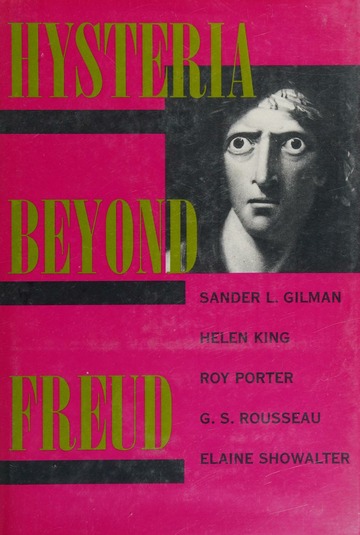
Chapter Two “A Strange Pathology” by G.S. Rousseau
page 93
“Although the diagnosis of hysteria in both women and men has virtually disappeared in our time, in practice its symptoms have been transformed into the medically sanctioned ‘conversion syndrome’ and then (mysteriously and perplexingly) have gone underground. It is easy to forget that the ancient threat of an invasive and irrepressible female sexuality a patent menace in epochs studied in this chapter, is in the lay imagination today far from having been removed in our own time. Indeed the social oppression of women throughout history has only recently – since the 18th century – been acknowledged in any organised way and this restraint bears serious implications for hysteria.”
Note 5
Female sexuality is not, of course, synonymous with feminism or any other political women’s movement; what I designate by the threat of female sexuality in history is eloquently discussed in Caroline Bynum, ed., Gender and Religion: On the Complexity of Symbols (Boston: Beacon Press 1986); Elaine Showalter, The Female Malady: Women, Madness and English Culture 1830 – 1980 (London: Virago 1987); Susan Rubin Suleiman, ed., The Female Body in Western Culture: Contemporary Perspectives (Cambridge, Mass.: Harvard University Press, 1985.
Page 134
“No matter what it’s medicalization has been, hysteria, at least until the early nineteenth century, has been so inexplicably entwined with the lot of women that the two can hardly be separated. Unquenchable sexual appetite was long thought to lie at the very root of the malady, especially by theologians and moralists in early Christian times. And the noteworthy aspect of this voracious female desire in both its pagan and Christian forms is that besides being inherently contagious it was conceptualized as morally dangerous (to the individual family unit, state, world community). Other women, observing its effects, would imitate it and develop their own versions. This voraciousness instilled male fear (engendering a type of male hysteria); the other dimension – contagion – was construed as a virulent form of miasma which patriarchy has always opposed,
…
But what is the source of this raging female appetite? Is it in fact ultimately theological? Was it due to an innate lewdness within the female anatomy or psyche, arising out of the labia over which women had no control, and which was living proof of a postlapsarian world whose irrepressible, erotic appetite was the scar woman wore for the sin of the edenic apple? Or was the perception of this female appetite something else? Something culturally ordained? Something socially constructed?”
Page 112
Love sickness – widespread in Middle Ages
note 74
Nymphomania invented 1775 by M.D.T. Bienville (also coquette described by Hannah W. Foster in 1797)
Page 114
Love sickness epidemic in Western Europe by 1623
Page 153
Melancholy, madness, hysteria, hypochondria, dementia, spleen, vapours, nerves: by 1720 or 1730 all were jumbled and confused with one another. Witch trials until 1730.
Page 170
Guidott’s…case history of Maplet suggests the existence by approximately 1700 of a new Sydenhamian paradigm about male hysteria
Page 179
For them, hysteria was not a malingering malefactor but a curable condition of the body’s nervous apparatus thrown into convulsion. Hysteria was thus not essentially the inflammation of the reproductive organs unduly excited as it would be again in the 19th century with its retaliative clitoridectomies and antimasturbation techniques, but the nerves labouring under some extraordinary local distress, lesion, or fever.
Page 182
Onania crusades = mass hysteria throughout 18th C
Read to: 254