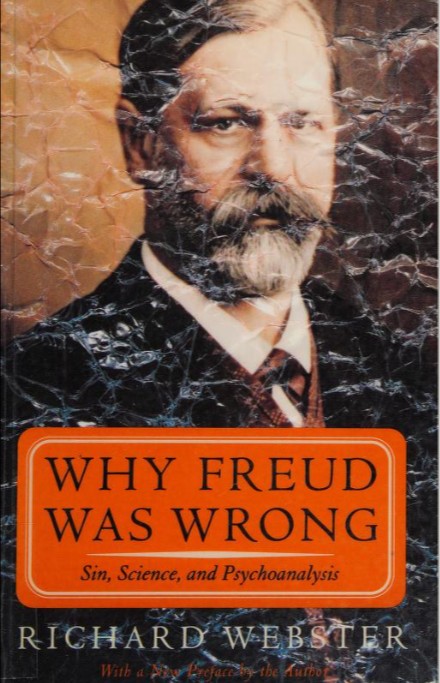
Why Freud was Wrong – Sin Science and Psychoanalysis
October 11, 1995
by Richard Webster.
Perhaps the most interesting, though least remarked feature of Studies on Hysteria is just how unoriginal many of its crucial ideas are. The central argument, namely that the physical symptoms of ‘hysteria’ were actually caused by some traumatic event which lay in the patient’s past was taken directly from Charcot. The contribution made by Freud and Breuer in this regard was not to import any new theory of medical causality, but to broaden the conception of the kind of trauma which might precipitate hysterical symptoms. The therapeutic procedure which they advocated departed quite radically from Charcot’s practice. But it too was derivative rather than original. The notion that some kind of catharsis could be used to offer relief from emotional distress was a very old one indeed, going back to the ancient Greeks and beyond. Indeed, many years before Breuer had treated Anna O., Jacob Bernays, the uncle of Freud’s future wife, had written about the Aristotlian concept of catharsis, engendering a widespread interest in the subject in Vienna.
As early as 1895 Stekel had published an essay on “Coitus in Childhood,” in which he formulated the thesis that sexual impulses which arise spontaneously in every childhood are normal psychological phenomena.
…
“In childhood it is clear how much of what people believe they do by cogitating and exerting their will is to be traced back to instinct. Childhood is the bridge which links homo sapiens with the animal kingdom.” Stekel wanted with this argument to free sexual wishes and behaviour in childhood from prejudice.
writes to Fleiss average 10 days until 1900. Freud later tries to suppress these letters.
1896 April 21st presented the seduction theory to colleagues at the Society for Psychiatry and Neurology in Vienna
The Aetiology of Hysteria(n=18 patients 12 female, not reported that none of whom were successfully cured)
Three groups –
assaults (abuse) by strangers “no question of consent”,
adult caregiver initiates child (“much more numerous” – “a regular love relationship”,
relationships with siblings or other children, often prolonged beyond puberty.
“With our patients, those memories are never conscious”
“The scenes must be present as unconscious memories; only so long as, and in so far as, they are unconscious are they able to create and maintain hysterical symptoms.”
According to the theory, a repressed memory of an early childhoodsexual abuse or molestation experience was the essential precondition for hysterical or obsessional symptoms, with the addition of an active sexual experience up to the age of eight for the latter.
Freud obviously had some awareness of the part he played, but he remained in denial – in 1925 Autobiographical Study he wrote: “I do not believe even now that I forced the seduction-fantasies on my patients, that I ‘suggested’ them”.
In 1925 Freud introduced a new element into the seduction theory: that with the female patients the alleged, or fantasied, seducer nearly always was the father. Neither in his initial articles on the seduction theory, nor in his later remarks of 1905 or 1914, did Freud say that in 1896 he had believed that the fathers were especially implicated.
has abandoned hypnosis, now offering ‘psychoanalysis’, peak of professional isolation except Fleiss
The term ‘psychoanalysis’ (psychoanalyse) was first introduced by Freud in his essay titled “Heredity and etiology of neuroses” (“L’hérédité et l’étiologie des névroses“), written and published in French in 1896
1897 abandons ‘seduction theory’ in letter to Fleiss but not public until 1905 [page 214]
“Then, third, the certain insight that there are no indications of reality in the unconscious, so that one cannot distinguish between truth and fiction that has been cathected with affect. “
1901 praises Fliess’ 1897 book:The Relationship between the Nose and the Female Sexual Organs“a fundamental biological discovery”, treating ‘nasal reflex neurosis’ caused by masturbation, still snorting coke
1902 promoted to university professor, forms Wednesday Psychological Society group
One of the most important roles of the messianic personality has always been that of acting as the fearless transgressor. The messiah is that person who appears to have the inner strength openly to attack established authorities or flout laws and taboos in order to further his chosen cause. It is by systemically transgressing taboos that he relieves his followers of the burden of guilt and anxiety that they would otherwise feel as a result of pitting themselves against their elders, or against established orthodoxies.
Page 15
In one of the most frequently quoted of his remarks, he wrote that: “a man who has been the indisputable favorite of his mother keeps for life the feeling of being a conqueror, that confidence of success which often induces real success. “
Page 104
Anna O. herself referred to this method as her ‘talking cure’ and it was this very general process of what might be called ‘confessional soothing’ which would become one of the prototypes of psychoanalytic therapy.
Page 106
Perhaps the most interesting, though least remarked feature ofStudies on Hysteriais just how unoriginal many of its crucial ideas are. The central argument, namely that the physical symptoms of ‘hysteria’ were actually caused by some traumatic event which lay in the patient’s past was taken directly from Charcot. The contribution made by Freud and Breuer in this regard was not to import any new theory of medical causality, but to broaden the conception of the kind of trauma which might precipitate hysterical symptoms. The therapeutic procedure which they advocated departed quite radically from Charcot’s practice. But it too was derivative rather than original. The notion that some kind of catharsis could be used to offer relief from emotional distress was a very old one indeed, going back to the ancient Greeks and beyond. Indeed, many years before Breuer had treated Anna O., Jacob Bernays, the uncle of Freud’s future wife, had written about the Aristotlian concept of catharsis, engendering a widespread interest in the subject in Vienna.
Page 107
During the Second World War psychiatrists used barbiturates or ether in order to disinhibit patients and supposedly to help them release their ‘repressed memories’ and the emotional reactions associated with these. The use of this kind of drug abreaction sometimes seemed to be extremely effective at restoring emotional vitality to patients suffering from ‘war neurosis’. It is important to recognise, however, that the psychiatrist who used these methods were often not in a position to determine whether the ‘memories’ released by drugs were authentic or not. In this respect it is interesting and significant that psychiatrists did not always find it essential to make a patient recall the precise incident which had supposedly precipitated the breakdown.
Page 109
Whereas the claim that repressedemotionscould engender psychological distress would have been traditional and in some cases perhaps true, the claim made by Freud and Breuer was of a quite different order. For what they believed they had discovered was an aetiological theory which could explain the origins of a particulardiseaseand cure this disease by uncovering repressedmemories.
In this respect too Freud and Breuer, far from being innovators, were following a well-beaten, if relatively recent, path. InThe Discovery of the Unconscious, Henri Ellenberger shows how, during the 19th century, the idea of unburdening oneself by confessing a shameful secret was gradually transferred from religion to medicine.
Page 142
The main agent of historical continuity between the seventeenth century physicians referred to by Willis and the twentieth century neurologists and psychiatrists who are discussed by Slater was, undoubtedly, Jean Martin Charcot.
…
Charcot believed that, although the cause of hysteria was to be found in psychological trauma, it was nevertheless a genuine illness with a real pathology. Freud developed and adapted this view. Specifically he came to believe in the existence of a neurophysiological mechanism whereby the nervous energy created by emotional trauma could be literally transformed into physical symptoms.
…
There are no doubt some psychoanalysts and a few psychoanalytically orientated neurologists who still believe in the reality of the intricate and invisible mechanism which Freud postulated. But medical science has found no evidence for the existence of this mechanism.
Page 161
Elisabeth von R.
“I no longer accepted her declaration that nothing had occurred to her, but assured her that somethingmusthave occurred to her. Perhaps, I said, she had not been sufficiently attentive in which case I would be glad to repeat my pressure. Or perhaps she thought that her idea was not the right one. This, I told her, was not her affair; she was under an obligation to remain completely objective and say whatever came into her head, whether it was appropriate or not. Finally I declared that I knew very well that somethinghadoccurred to her and she was consuming it from me; but she would never be free of her pains so long as she concealed anything. By thus insisting I bought it about that from that time forward my pressure on her head never failed in its effect.”
Page 163
Essay: The Psychotherapy of Hysteria
“It is of use if we can guess the ways in which things are connected up and tell a patient before we have uncovered it….
We need not be afraid, therefore, of telling the patient what we think his next connection of thought is going to be. It will do no harm.”
Page 182
When, in October 1895, Freud had sent to his friend Wilhelm Fliess the two notebooks containing hisProject for a Scientific Psychology,he enclosed a covering letter drawing attention to the crucial role which he had assigned to sexuality.“Just think,” he said, “among other things I am on the scent of the following strict precondition for hysteria, namely, that a primary sexual experience (before puberty), accompanied by revulsion and fright, must have taken place; for obsessional neurosis, that it must have happened, accompanied bypleasure.”In these words we may see the beginnings of what was eventually to become Freud’s ‘seduction theory’ in which he would put forward the idea that all hysterical patients had been sexually seduced as children.
Page 197
“We must not believe what they say, we must always assume, and tell them too, that they have kept something back because they thought it unimportant or found it distressing. We must insist on this, we must repeat the pressure and represent ourselves as infallible till at least we are really told something.”
Page 202
“Before they come for analysis the patients know nothing about these scenes. They are indignant as a rule if we warn them such scenes are going to emerge. Only the strongest compulsion of the treatment can induce them to embark on a reproduction of them. While they are recalling these infantile experiences to consciousness, they suffer under the most violent sensations, of which they are ashamed and which they try to conceal, and even after they have gone through them once more in such a convincing manner, they still attempt to withhold belief from them, by emphasizing the fact that, unlike what happens in the case of other forgotten material, they have no feeling at remembering the scenes.”
Page 216
The most important of all these discoveries would be the theory of infantile sexuality. The ‘official’ version of Freud’s intellectual biography represents this as a major theoretical advance. From the point of view of the development and prosperity of the psychoanalytic movement it most certainly was just that. For the theory of infantile sexuality was much more attractive than the seduction hypothesis both to potential disciples and to potential patients. It also appeared to have a much greater explanatory capacity. One commentator, Walter Kendrick, has even made the interesting suggestions that Freud’s motive for abandoning the seduction theory was not cowardice but a desire to escape from its relative narrowness:
“if neurosis were caused exclusively by violation of children, psychoanalysis would have become merely a specialised form of therapy. Freud was too ambitious for that; he wanted to account for the whole of human culture, all the way back to the caves, and he never could have done that with a technique tailored to a minority. Ambition, then, rather than cowardice, was his motive…”
Page 211
“In the period in which the main interest was directed to discovering infantile sexual traumas, almost all of my women patients told me that they had been seduced by their father. I was driven to recognise in the end that these reports were untrue and so came to understand that hysterical symptoms are derived from fantasies and not from real occurrences.”
Page 326
When [Erich] Fromm seeks to persuade us that Hitler was a pure ‘necrophile’ whereas Albert Einstein, Albert Schweitzer, and Pope John XXIII were pure ‘biophiles’, he talks in the language of modern scientific neologism. Yet his naive desire to divide the world into good and evil evidently springs directly from Judeo-Christian apocalyptic. In this respect Fromm is only grotesquely exaggerating a tendency which is fundamental to classical psychoanalysis and which was originated by Freud himself – the psychoanalytic habit of inventing or exaggerating the differences between human beings – differences between ‘moderns’ and ‘savages’, between the mature personality and the ‘neurotic’, between men and women.
Throughout all the centuries of Christian history there has functioned what the French historian Leon Poliakov has called “that terrible mechanism of projection that consists in attributing to the loathed people of God one’s own blasphemous desires and unconscious corruption.” Millennial movements of the Middle Ages, the great European Witchhunt, modern anti-semitism, and Stalin’s purges have all alike been marked by collective fantasies in which groups identifying themselves is the ‘pure’ have sought to annihilate entire classes of human beings imagined as ‘evil’ or ‘unclean’.
Page 336
For it was part of Freud’s particular genius that, in addition to translating an ancient doctrine of sin into modern biologistic terms, he also found a place for one of the most powerful and binding of all religious institutions – the institute of confession. The aspect of religious ritual which had been renounced by Protestantism as a superstition was restored by Freud in the name of science.
Page 352
But ultimately the effect of analytic therapy can only be to maintain, rather than dissolve, guilt. Just as the Roman Catholic ritual of confession has always functioned to lock penitents into psychological dependence on the institutions of the church by constantly vitalizing feelings of guilt, so analytic therapy has tended to function in the same way.
Page 400
[Otto] Rank’s rebellion showed up a particular area weakness in Freud’s entire theoretical edifice. For to quite an extraordinary degree Freud managed to construct a theory of human development which focused upon the father, and which paid relatively little attention to the role of the mother and to women’s sexuality.
Page 411
The first observation which should be made is that the case history of Freud’s daughter is by no means the first in which a central role is played by masturbation supposedly engaged in by a young woman. In his analysis of Dora, as we have seen, Freud confidently constructs what he supposes to be the fact of her childhood masturbation from her own innocent report that she once suffered from catarrh.
Page 416
So profound was Freud’s belief that psychoanalysis was a scientific technique which could be employed objectively in order to achieve medical ends, and so lacking was he in ordinary psychological insight, he appears not to a recognised that in discussing with his 26 year old daughter her supposed mastubatory fantasies, and her putative sexual fixation on him, he was entering a psychological minefield. Apart from anything else, by showing such an interest in his daughter’s sexual imagination, he was clearly transgressing a powerful taboo – and doing so in a manner which evidently gratified his own sexual curiosity.
Page 449
As a few historians and sociologists have long recognised there was a particular close association between Puritanism and the emergence of the modern scientific method. The Puritan idealisation of reason, which was itself a secularised transformation of the form of rational asceticism worked out during the Middle Ages in the great monasteries of the West, depended crucially on an active renunciation. It depended above all on the Puritan view that it is not simply pleasure or sexual temptation which may distract the mind of the Christians from God but ordinary human affections. The duty of the Puritan was to control such affections rigorously and never to allow them to usurp the controlling power of the rational soul. To be ensnared in the world of human relationships was itself to succumb to the realm of the flesh, which was imagined as unclean.
Page 523
… the recovered memory movement, although it may be supported by some feminists, does not belong to the cause of liberation. It is essentially a patriarchal movement which can be traced back to the sternest patriarch and prophet of modern psychology – Freud. Its doctrines are remarkably similar to those of other movements of Puritan revivalism. It is largely because of this that it swept through Puritan North America notagainstthe tide of Christian fundamentalism but in alliance with it. For in some communities woman have been encouraged to recover ‘memories’ of incest almost as frequently by ministers of religion or Christian counsellors as they have by secular psychotherapists.
Page 560
[Malcom Macmillan’s book] includes the simple but profound observation that “Psychoanalysis concentrates on precisely those things in which people have the greatest interest and about which no other discipline says anything very much.” What Macmillan has in mind above all is Freud’s ‘emphasis on sexuality’:
“There is no doubt that this was part of the attraction with psychoanalysis exercised in the early days.”
Page 597
[David McClelland’s] description of psychoanalysis as the faculty religion in American universities is particularly interesting:
“Psychoanalysis stands in striking contrast to Christianity in intellectual circles. It is enthusiastically accepted, or at least taken very seriously, by the very same men who ignore or despise Christianity.”