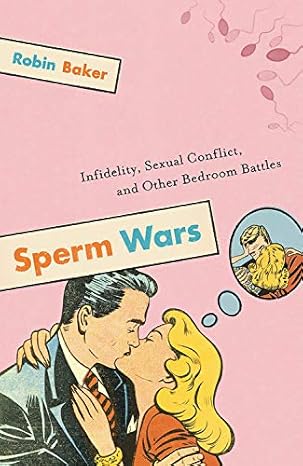
Sperm Wars: Infidelity, Sexual Conflict, and Other Bedroom Battles
In this book, best-selling author Robin Baker reveals these new facts of life: ten percent of children are not fathered by their “fathers;” less than one percent of a man’s sperm is capable of fertilizing anything (the rest is there to fight off all other men’s sperm); “smart” vaginal mucus encourages some sperm but blocks others; and a woman is far more likely to conceive through a casual fling than through sex with her regular partner.
https://en.wikipedia.org/wiki/Sperm_Wars
Oral sex is explained as an opportunity for partners to judge each other’s reproductive health, and for mates to detect recent infidelity (also proposed by Kohl & Francoeur, 1995 “The Scent of Eros“). The shape of the penis and the thrusting during intercourse serve to remove other men’s semen.[6] Male masturbation is said to discard old, dying sperm, so that an ejaculate contains younger sperm that will stay active inside the cervix longer, with more of a chance of being present during the window of ovulation. Baker also proposes that men adjust the amount of sperm they ejaculate based on the time their mate has spent away from them.[7] Likewise, women are found to be more likely to engage in extra-pair copulation and retain larger amounts of sperm during their most fertile phase of the month, and more likely to have sex with their regular partner during the infertile phase.[8]

BUT
To test this idea, reproductive biologist Harry Moore and evolutionary ecologist Tim Birkhead of the University of Sheffield in the U.K. mixed sperm samples from 15 men in various combinations and checked for how the cells moved, clumped together, or developed abnormal shapes. “These are very simple experiments, but we tried to mimic what goes on in the reproductive tract,” Moore says. The team found no excess casualties from any particular donor or other evidence of warring sperm, they report in the 7 December Proceedings of the Royal Society. “The kamikaze sperm hypothesis is probably not a mechanism in human sperm competition,” says Birkhead.
The findings are “the nail in the coffin for the kamikaze hypothesis,” says Michael Bedford, a reproductive biologist at Cornell University’s Weill Medical Center in New York City. He says he had never given the idea much credence. But Birkhead maintains that kamikaze sperm might exist in species where promiscuity is the norm and competition is intense.