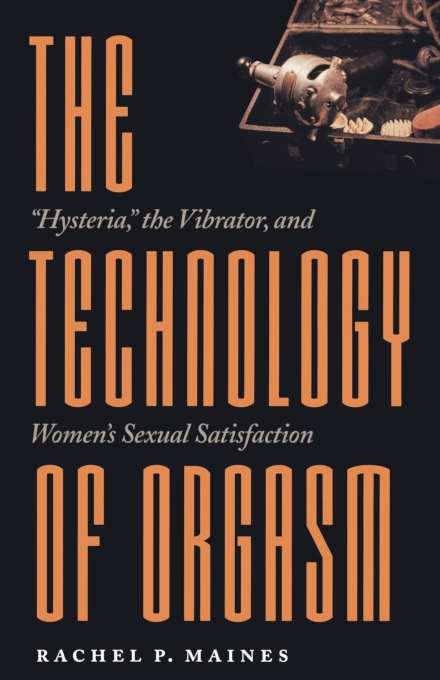
The Technology of Orgasm – “Hysteria,” the Vibrator, and Women’s Sexual Satisfaction
by Rachel Maines.
At the same time, hysterical women represented a large and lucrative market for physicians. These patients neither recovered nor died of their condition but continued to require regular treatment.
On my Kindle.
page 3
When the vibrator emerged as an electromechanical medical instrument at the end of the nineteenth century, it evolved from previous massage technologies in response to demand from physicians for more rapid and efficient physical therapies, particularly for hysteria. Massage to orgasm offemale patients was a staple of medical practice among some (but certainly not all) Western physicians from the time of Hippocrates until the 1920s, and mechanizing this task significantly increased the number of patients a doctor could treat in a working day. Doctors were a male elite with control of their working lives and instrumentation, and efficiency gains in the medical production of orgasm for payment could increase income. Physicians had both the means and the motivation to mechanize.
The demand for treatment had two sources: the proscription on female masturbation as unchaste and possibly unhealthful, and the failure of androcentrically defined sexuality to produce orgasm regularly in most women.4 Thus the symptoms defined until 1952 as hysteria, as well as some of those associated with chlorosis and neurasthenia, may have been at least in large part the normal functioning of women’s sexuality in a patriarchal social context that did not recognize its essential difference from male sexuality, with its traditional emphasis on coitus. The historically androcentric and pro-natal model of healthy, “normal” heterosexuality is penetration ofthe vagina by the penis to male orgasm. It has been clinically noted in many periods that this behavioral framework fails to consistently produce orgasm in more than half of the female population.
Because the androcentric model of sexuality was thought necessary to the pro-natal and patriarchal institution of marriage and had been defended and justified by leaders of the Western medical establishment in all centuries at least since the time of Hippocrates, marriage did not always “cure” the “disease” represented by the ordinary and uncomfortably
persistent functioning of women’s sexuality outside the dominant sexual paradigm. This relegated the task of relieving the symptoms of female arousal to medical treatment, which defined female orgasm under clinical conditions as the crisis of an illness, the “hysterical paroxysm.”
page 4
In effect, doctors inherited the task of producing orgasm in women because it was a job nobody else wanted.
There is no evidence that male physicians enjoyed providing pelvic massage treatments. On the contrary, this male elite sought every opportunity to substitute other devices for their fingers, such as the attentions of a husband, the hands of a midwife, or the business end of some tireless and impersonal mechanism. This last, the capital-labor substitution option, reduced the time it took physicians to produce results from up to an hour to about ten minutes. Like many husbands, doctors were reluctant to inconvenience themselves in performing what was, after all, a routine chore. The job required skill and attention; Nathaniel Highmore noted in 1660 that it was difficult to learn to produce orgasm by vulvular massage. He said that the technique “is not unlike that game of boys in which they try to rub their stomachs with one hand and pat their heads with the other.”8 At the same time, hysterical women represented a large and lucrative market for physicians. These patients neither recovered nor died of their condition but continued to require regular treatment.
…
page 8
But the sheer number of hysterics before the middle of this century, and their virtual disappearance from history thereafter, suggests it is perceptions of the pathological character of these women’s behavior that have altered, not the behavior itself. 32
The partial or complete loss of consciousness-or more properly, of reactivity to outside stimuli-was variously interpreted and described over time. Aretaeus, like Plato, believed that the inflamed and disconnected uterus was suffocating or choking the patient, a theme dwelt on at considerable length in late classical, medieval, and Renaissance medical writings. The uterus, engorged with unexpended “seed” (semen in Latin), was thought to be in revolt against sexual deprivation. The cure, consistent with the humoral theory popularized by Galen, was to coax the organ back into its normal position in the pelvis and to cause the expulsion of the excess fluids.33 When the patient was single, a widow, unhappily married, or a nun, the cure was effected by vigorous horseback exercise, by movement of the pelvis in a swing, rocking chair, or carriage, or by massage of the vulva by a physician or midwife.
…
page 9 – 10
In the nineteenth century, as noted by Peter Gay and others, the received wisdom that women required sexual gratification for health came into conflict with newer ideas regarding the intrinsic purity of womanhood. A not uncommon resolution of the conflict of medical philosophies over women’s sexuality was the compromise position that women ardently desired maternity, not orgasm.37 This pro-natal hypothesis not only preserved the illusion of women’s spiritual superiority while explaining their observed sexual behavior but also reinforced the ethic of coitus in the female-supine position as a divinely ordained norm. As Gay rightly points out, this proposition also protected the male ego and the androcentric model of sexuality.38
Freudian interpretations after 1900 presupposed sexual drives in women, placing these in a new kind of androcentric moralism, that of psychopathology, that was to persist into our own time. In the new paradigm, hysteria was caused not by sexual deprivation but by childhood experiences, and it could be manifested in propensities to masturbation and to “frigidity” in the context of penetration. 39 These two “symptoms” were also evidence, in the Freudian view, of female sexual development arrested at a juvenile level. The mystique of penetration thus could remain unchallenged even as the theoretical ground shifted under the medical and sexual issues. Real women, according to Freudian theory as well as earlier authorities, experienced mature sexual gratification as a result of vaginal penetration to male orgasm and accepted no substitutes for the “real thing.” The role of the clitoris in arousal to orgasm was systematically misunderstood by many physicians, since its function contradicted the androcentric principle that only an erect penis could provide sexual satisfaction to a healthy, normal adult female.40 That this principle relegated the experience of two-thirds to three-quarters of the female population to a pathological condition was not perceived as a problem.
This androcentric focus, in fact, in many cases effectively camouflaged the sexual character of medical massage treatments. Since no penetration was involved, believers in the hypothesis that only penetration was sexually gratifying to women could argue that nothing sexual could be occurring when their patients experienced the hysterical paroxysm during treatment. Even the nineteenth-century physicians who excoriated the speculum for its allegedly stimulating effects and questioned internal manual massage saw nothing immoral or unethical in external massage of the vulva and clitoris with a jet of water or with mechanical or electromechanical apparatus.
…
Criticism
A failure of academic quality control: The technology of orgasm by Hallie Lieberman and Eric Schatzberg.
ABSTRACT
The Technology of Orgasm by Rachel Maines is one of the most widely cited works on the history of sex and technology. Maines argues that Victorian physicians routinely used electromechanical vibrators to stimulate female patients to orgasm as a treatment for hysteria. She claims that physicians did not perceive the practice as sexual because it did not involve vaginal penetration. The vibrator was, according to Maines, a labor-saving technology to replace the well-established medical practice of clitoral massage for hysteria. This argument has been repeated almost verbatim in dozens of scholarly works, popular books and articles, a Broadway play, and a feature-length film. Although a few scholars have challenged parts of the book, no one has contested her central argument in the peer-reviewed literature. In this article, we carefully assess the sources cited in the book. We found no evidence in these sources that physicians ever used electromechanical vibrators to induce orgasms in female patients as a medical treatment. The success of Technology of Orgasm serves as a cautionary tale for how easily falsehoods can become embedded in the humanities.
…
Only 32 pages of Technology of Orgasm are actually devoted to her core argument about physicians’ use of vibrators.
…
The widespread use and marketing of phallic vibrator attachments undermines the theoretical basis of Maines’ claim that physicians assumed, absent penetration, that nothing sexual happened during hysteria treatments. Her sources point to a different conclusion. Rather than clitoral treatments leading to the embrace of the medical vibrator, the evidence suggests instead that electrical devices and vibrators with phallic attachments were used regularly for internal vaginal treatments in gynecology. If vibrators were being used to stimulate patients to orgasm, widespread penetrative use would make it difficult for both doctor and patient to ignore the sexual nature of the treatment, according to her argument that “the character of [vibrator treatments] was camouflaged… by the comforting belief that only penetration was sexually stimulating to women”
…
It turned out that the central thesis of Maines’s Technology of Orgasm wasn’t true. Has there been any more recent scholarship on the early history of the vibrator?
https://www.reddit.com/r/AskHistorians/comments/x5nc8k/it_turned_out_that_the_central_thesis_of_mainess/
Before addressing the specific question of the vibrator, I’d like to go back to Maine’s discredited theory, to point out the elephant in the room: from the 1880s to the 1920s, many Western doctors embraced the technique of “gynecological massage” aka “pelvic massage” or “uterine massage” and used it on their patients.
As Lieberman and Schatzberg noted in their critic of Maines’s book, these massage techniques, manual or machine-assisted, were not meant to treat hysteria, but a large variety of gynecological problems, such as prolapsus, metritis and vaginismus, to the point that some practitioners used them as a gynecological panacea. This was not totally disconnected from hysteria, as this was linked to the “wandering womb” theory: the point was to set a disoriented uterus in the right direction. The story of this medical “fad” has been told by Malmberg (2019), but its first years have been to some extent mythified in books of the late 19th century, such as the PhD dissertation (1895) of Perlia Peltier, born Gossoukova, one of the first French female doctors and also an adept of the method.