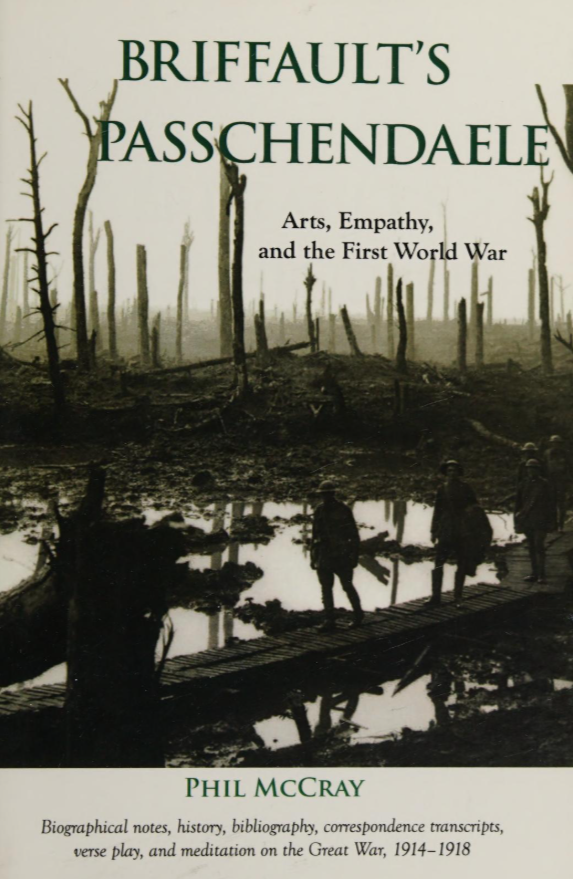
Briffault’s Passchendaele – Arts, Empathy, and the First World War
Biographical notes, history, bibliography, correspondence transcripts, verse play, and meditation on the Great War, 1914-1918.
by Phil McCray.
https://archive.org/details/briffaultspassch0000mccr/mode/2up
page 1 – 2
By unanimous judgment, Briffault was a fabulously learned and inventive thinker, yet also an overbearing and difficult personality. He was a communist and an atheist, yet he was a dandy who dressed well and accustomed himself to the fine and cultured living he had known as a child. He had many mistresses, and his behavior toward his second wife (the American translator Herma Hoyt Briffault1) struck all his acquaintances as, at best, insufficiently kind. He once refused to promenade in Cap d’Antibes after having broken his walking cane, appearing without which might have signaled that he was something less than aristocratic. Briffault dedicated one of his books “to no one,” since he had written it entirely without the patronage he knew he had deserved.
His intellectual arrogance can be inferred by knowing that when Briffault was a boy, a guest in the family home placed his hands on the young lad’s head, and to illustrate a point he was making about the brave future, said: “He might be the one.” The guest was Friederich Nietzsche, and it is unlikely that such a bestowal would be soon forgotten by an incipient egocentric.
…
He died in Hastings, England in 1948, and his will left his material possessions not to his wife, but to his Russian mistress Mme Marina Stalio. The rights to his literary estate were granted to his surviving daughter, Joan Briffault de Hackelberg, who had emigrated to Chile. Though he chose to become a British citizen, and served in His Majesty’s armed forces during the Great War, Briffault had a life-long loathing for England and its rampant imperialism, racism, and subjugation of citizens by class. Some of his invective took the form of bitter ejaculations, and appeared to some of his acquaintances to be more a sort of a psychological reflex than rational opinion.
…
page 3
When the Munich Pact was signed in 1938, he returned his World War One decorations to the King. Yet he wanted to be buried in England, that is to say, not in France, and not in Florence, the cities in which he passed many fecund years of his life. He evinced disdain for property, yet received without demur the material gifts of persons who offered him support. Similarly, he claimed that marriage and monogamy were utterly ridiculous, yet he was married twice; he professed the strongest of faiths in the common man, whose public behavior he could not stand. That Briffault was able to simultaneously entertain two completely opposite compulsions in his mind may suggest that he was capable of enormous feats of genius – as genius was defined by Aristotle – or provides support of the conclusion that these ambivalences were related to the narcoleptic seizures he experienced all his life.
Briffault was not known to have done any actual field research in cultural anthropology, hence his emphasis on the matriarchal structure of culture was purely theoretical. Ashley Montagu and other intellectuals were, however, uniformly amazed by his reading and his astounding ability to recollect and cite resources. Montagu wrote: “As a man of imagination – undisciplined imagination – Briffault was brilliant. As a man he was a failure. Temperament, as Voltaire remarked, is Fate.”
Many of his peers also questioned his conclusions, and regarded the process and assumptions of his scholarship as quite outlandish. Even Gordon Rattray Taylor, in his introduction to a later, condensed version of The Mothers, struggled to find indisputable value in Briffault’s theories, noting that the author had tried to generalize when generalization was impossible, and that some of his intellectual methodology was altogether flawed.
…
page 4
Returning to private life after the Great War, Briffault’s inflexibility relating to social decorum, his rigorous intellectual standards, and his characteristic obduracy resulted in numerous personal and professional quarrels. He once behaved scandalously at a religious mass at Chartres, and was so queasy about public physicality that he forced Herma to wear a robe when swimming. He traveled from California to New York via Niagara Falls, but appears to have been wholly indifferent to that grand spectacle of nature. He was mad for Wagner’s operas and would play the radio at full volume; he “abominated Mozart and Bach.” He exaggerated small nuisances and delighted in contravening authority in even the smallest matters. He admitted to being emotionally undone by the death of his favorite daughter Muriel, and he was so estranged from his son Lister that Herma does not appear to have known of the latter’s existence until after she and Briffault were married.
Robert Briffault was frequently poor (and at the end of his life entirely destitute) but he continued to try to live the life of a dandy and a connoisseur. Both he and Herma often declared that they “were not worthy of being communists,” suggesting the purely parlor nature of their political beliefs. The 1930s and the years of the Second World War presented their own difficulties for his scholarly career, and he seems to have regarded all editors, publishers, and translators as his natural adversaries. His relationships with his several mistresses was a strange tangle of invidious chaos. He had an imperial sense of his role in the intellectual life of the world, felt aggrieved by his lack of fame, and very strongly believed that he was owed patronage by whomever might be capable of providing him with money, housing, or access to publication.
…
page 5
One of the most curious relations in Briffault’s life may be also the most telling. After the Second World War-Briffault is in his seventies and unwell-he establishes an affair de cœur with Malrika Phillips, the young wife of Rodney Phillips, a wealthy actor and publisher.
…
page 6
[Malrika had spent the] war years in North Africa, and returned to France in 1945, where she took up with a bunch of rive gauche characters, wore long hair and blue jeans, practiced free love and all the concomitant affectations. Briffault sought to save her from the phony existentialist milieu in which she was swimming.” Malrika was the daughter of Marie (Marevna) Bronislava Vorobieff-Stebelska, often referred to as the first female cubist painter,
who had an ill-fated dalliance with the Mexican painter Diego Rivera.
Briffault’s relationship with Malrika was tortured and intensely erotic. He once signed a letter to her with “I kiss you in a place where I won’t get any lipstick on myself,” and “I am dying of the desire to make love to you, and at the same time I want to scream at you, to insult you.”
Trained as an exotic dancer and schooled partly by Isadora Duncan, “Malrika Rivera” became an actress, and appeared with Julie Christie in the 1965 film Darling. Briffault also befriended Marevna on the Riviera, and made futile attempts to gain the favor of and pecuniary support of Malrika’s mother. In the last two years of his life, and tubercular, Briffault’s exalted appreciation of carnality and amor devolved into an obsession with pornography, though his writings suggest that this was but a mystical expression of the forces of femininity which had all his life informed both his spirit and his intellectual foundations. Herma Briffault did eventually file for a divorce (never legalized) but she was insistent that Briffault was a great man, and that he had been ill-treated by members of the intellectual firmament.
…
page 8
That matriarchal origins of culture were not the only force of the female that obsessed him was attested to by what his friends call his “numerous” mistresses. The bon vivant who appreciated fine champagnes and perfumes did not always extend such generosity to his paramours or to his two wives, and his misogynistic habits suggest further ambivalences of mind regarding mothers and women.
…
page 9
Zena is a derivative soul of a Russian girl Briffault knew, by whom his heart was affected in a painful and disorienting way. He kept a mistress during his medical service in the war in Flanders, named Julia; she was the prototype of Keetje, and had a monumental psychological effect on the author. Keetje is perhaps Briffault’s most significant female archetype. Her life is vibrantly portrayed in Europa in Limbo. Keetje appears first as a scruffy waif-gamine displaced by the war, who later navigates through the broken world to the highest levels of intrigue and power. Keetje’s natural understanding of her sexuality-as-power expresses one of Briffault’s chief beliefs, the authority inherent in the self-defined female: the hoyden [boisterous girl] as rulebreaker, the transgressive, cynical spy.
…
page 52
Briffault loathed the eager totalitarian nature that would later degenerate into fascism, and his letters from Zillebeke and Passchendaele plainly cite the damage Boche forces inflict, but he cannot have much differentiated the final effects that national and class politics would have on the human body in his care, maimed and extinguished.
…
page 55
Freud’s conceptions of the tension between collective war and individual freedom were formed in large part by his study of the First World War. In his 1930 book Civilization and its Discontents, Freud understood war and its slaughter as instinctual aggression, death drive, libidinal release, an acceptable locale for sadism and masochism, a false religion, and deep-rooted hunger for power.
For Werther [ref: Goethe’s The sorrows of Young Werther ], sex and death were the same. His suicide was the only possible fruition.
…
page 85
Lawrence Koons and William Hixson conducted interviews and research for a prospective biography of Robert Briffault in the early 1960s. Though they eventually abandoned the project, each unconvinced he could do justice to their subject’s extensive intellectual breadth and large life, they were able to meet with many of Briffault’s principal acquaintances, only twelve years after his death. Their research materials were eventually donated to the McMaster University Archives, in Hamilton, Ontario, Canada, and include correspondence with Herma Briffault, photographs, plus extensive interpretive notes by Koons composed immediately after his interviews.
It is possible to believe that Robert Briffault regarded the 1209-1229 Albigensian Crusade as the fatal conclusion of humanity’s hopes that humankind’s spirit of romance might form the first rule of human liberalism and gentility. Instead, as he might have it, heartless marauders astride armored horses slaughtered the serene poets of Provence and Languedoc with the pitiless swords and spears of hatred and paranoia.
…
page 86
Briffault’s letters to his daughters from Flanders are graphic descriptions of his life in the war. After long narratives about the conditions and horror of the front, he didactically advises them to see Birth of a Nation, and Intolerance, and to read Swinburne…
…