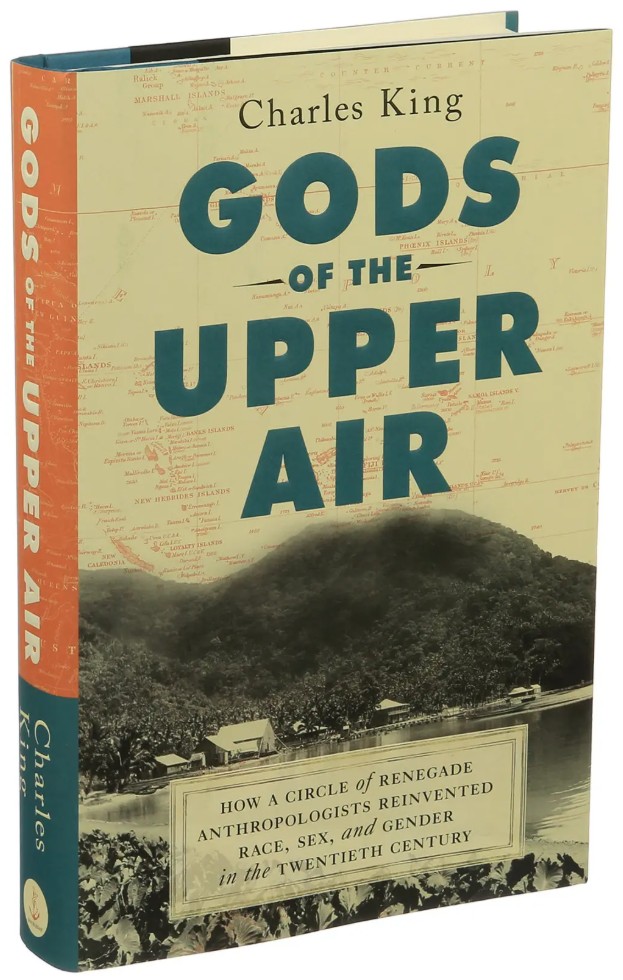
Gods Of The Upper Air
How a circle of renegade anthropologists reinvented race, sex and gender in the Twentieth Century.
by Charles King.
Published 2019 – hard-cover book in our library.
Mead stands out, especially for the links between her personal and professional lives. From young adulthood on, she was inclined toward polyamory, feeling cosseted and constrained by her culture’s ideal of monogamy.
Reviews:
Mead stands out, especially for the links between her personal and professional lives. From young adulthood on, she was inclined toward polyamory, feeling cosseted and constrained by her culture’s ideal of monogamy. Benedict was the love of her life, even as she had multiple relationships (and marriages) with men, some characterized by emotional turbulence. King shows how the combination of Mead’s own beliefs, her training and her fieldwork led her to rethink how gender is understood. Just as with race, more differences occur within categories than between them; maleness and femaleness are socially constructed categories, not biological binaries.
Occasionally, though, King goes too far. That Mead “writhed with desire” for one of her lovers borders on casting Mead as oversexed. It’s more instructive to learn the degree to which Mead faced intense misogyny, including from anthropologist Edward Sapir, who wanted to marry her.
For a while he [Boas] held a curatorship at the relatively young American Museum of Natural History, but the museum was a creature of the establishment, hosting grand conferences on eugenics and showcasing displays on the “ill effects of racial interbreeding.” The then-dominant school of anthropology propped up a narrative tracing “the stages of human culture,” from “savagery” through to “barbarism” and finally to “civilization.” Mainstream scholars insisted that white supremacy was justified by head measurements and heel length.
Pager 213
She [Hurston] was making data, not just gleaning it, and she wanted the reader to understand that fact. In doing so, she put on permanent display one of the deepest of Boasian messages: that all cultures change, even while anthropologists are busy trying to write up their field notes about them.
Page 343
Virtually every member of the Boas circle was routinely denounced as naive, uncivilized, unpatriotic or immoral. Boas was a crank who denied American greatness. Mead was a trollop who insisted that sex wasn’t necessarily private, perplexing, and vaguely wrong. Benedict was a harridan. Deloria and Hurston were, say no more, an Indian and a Negro. But their whole point was to be upsetting. Getting over yourself was bound to be hard. The payoff was to get smarter – about the world about humanity about the many possible ways of living a meaningful flourishing life.
Some of Boas’s specific findings have fallen to better research and better data. No one now does anthropology exactly the way Mead or Benedict did. Scholars today are skeptical about some of the generalizations that the Boasians allowed themselves, Fieldworkers would eventually come to question the entire concept of culture as a distinct thing that could be easily described and analyzed, as if fixing a moth to a microscope slide. (Two Crows denies it.) But from the 1880s to the 1940s, these thinkers helped herd human knowledge in a very particular direction: towards giving up the belief that all history leads inexorably to us.