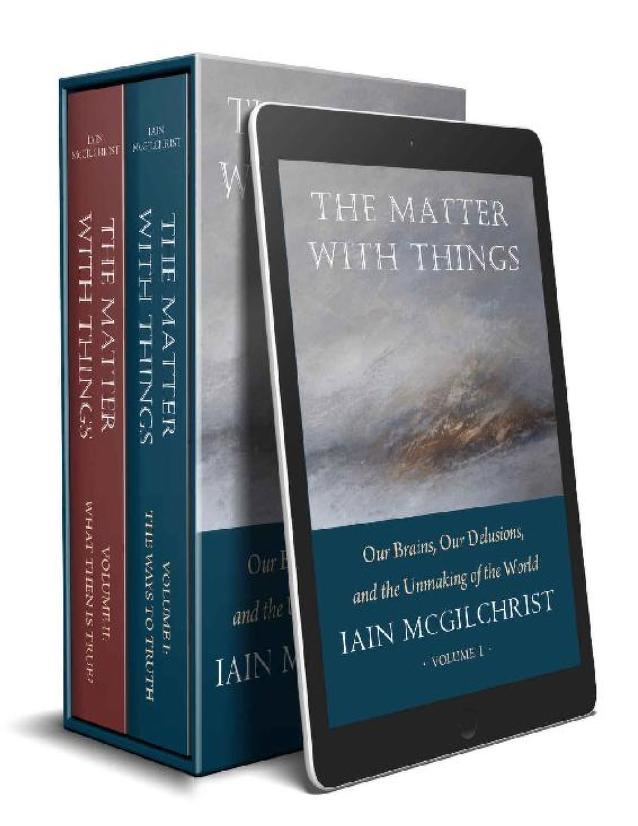
The Matter with Things – Our Brains, Our Delusions, and the Unmaking of the World
by Iain McGilchrist 2021
The Matter with Things explores the radically different ways in which the two hemispheres of the brain apprehend reality, and the many cognitive and worldly implications of this.
The book “is an attempt to convey a way of looking at the world quite different from the one that has largely dominated the West for at least three hundred and fifty years (i.e. since the Scientific Revolution and the Enlightenment) – some would say as long as two thousand years.”
Read for free:
TOC, videos and other info
https://channelmcgilchrist.com/matter-with-things/
Summary and discussion on Wikipedia
https://en.wikipedia.org/wiki/The_Matter_with_Things
Backup PDF
the-matter-with-things-our-brains-our-delusions-and-the-unmaking-of-the-world.pdf
Page 841 ? [no numbers on pdf]
It could be said that the trouble with Western philosophy began with Plato’s foregrounding of logos. In the Greek world, as in most pre-modern cultures, there had always existed more than one way of acquiring an understanding of the world. The Greeks, let it not be forgotten, also gave birth to many of the most enduring myths by which we understand our relationship to the world, such as those of Œdipus, of Prometheus, of the gods of the Iliad and of the Odyssey. There was, and is, no conflict here.
Indeed they distinguished two types of truth, mythos and logos; each was considered essential in its own proper field, and the two were not to be confused. So Karen Armstrong writes:
Logos (‘reason’) was the pragmatic mode of thought that enabled people to function effectively in the world. It had, therefore, to correspond accurately to external reality. People have always needed logos to make an efficient weapon, organize their societies, or plan an expedition. Logos was forward-looking, continually on the lookout for new ways of controlling the environment … Logos was essential to the survival of our species.
But logos had its limitations. Good at manipulating the world and making us powerful, it did not contribute to any broader understanding of the meaning of our lives – for that people turned to mythos. Armstrong continues:
Myths may have told stories about the gods, but they were really focused on the more elusive, puzzling, and tragic aspects of the human predicament that lay outside the remit of logos … When a myth described heroes threading their way through labyrinths, descending into the underworld, or fighting monsters, these were not understood as primarily factual stories. They were designed to help people negotiate the obscure regions of the psyche, which are difficult to access but which profoundly influence our thought and behaviour … When Freud and Jung began to chart their scientific search for the soul, they instinctively turned to these ancient myths.
A myth was never intended as an accurate account of a historical event; it was something that had in some sense happened once but that also happens all the time.
In other words, myths were archetypal, not incidental, truths, reflecting eternal patterns that we could recognise, but which could not, without diminishment, be translated into the everyday terms of logos. And, as Armstrong goes on to emphasise, myths were not primarily propositional, but grounded in action. The truth of a myth was not verified by data, but in the playing out of one’s life:
The only way to assess the value and truth of any myth was to act upon it. The myth of the hero, for example, which takes the same form in nearly all cultural traditions … showed us how to live more richly and intensely, how to cope with our mortality, and how creatively to endure the suffering that flesh is heir to. But if we failed to apply it to our situation, a myth would remain abstract and incredible.
However, things were slightly more complex than this suggests, since logos and mythos went through a number of transformations. At one stage, indeed, according to the historian of ideas Bruce Lincoln, it was logos that was thought of as unreliable, feminine and seductive:
the most ancient texts consistently use the term logos to mark a speech of women, the weak, the young, and the shrewd, a speech that tends to be soft, delightful, charming, and alluring, but one that can also deceive and mislead.
‘Words, words, words …’ This would certainly fit with Mercier and Sperber’s view that logic was invented in order to win arguments, not to take us closer to the truth.
Mythoi by contrast were the ideals of men of action, weighty, performative, supportive of the truth: alēthea mythēsasthai (‘to speak the truth’) occurs as a formula five times in Homer, Hesiod and the Homeric Hymns (all prior to the end of the seventh century BC) . Mythoi can at times be corrupt, but when they are, the effect is shocking and implies shame, such as if a lawyer were to lie; whereas the corruption of logos, at this stage, was taken for granted: ‘the lying logos is deceptive, disingenuous and slyly delivered, hard to detect, the more to be guarded against’.
It’s worth noting that mythos is inclusive of logos, whereas logos is exclusive of mythos. Mythos ‘denotes the whole package, the logos plus the speaker and the context; when mythos is in play, something is at stake’.
It is thus dependent to an extent on trust in the authority of the speaker: as soon as people routinely question the authority of heroic figures, it loses power. Thus it is that with Plato one sees a reversal of the fortunes of mythoi. He cites them generally unfavourably in respect of their truth in numerous places, though he concedes there is ‘some truth’ in them.
In reality, he is himself the inventor of several of the best-known myths of ancient philosophy: the myths of Atlantis, of Er’s journey into the afterlife, of the ring of Gyges, of the chariot of Phæthon, not to mention the myth of the Cave.
Plato was complex. However, his legacy has been one-sided; and from this point onwards, truth is no longer thought of as that which comes from the experience of living, but as what can be argued towards without reference to context. Such a view is a necessary counterpoise, and can be productive: but as always, there needs to be a balance.
It will be obvious to the reader that mythos, in its trans-linguistic, implicit, richly connotative, performative way, rooted as much in the body and emotion as it is in cognition, is more amenable to the right hemisphere’s take on the world; whereas logos, at least in Plato’s sense – Heraclitus, for example, had used logos to mean a deep understanding beyond language, never to mean rationality or rhetoric – is more amenable to the explicit, linguistic, propositional stance of the left hemisphere. We now live in a world where mythos has been largely routed, and confined to the fiction shelves. Yet we need to bear in mind that there is more truth about the human predicament in King Lear than in any number of textbooks of genetics, irrespective of whether there was ever a King Lear at all.
Page 1081 ? [no numbers on pdf]
Bohr’s greatest insight into the deep nature of the universe was that contraria sunt complementa: contraries fulfil one another. But it is also a timeless insight, to be found in one form or another in most ancient cultures of which I am aware. The most sophisticated of these, because of the detailed and refined exposition it has given rise to in China, is that of yin and yang, contrary forces that fulfil one another by their complementary nature (whose symbol, incidentally, Bohr placed at the centre of his coat of arms when ennobled by the Danish Government). And in that symbol the male and female principles are also implied. That the concepts may have become vulgarised is not a weakness in the concepts but, rather, in the cast of mind that does not measure up to them, much as a religion is not vitiated simply by the misguidedness of some of its followers.
The idea of complementary opposites is, however, present at the beginning of the Western philosophical tradition, most notably in Heraclitus. And as Nietzsche says, ‘The world for ever needs the truth, hence the world for ever needs Heraclitus.’
In one of his most penetrating observations, Heraclitus notes:
They do not understand how a thing agrees at variance with itself: it is an attunement turning back on itself, like that of the bow and the lyre.
It is the tension between the warring ends of the bow that gives the arrow the power to fly, as it is the tension in the strings of the lyre that gives rise to melody: this is what he meant by his saying ‘war is the father of all things’. What looks like a waste of effort – pulling in opposite directions is the essence of generative vitality. The word translated here as attunement is harmoniē. Harmony is, after all, the reconciliation of things that contend with one another. According to Charles Kahn, Heraclitus’ most rewarding commentator, the word brings together three main ideas – the fitting together of surfaces that are ‘true’; the reconciling of warring parties; and the accord of musical strings. Whatever is, therefore, brings together elements that are made to fit, and in a manner that is fitting; draws peace out of conflict; and gives birth to beauty out of this reconciliation.
Another fragment is equally pregnant, and of even greater density:
Graspings: wholes and not wholes, convergent divergent, consonant dissonant, from all things one and from one thing all.
(Incidentally, neither in this nor in the harmoniē fragment just quoted, does the word ‘thing’ occur in Greek: it is an interpolation that, significantly, the English language foists on the translator.)
The Greek word syllapsies – here translated ‘graspings’ – seems, again according to Kahn, to suggest several ideas: something ‘grasped’ (perhaps suggesting sudden comprehension); something that brings elements together; and fertility (Aristotle uses the word to mean the sexual generation of life). It is hard to overestimate the richness of this fragment. It says many
things at once: that a deep understanding of the nature of reality comes in glimpses, or graspings – moments of insight; that, in that insight, all is neither simply single, nor simply manifold, neither simply whole, nor simply not whole, neither simply like nor simply unlike, each thing working with, and by the same token working against, the others; that the One and the Many bring one another forth into being, together generating the reality that has this structure at its core; and that despite (or, in light of all this, perhaps because of?) the nature of this multiplicity, all is held together in a syllapsis: the only word here not to be paired with an antithesis. And the whole saying is in itself a syllapsis – a gathering which, in its fertility, births a syllapsis – a moment of dawning insight in us.
Much of what we know of Heraclitus’ sayings comes in reports at second-hand, several of them from Plutarch. In one, Plutarch aims to clarify what Heraclitus is believed to have said:
According to Heraclitus one cannot step twice into the same river, nor can one grasp any mortal substance in a stable condition, but by the intensity and rapidity of change it scatters and again gathers. Or rather, not again nor later but at the same time it forms and dissolves, and approaches and departs.
Contemporary physics, as so often, confirms metaphysics. Thus, though it might be thought that a wave and a particle were mutually exclusive forms of manifestation – one possible at one moment, the other at another light can be imaged as wave and particle simultaneously.
Page 1205 ? [no numbers on pdf]
WHEN TIME BREAKS DOWN: CARTESIANISM
If in reality ‘everything flows’, what could be more devastating than the loss of flow from one’s world? Nothing, not even one’s self-experience, would appear real any more.
The static and the timeless has been privileged in the West ever since Plato followed the path of Parmenides, not Heraclitus. With Descartes things went much further. Descartes deliberately excluded from his thought processes, like many subsequent philosophers in the analytic tradition, the kind of understanding available from the right hemisphere; and so he was obliged to see time as composed of static points or slices in need of a mysterious stitching together.
Page 1278 ? [no numbers on pdf]
Let us return, then, to Heraclitus, whose saying that one cannot step into the same river twice is familiar. Its power depends on the fact that the river has permanence: we call it the same river, because it is. Heraclitus points not to change only, but as much to permanence: flow which ever changes but ever remains. There is no succession of things involved in this change, because they always flow, interpenetrating one another. One of Plato’s teachers, Cratylus, who was a pupil of Heraclitus, was right when he wittily added that we cannot step into the same river once, since at any instant it is already changing, and we too are in flux. And yet, like the river, it is only by changing that we can acquire the permanence we have.
Flow, then, is not primarily about change, since it is equally about persistence: I explored this coincidence of opposites in the chapter on the nature of the organism (Chapter 12), quoting Novalis. Consciousness flows, the body flows; given this, it is hardly surprising that the evolution of the self is such a flow, too. At least the right hemisphere sees that this is the case: it is the right hemisphere, in particular the right dorsomedial prefrontal cortex (along with the right temporoparietal junction), that plays the critical role in sustaining the sense of a continuous self.
This is important because, in the left hemisphere’s world, a self does not hang together. For Descartes, as we have seen, analysis reduced flow to a series of atomic points each devoid of any sustaining continuity with any other. His radical doubt meant that he was sure of an existence at the ‘now’ point of his doubting (because something had to exist to be capable of doubt at all), but not of how he, René Descartes, should persist over time.