Simon Magus – general notes
Hippolytus says the free love doctrine was held by them in its purest form, and speaks in language similar to that of Irenaeus about the variety of magic arts practiced by the Simonians, and also of their having images of Simon and Helen under the forms of Zeus and Athena.
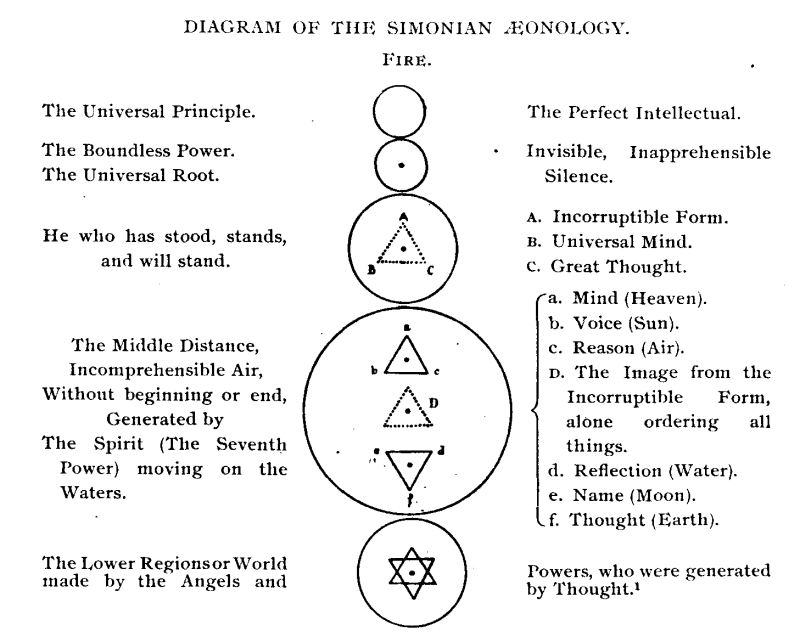
In this account of Simon there is a large portion common to almost all forms of Gnostic myths, together with something special to this form. They have in common the place in the work of creation assigned to the female principle, the conception of the Deity; the ignorance of the rulers of this lower world with regard to the Supreme Power; the descent of the female (Sophia) into the lower regions, and her inability to return. Special to the Simonian tale is the identification of Simon himself with the Supreme, and of his consort Helena with the female principle.
Epiphanius writes that there were some Simonians still in existence in his day (c. AD 367), but he speaks of them as almost extinct.
…
The apocryphal Acts of Peter gives a more elaborate tale of Simon Magus’ death. Simon is performing magic in the Forum, and, in order to prove himself to be a god, he levitates into the air above the Forum. The apostle Peter prays to God to stop his flying, and he stops mid-air and falls into a place called “the Sacra Via” (meaning “Holy Way” in Latin), breaking his legs “in three parts”. The previously non-hostile crowd then stones him.
…
in the 17th Homily, the identification of Paul with Simon Magus is effected. Simon is there made to maintain that he has a better knowledge of the mind of Jesus than the disciples, who had seen and conversed with Jesus in person. His reason for this strange assertion is that visions are superior to waking reality, as divine is superior to human. Peter has much to say in reply to this, but the passage which mainly concerns us is as follows:
But can any one be educated for teaching by vision? And if you shall say, “It is possible,” why did the Teacher remain and converse with waking men for a whole year? And how can we believe you even as to the fact that he appeared to you? And how can he have appeared to you seeing that your sentiments are opposed to his teaching? But if you were seen and taught by him for a single hour, and so became an apostle, then preach his words, expound his meaning, love his apostles, fight not with me who had converse with him. For it is against a solid rock, the foundation-stone of the Church, that you have opposed yourself in opposing me. If you were not an adversary, you would not be slandering me and reviling the preaching that is given through me, in order that, as I heard myself in person from the Lord, when I speak I may not be believed, as though forsooth it were I who was condemned and I who was reprobate. Or, if you call me condemned, you are accusing God who revealed the Christ to me, and are inveighing against Him who called me blessed on the ground of the revelation. But if indeed you truly wish to work along with the truth, learn first from us what we learnt from Him, and when you have become a disciple of truth, become our fellow-workman.
The fantastic stories of Simon the Sorcerer persisted into the later Middle Ages, becoming a possible inspiration for the Faustbuch and Goethe’s Faust.