Who was Asherah – Wife of Yahweh?
Dr. Justin Sledge | ESOTERICA.
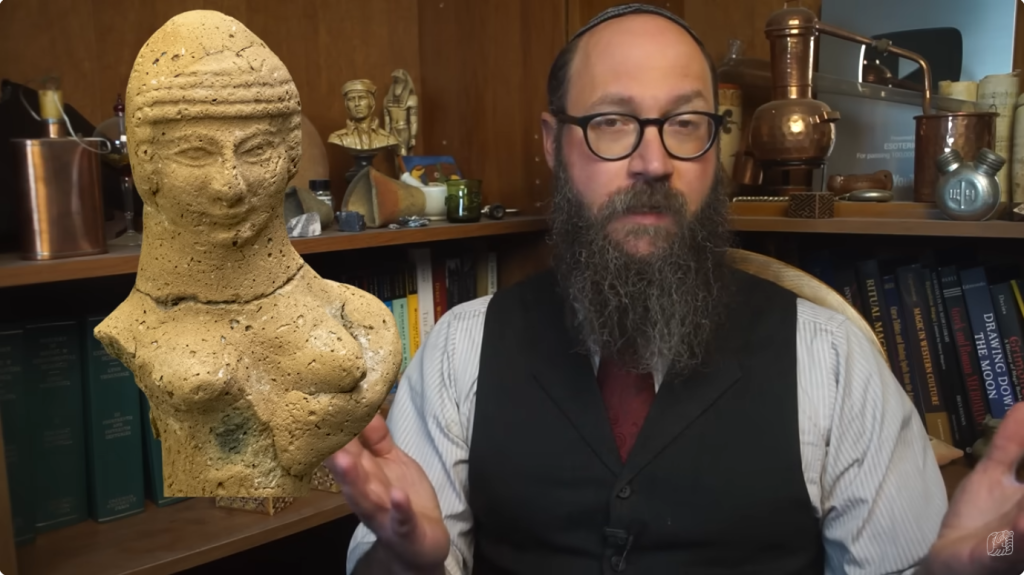
She has a kind of erotic aspect to her. She’s known as the lady of voluptuousness and happiness.
…But with his assimilation to the fatherly deity El, Yahweh seemingly inherits as it were the consort wife of El known in Ugaritic mythology as Atherat and cognate in Hebrew as Asherah. But this was a complicated relationship to say the very least and it ultimately ended in divorce between Yahweh and Asherah…
Transcript
Western monotheism has arrived at the concept of a singular god often by two distinct means. One by addition from nothing. Theologians and philosophers start from no gods and argue for the existence of one such being and then the impossibility of there being any other such beings. These arguments stretch all the way back into the ancient Greek world and have endured through the works of theologians through the centuries.
However, another mechanism has also been long at work in monotheism. This is monotheism through subtraction. That is to say, starting with a popoly of divine beings and very slowly demoting them, consolidating them and erasing them such that only one supreme being remains.
And something like this process certainly happened among the ancient Israelites with various divine beings such as El, Baal, Mo, Yam, Lotan. All of these beings ultimately vanishing off through demotion, consolidation, and eraser through the millennia. But perhaps the one most conspicuous god lost in the process of the elevation of Yahweh as the sole cosmic deity was the eraser and demonization of what was likely or perhaps the wife consort Asherah.
Yeah, it seems that the national god of the ancient Israelites may have or even likely had a wife or a consort and she may have been systematically demoted and then ultimately erased from history. But what do we actually know about this goddess Asherah? And what is the evidence that she was in fact the wife of Yahweh, the wife of the deity that simply became God?
But now, let’s explore Asherah, the lost wife of God.
I’m Dr. Justin Sledge and welcome to Esoterica, where we explore the arcane in history, philosophy, and religion.
[Music]
This episode is actually part of an ongoing series here on the channel of the history of the ancient Israelite god Yahweh. Now, I’ve already done a couple of episodes about the origins of Yahweh and the development toward monotheism if you want to check out those videos before getting to this one.
But in a painfully brief summary of those episodes, Yahwei seems to have been a deity imported into the Canaanite pantheon from the south at some point in the late Bronze or early Iron Age, who would then go on to meteoric success as the national god of the Israelites and for billions of people just well God. This warrior storm deity would be assimilated to the chief of the Canaanite pantheon, El just God. set into conflict with another storm deity, Baal, with elements of both incorporated into the composite picture of Yahweh as he appears in Israelite cultic and religious life.
Following the destruction of the northern Israel kingdom in 722 B.CE and Judea in 586 B.CE. It appears that Yahweh hetheism or monolatry would eventually transform into something like monotheism during the Babylonian exile.
Again, this is all just a very, very short summary of a much more complex process that I’ve actually outlined in much more detail in those previous episodes on Yahweh. So again, make sure to check those out.
But let’s rewind a second. Recall how Yahweh would become assimilated into the larger Canaanite pantheon, especially by being conflated to a significant degree with the grandfatherly chief of that pantheon, El, whose name just means, well, God. Basically, if you’ve ever imagined God as a kind of bearded old man sitting on a throne, you’re basically actually imagining the Canaanite God El and in some sense, not the youthful warrior god Yahweh. But this assimilation had a kind of strange effect to it. A bug or a feature depending on how you want to look at it.
Our earliest linguistic and epigraphic evidence actually presents Yahweh as again a youthful warrior storm god manifesting as a powerful thunderstorm. He’s sometimes referred to as the rider on the clouds. But as a youth, this deity doesn’t appear to have a consort or a wife.
Much like the Canaanite god Baal, who mostly actually just hangs out and by hangs out with, I mean rampages with his fierce virgin sister Anat. In fact, Baal doesn’t even have his own house until much later in the development of his myth cycle. Apparently living in his parents’ basement or or something. Get a job, Baal.
But early on, Yahweh was in a similar situation. He was a divine bachelor. But with his assimilation to the fatherly deity El, Yahweh seemingly inherits as it were the consort wife of El known in Ugaritic mythology as Atherat and cognate in Hebrew as Asherah.
But this was a complicated relationship to say the very least and it ultimately ended in divorce between Yahweh and Asherah with Asherah becoming just someone that Yahweh used to know. Indeed, of the 40 or so mentions of Asherah in the Israelite literature of the Hebrew Bible, what we overwhelmingly learn is that some Israelites made shared cultic space for both Yahweh and Asherah in some form. And others, especially the ones that were editing the Hebrew Bible, as it’s come down to us, especially the Deuteromist, they found this a cultic outrage, an abomination that should be driven from Israelite cultic practice.
But before getting to the Israelites, let’s explore the development of Asherah in the centuries before Israelites and indeed in the centuries before even Yahweh appeared on the scene. But to start, what does this name Ashira, Ashu, Asheru, Atherat, as it appears in the various forms in the ancient near east, what does this name even mean?
Well, that question remains pretty vexed by scholars. An earlier generation of scholars held that the name was some version of auyami, something like she who treads upon the sea. But this form is actually never attested and it seems too late a form considering just how early she actually appears in the historical linguistic record. Further, another reading attempts to see this as a root that means something like wife or consort. But again, this form also isn’t attested and it doesn’t have any precedent in Semitic languages otherwise.
However, a form that is attested in Phoenician, Aadian, Aramaic, and Ugaritic is something like alf tav, which does mean something like holy place or sanctuary. And thus, her name actually may mean something like “she of the sanctuary”.
Though again, the exact meaning of her name rose mysterious much in fact like the name Yahweh. We don’t really understand completely how this name Yahweh developed either. But so far as we can tell, Asherah first appears in history in a Sumerian votive offering to Hammurabi in the mid 18th century B.C.E. Yeah, that Hammurabi. Hammurabi’s code Hammurabi. And so this is about 800 years or so prior to the earliest possible mention of an Israelite polity or the appearance of Yahweh as a god on the [inaudible]. But in this vote of offering, we have a mention of Asherah in her Aadian name form, Ashu, where we learn that she is thought of as the lady of the mountain.
She has a kind of erotic aspect to her. She’s known as the lady of voluptuousness and happiness. She’s considered to be the daughter-in-law of the heavenly Sumerian deity An. She shares some of the epithets of Ishtar and that she is thought of as an Amorite deity. The Amorites were a northwestern Semetic people bordering on the old Babylonian Empire to the west and eventually to the Israelites to the northeast. Indeed, Hammurabi himself was actually an Amorite. So maybe that’s part of the reason why we see Asherah here.
Further, it also appears that she was the consort of the head of the Amorite pantheon, Amuru, a title of whom was Lord of the mountain, the Belshadi, a similar epithet that Yahweh will eventually acquire as El Shadai, god of the mountain. Further in the text, she’s also known as the lady of patient mercy who prays reverently for her spouse, his lady, further cementing her position as the consort of the Amorite high god.
Further god lists such as the an equals anum series or the tint tier equals Babilu or the Nepur god list all detail just various positions with various Semitic epithets which are now linguistically assure of the god Asherah . They list her along with various other spirits and entities and indicate that she did have a temple in Babylon known as the house of the luxury of the land. Indeed, her name is listed as part of the Akitu or the Sumerian Acadian New Year processions at the temple of Anu at Uruk, though her name is just listed along with a bunch of other deities. So, she’s not especially interesting in this text.
Cylinder seals, which are these little tiny rolling seals that help to mark out um authority and documents, also testify to the importance of her name acting as a kind of theoiform in several different known examples.
Another text referred to her as the lady of the step. This is another epithet probably associated with both her Amorite origins but also it might have some afterlife connotations as well.
She’s mentioned in at least two other divinatory or esoteric texts. One in which we learn there existed an um man Asherah at or an Asherah wizard Asherah wizard responsible for some sort of divination.
But in short, we don’t really learn all that much about her at this earliest period. She seems to have been the consort of the Amorite high god, thought of as the daughter-in-law of the Sumerian deity of heaven an thus she enjoyed some popularity as such. She had at least one temple in Babylon and may have had some connection to divinatory practices, though what god didn’t have some connection to divinatory practices? That was extremely common in this period.
A bit later on, she appears in a Hittite text. The Hittites were an Indo-Uropean-speaking people in Anatolia, what is now Turkey, who flourished from sometime around 1700 to, 1200 B.CE. The Bronze Age collapse got rid of them. Though the Hittite text seems to be a translation of another West Seemetic text. In fact, the Hittites were some of the first folks interested in something like religious studies, studying preserving numerous non-Hittite religious texts from their neighbors.
In fact, an otherwise unknown Indo-Uropean language was recently discovered among these Hittite religious studies collections. So, that’s kind of neat.
But this text is a mythic narrative in which a Hittite version of Asherah, Asherah tu attempts to seduce an otherwise unnamed storm god, seemingly Baal. But he rebuffs her and he reports her salacious activity to her husband Elkunirša whose name is actually a composition of the Semitic phrase something like El creator of the earth who informs the storm god to sleep with her after all in order to humiliate her.
The storm god does so, mocking that he’s actually killed 77 out of her 88 children, and this causes her to go into a cycle of mourning for seven years. The text then breaks off with Elkunirša now plotting with Asherah tu against the storm god who now has Ishtar’s help somehow with the text breaking off again into fragments. But again, we find Asherah as a consort to the chief god here, Elkunirša, displaying an erotic element with a storm god, but now bearing divine children and in a um complicated relationship with with that storm god.
But of course, our greatest source for understanding the goddess Asherah is from the Ugaritic archives, which were destroyed and then preserved precisely by that destruction sometime around 1185 B.CE. during the Bronze Age collapse. The same collapse that took out the Hittites and probably created the power vacuum that allowed for the rise of smaller polities like the Israelites.
There we find three chief sources for information on Asherah known in Ugaritic as Atherat. The Kerro or Kerta myth, the Baal cycle, and then just a miscellaneous grab bag of various mentions.
The myth or epic of Kerta or Kerro follows that unfortunate son of El who’s been widowed seven times. He’s now childless and he’s the last of his family line. Desperate for an heir, El in a dream instructs him to wage war against the city of Udum to force the king there to give his daughter or granddaughter, it’s not clear in the text, Hara to him in marriage. And ultimately, he stops along the way to a shrine of Atherat offering her gold and silver if he’s to be successful. And ultimately, he is successful and he and Haria are married and have two sons and six daughters.
However, Kerta ultimately renegs on his promise to the goddess Atherat to pay her that gold and silver as tribute after his marriage and all hell breaks loose. Ayharat promptly curses him and apparently his eldest son Yatsib who Atherat herself had nursed with a terrible fever illness. His children intercede on his behalf with the gods and eventually El does side with Kerta, noting that the vow he made in the beginning was ludicrous in the first place. Eventually that eldest son attempts to overthrow Kerta who then Kerta curses before the text finally breaks off with Kerta and his fate ultimately unknown. Though some scholars do believe that ultimately all of his children die along with him aside from a last daughter who becomes his heir.
But Atherat’s role in this text seems again to be that of the consort of the high god El, but also conspicuously responsible for somehow attaining a royal heir at her own shrine. Indeed, she even acts as their wet nurse. The children of Kya are nursed by Atherat, something along the lines of the fearsome god Anat. But she’s also clearly powerful. Atherat’s very clearly powerful, and she won’t stand her promises that she dos out to be betrayed.
While El seems to be the chief actor in some sense, in another sense the real power behind the throne, at least as it were, at least in terms of the production of divine progeny seems to be Atherat. Of course, the Baal cycle is perhaps the most famous text of the Canaanite religion as it survives to us and it gives us our best insight into the religious sensibilities of that region and the late bronze age. Here we have the rise of Baal, his war with the sea and death, yum and moat, the creation of his palace, and the ultimate triumph of his will as the ruler of the gods. In fact, I’ve done a whole episode on Baal and the Baal cycle if you want to learn more about this ancient Canaanite deity.
And it’s in this cycle that we learn the most about ancient Atherat, ancient Asherah a. And in the contest with Baal and the sea, Yam, she’s actually referred to as a goddess and is sympathetic with the sea. It’s actually one of her sons. And indeed, one of her epithets is Atherat of the Sea. And she seems to be at least once described as seemingly doing her laundry in the sea, winking seductively at El, though remaining very ladylike and domestic, taking with her the signs of domestic propriety, her spindle warl. But her relationship with Baal is unsurprisingly complex and she seems to often be actively resisting him. And that makes some sense given that she is the mother of all the gods including Yam and Mot the sea and even death and the consort of El. All of which are subject to hostility by Baal. Indeed, Yam will be defeated by Baal. Death will be met with a kind of dant and El eventually will be overthrown in the Baal cycle with Baal becoming the lord of all the gods, hence his name Baal. Thus, the Rabbitu or the queen mother as she’s known in Ugaritic logically has a tense relationship with the storm god.
And that’s just what we see when the horrible Anat and Baal approach her such that she will intercede on Baal’s behalf for the construction of Baal’s own palace. She recoils in horror. Her voice breaks and her face breaks out in anxious sweat at the sight of this fearsome brother and sister duo.
However, her dignity is preserved as she travels to the tent of El. There she rides astride a donkey while the fearsome virgin Anat is made to walk alongside on foot. Ultimately, Aurorat’s position to El is granted and Kthar Vakasis grants the great palace of Baal to be built. But again, Baal and Atherat only reach a kind of dant with her with her rejoicing when Mot or death seemingly strikes down Baal in their contest. Indeed, with Baal dead, she as Rabitu or queen mother is actually able to elect one of her sons as the new head of the divine family, a situation that she clearly enjoys.
And she elects Athtar the Terrible. Athtar the Terrible! But Baal emerges from death and slaughters the many children of Atherat, leaving an unclear number alive, if any. Indeed, this section seems to echo part of that Hittite epic that I just mentioned a bit ago, where the storm god brags about killing 77 of the 88 children to mock the goddess. But how or if these texts are connected isn’t in the least bit clear.
But the Atherat of the Baal cycle is clearly one of her being the lady of the sea. This connection with the sea, however, isn’t really clear. She’s the Rabbitu or the queen mother and thus the mother of the gods as consort of El. She also has a clearly erotic nature, but also pretty clearly domestic, washing divine laundry and bearing her spindle whirl. Her connection with Baal and Anat is tense to say the least, and she certainly doesn’t seem to be interested in seducing him as it occurs in the Hittite narrative.
Though while she’s clearly connected to progeny of the gods and of royal figures, there’s actually very little evidence of her as a general fertility or mother goddess, whether it’s people or agricultural either. Though such a conclusion wouldn’t be unreasonable if we’re being honest. In addition to these cycles described by Ellie Melik, they’re all written by one scribe, actually.
About a dozen or so other smaller fragmentary myths, ritual texts, and god lists also survive from Ugarit, and they preserve some further information about AIAT as well. Though to be honest, nothing much is added to what we’ve already learned. Atherat is the progenitor of the gods. She nurses various divine beings. She possesses a maternal aspect. She was actively the object of worship at Ugarit with various sacrifices, including animal sacrifices.
Though I should mention that a previous generation of scholars have often linked her with lions and serpents. You still see this repeated online in places, but more recent scholarship has projected this iconography as basically a case of mistaken identity.
Of course, Asherah is most well known from the appearance of that term in the Hebrew Bible or the Christian Old Testament. But as we’ll see, exactly what the Asherah of the Hebrew Bible is or wasn’t isn’t really clear at all.
Mentioned about 40 times in the Israelite library known as the Hebrew Bible. Asherah is also known in the feminine plural ashro and in the masculine plural asharim. Yeah, the masculine plural. And it seems to refer to a range of things, trees, poles, some type of specific wooden objects, perhaps a statue along with perhaps a handful of reference to a goddess in this case.
Further, the references to the Asherah aren’t evenly distributed with most of them occurring in the Deuteronomistic historians specifically to explain the wrath of Yahweh or to call for religious reform given that these apparently wooden objects are appearing in cultic sites or bamote or high places. These asharim or asherot could be made or even planted suggesting they were something like trees or bushes and could be hewed down and subject to burning indicating perhaps their wooden nature. This association with trees by the way would continue in Greek and Latin translations of the Hebrew Bible where they were variously rendered as something like groves. So the idea that the Asherah become sacred groves in the Septuagent.
Such an understanding would actually be expressed in rabbitical Judaism as well. The Mishna at Avodazar 3:7 concludes that the Ashira is just a tree under which there is an idol placed or per Rabbi Shimon it’s just any tree that’s worshiped at all. But note in all those cases the Asherah is not a goddess. In many cases they’re just mentioned along the Asherah are just mentioned alongside the destruction of altars to foreign gods are simply Yahweh shrines outside the Jerusalem temple. Though there was an Asherah in the Jerusalem temple.
Grammatically speaking, they often occur in the plural with a definite article. The Asherah, the Asherat, most of them are references to the Asherah wrote, are not specifically referring to a personal goddess, but seemingly to some cultic object, which however may have been associated with that goddess. We just don’t know. However, this is just as I said less than clear. In some cases, Baal and Asherah a, although again, often in the grammatical plural, Baaleim, Asharim, are together mentioned as if they may be forms of those respective gods. But again, why are they in the plural? In fact, scholars have even noticed that many of the postexilic texts often refer to the term ashira, which is feminine in gender with a masculine plural ending, asharim, as a form of perhaps spiteful misgendering, or maybe just because they forgotten that the word originally referred to a goddess at all.
Asher as a goddess might have just been forgotten by that point. However, glimpses of the goddess might persist. Maka is actually removed from being queen mother for making a horrid thing for the Ashira by her son Assa who cuts down that horrid thing and then burns it in the Kedron Valley. Does the relationship of Maka as queen mother have some sort of relationship to the horrid thing she made for the Asherah a? Also again she’s the Rabbitu in the Ugaritic mythology. She’s herself a queen mother. Is there some connection here?
Well, the question is as mysterious as it is tantalizing. In the prophetic duel between Elijah and the prophets of Baal, we also learn that there are some prophets of Asherah a, but many scholars think this may have just been a scribal mistake as the prophets of Asherah ultimately just disappear from the duel later on in the text. 2 Kings 17:16 also makes a singular mention of Asherah again is some kind of cult object.
And later in 2 Kings 18:4, we have the Asherah being destroyed with the bronze serpent of Moses because people were offering incense to them. So again, what exactly this is, is it a goddess or an image of a goddess or a tree? None of this is clear.
By Josiah’s time, we learn of an Asherah in the Jerusalem temple which he drug out and burned in the Kidedron Valley. If the mentions of Asherah in Deuteronomy and in Kings do so much to a face Asherah as a goddess so much more so than that of the chronicler who may be actively obfuscating history or frankly just doesn’t even know it at all. While the dutonomist may be condemning and pyicizing against Asherah or her cultic symbols, the chronicler either has just actively engaged in full eraser of her or again that history is just totally lost to them with now all mentions of Asherah occurring either in the feminine or masculine plural forms or now all plural.
The prophets who are famous for their partisanship of Yahweh are surprisingly silent on the question of Asherah or the Asherah with only four such mentions in all of the prophetic literature. Isaiah reflects back on the presence of the Asherah as and on a future without them. Jeremiah invokes the language of Hosea actually and is also seemingly looking backwards to past signs. and Mikah is actually looking forward to a future destruction of the Asherah as and the cities that house them.
Though speaking of Hosea, some scholars have actually read the second chapter of that book as a kind of get, a kind of bill of divorce between Yahweh and Asherah a. Though this reading is contentious and I don’t think it’s been accepted by the consensus of scholars. Most scholars reading that as a bill of divorce between Yahweh and Israel.
Regardless, with some 40 mentions of Ashira in various forms in the Hebrew Bible, we learn virtually nothing about any goddess here. Most mentions are of some cultic object or objects, perhaps a tree or a pole placed on altars or near altars, including in the Jerusalem shrine. The word often occurs in the plural, sometimes with even the definite article and even in the masculine plural with the definite article. again perhaps as sardonic mockery.
Perhaps only three, maybe five at a stretch, but probably just three seem to imagine Asherah as a goddess, unlike Baal, which was certainly considered to be a god. And perhaps by them, she was just forgotten or never really an important local deity. Again, Ugger is really far to the north and quite a bit back in time. But certainly we have no traces of her being a mother or fertility goddess despite her association with trees which remains ambiguous.
Indeed, many scholars doubt on contextual and linguistic grounds there just just any goddess mentioned in the Hebrew Bible at all. Though that’s to be severely contradicted by the wealth of archaeological evidence which seem to indicate some kind of goddess was worshiped in the region. Though I and other scholars suspect that the discussion of the cult object and the goddess are probably just conflated in the discussion of the Asherah in the Hebrew Bible, the most important such reference seems to be that horrid thing made by Queen Assad’s mother, Makkah. Again, perhaps reflecting Asherah herself as a queen mother, at least in some kind of past life.
But around the same time that Asherah is being demoted, erased, and forgotten in Judea, she seems to have been enduring just fine south of the region in what is now pre-Islamic Arabia. There’s a collection of about a dozen monumental inscriptions in three of the major dialects of that language, which have survived and invoke Atherat as part of the astral triad of that region. Though with the lunar deities such as Wad and Am, Atherat may have been a kind of solar deity, though this is far from certain.
Most of these inscriptions are just mentions of her name with regards to dedication, votive offerings, some temple restorations, and perhaps rededications. There’s perhaps a month dedicated to her and then just fia forms and names. While these South Arabian inscriptions tell us a little about Atherat and her worship in the region, they are in fact testimony to her cult persisting well south before the rise of Islam.
And in effect, that would be all that we would know in terms of ancient Asherah in the world. But two extraordinary inscriptions discovered in the 20th century have seemed to have raised the shocking possibility that despite the seeming cover up or eraser of Asherah in the Hebrew Bible, that she was in fact the wife or the consort of Yahweh. The site ated okcom was found shortly after being robbed and was published by deor and can be dated to sometime in the middle of the 8th century B.CE. Tomb 2 famous for its magic hand engraving contains an inscription that reads something like
Uryyahu the honorable has written this.
Blessed is / be Yuriyahu by Yahweh
and [because] from his oppressors by his Asherah ah
has saved him
[written] by Oniyahu
by his Asherah ah
and his Asherah ah
This fragmentaryary inscription is made all the more difficult by all the scratches and the soft stone around that abound in the area. One man’s scratches and other man’s paleo Hebrew. But what we seem to have in this description is a mention of someone by the name of Yoryahu that Yahweh the forum is in his name being blessed and saved by both Yahweh and the unusual form by his Asherah . Now, as you can imagine, this inscription has invited numerous readings, translations, and interpretations. But at the core, there seems to be general scholarly consensus that both Yahweh and his Asherah are objects of praise by Yuryahu.
The question is, what is going on with that pronomial suffix that his of his Asherah ? More on that in just a minute.
A slightly earlier inscription found way out in the Sinai at Countit Adrude has a similar inscription and is found on two large vessels or pithoy and says something like says Ashi the king say to so and so and to Yavasa and to blessed are all of you to Yahweh of Samaria and to his Asherah . With the other reading something like Amar Yav says to his Lord it is well with you. I bless you by Yahweh of Tan and by his Asherah. May he bless you and keep you and be with my Lord.
Here we have localized versions of Yahweh though the Sinai is pretty far removed from Samaria again followed with that Asherah in that pronomial suffix form his Asherah . Further, Pithos A features numerous images, including bovine nursing imagery, which sometimes is associated with Asherah and El, two seemingly seated entities with Egyptian bestlike features near a seated heart player. Just how the imagery interacts with the inscriptions isn’t clear, and there’s a lot of debate.
But what might all of this actually mean in terms of Yahweh and Asherah ? The inscriptions seem to represent Yahweh and his Asherah doling out blessings. One inscription echoes the language of the priestly benediction in fact. But exactly what is the Asherah of these inscriptions? Well, first off, there aren’t really any known cases where a proper name takes such a prenomial suffix in classical Hebrew. So, arguments have been made to just this effect. This just isn’t a proper noun or a name.
We’re not dealing with a goddess in this situation. And thus, she can’t be wed or a consort to Yahweh. And thus in line with all of this, the concept that the Asherah is some kind of cult artifact or some other kind of object in association with Yahweh. But do cultic objects provide blessings?
While objects like the altar and the ark of the covenant in the Hebrew Bible do take such a prenomial suffix, they can’t do it in such a way that they give out blessings. Persons give out blessings and perhaps through the ark Yahweh dispenses blessings but the bless the ark is itself not doing the blessing and yet given the iconography there seems to be a kind of seated monarch and consort imagery at hand which would indicate that we’re not only reading about Yahweh but actually seeing Yahweh and his Asherah in this imagery.
But again this is all just up for debate and trust me it is very much being debated and will continue to be Though regardless, we don’t really learn anything new about Ashira from these inscriptions. And the question of if these are inscriptions or evidence for Ashira as a kind of consort of Yahweh remain completely unresolved.
However, and I’m slow to editorialize here on the channel, but if I’m being honest, if these inscriptions just didn’t mention Yahweh specifically, let’s say they just read El and his Atherat, Rah and his Hathor, or Zeus and his Hera. And I know those aren’t exactly perfect or even good parallels. Would anyone bat an eye? My worry is that theological bias and frankly scholars just being precious about this deity Yahweh are interfering with what seems to be the most simplest reading imaginable.
Yahweh and his apparent wife or consort Asherah are being sought out for blessings by pilgrims and by the dead in these inscriptions. That seems to be the clearest reading. Yes, the prenomial suffix issue is real, no doubt, but this is also 8th century BCE Hebrew with much of the classical Hebrew that we rely on by comparison being a good bit later. Maybe we just need a different understanding of how Hebrew grammar worked at this linguistic time period. And both inscriptions use the same language, which may indicate that it was a kind of ritual or stereotype use to begin with. I suppose I just honestly wonder if there weren’t some kind of theological a priori dedication to monotheism, would there be any debate here at all? I just don’t think so.
Interestingly enough, with all this debate on Asherah and Yahweh, what’s ironically clear is that Asherah is both earlier and better attested epigraphically than Yahweh. By the time Yahweh entered history on the Misha, Asherah had already been attested for some 800 years. Thus, for much of history, Yahweh was just a footnote in Asherah ‘s history and not the other way around.
And thus, Israelite history may have a history of erasing and forgetting Asherah , the divine queen mother, as much as it has centering and worshiping Yahweh. But the repressed always has a way of returning. The safer zohar, the most important expression of the kabala, has an absolutely startling passage at 149a, wherein it argues that the prohibition on worshiping Asherah was only to prevent a kind of one-sided appreciation of the divine. Rather, Asherah is simply the female aspect of Asherah , the spherote of potency. Yes. Thus, Baal, literally husband and Asherah, are the divine husband and wife after all.
Yeah. Shockingly, the Zohor is actually arguing that Asherah is in fact the female divine presence known as the Shina. And thus, to worship the divine in the divine fullness, both the masculine and the feminine must be joined together into a divine totality. And Asherah, once belittled and mocked through misgendering and erased from Israelite history, is returning from her theological exile at the very heart of Jewish mysticism.
Asherah has thus come home. The literature on Asherah is extensive, but I’ll include a reading list that informed this episode in the description. And of course, we’re not yet at all done with Yahweh. The apocalyptic Yahweh at least remains on the horizon. So, we’re going to return to this God very soon. Until then, I’m Dr. Justin Sledge, and thank you for watching Esoterica, where we explore the arcane in history, philosophy, and religion.
[Music]
Comments
Reply
6 replies
@nikok410
3 days ago
Man, that divine spousal infidelity drama
196
Reply
7 replies
@D2ezbmu
21 hours ago
Absolute banger. The ending about conjoining the feminine and masculine as one instantly reminded me of Gnosticism.
24
Reply
@kristinthomsen3175
1 day ago
Thank you for covering Asherah . I wish we had more information on her. It is important to learn as much of the fullness of truth as possible and challenge our preconceived notions and personal biases. Almost everything we learn about our history has been crafted for us by our rulers going as far back as we can go. Even today, we see leaders rewriting history to aid their power when we all saw that what happened isn’t what they say. Yet, it still gets rewritten as the wear down people’s objections and energy to fight back. Some folks act like there wasn’t even a gloBaal pandemic a few short years ago, except when they twist it to promote their power or narrative. Religious history is the same. I am so glad that Asherah is rising up from the ashes.
51
Reply
3 replies
@Valdagast
3 days ago
Note to self: Always keep your oaths to the gods. Jephtha is clearly the role model here.
156
Reply
8 replies
@phantomcreep
1 day ago
I’m so happy you’re covering this
41
Reply
@SPKonrad36918
3 days ago
You have got to be exhausted with all the content you’ve been putting out lately – my sincere thanks for all your hard work, very enlightening
️
97
Reply
1 reply
@fionan_a2082
3 days ago
Great. I enjoyed the editorial section at the end, it makes sense to me. Fascinating that the Hittites were studying all this too!
76
Reply
2 replies
@WorshipperoftheOldGods
1 day ago
Hail Asherah ah!
4
Reply
@Wyattinous
1 day ago (edited)
Man you constantly amaze me with the topics you talk about. You’re such an incredibly well educated scholar, who tells us every day shmucks about religious/occult knowledge our own priests/religious teachers would likely never even know about, let alone divulge to us on a whim. I can’t understate how important your presence has been these past few years. Thank you
11
Reply
@mieliav
5 hours ago
I’ve been volunteering at the temple of Asherah a-of-the-sea in Nahariya lately, so this was really relevant! thanks.
2
Reply
@Archeangelous
3 days ago
Was just reading through Kings and its mention of the [Asherah] poles. Thank you for some additional context on why these were used.
71
Reply
4 replies
@nataliefaust7959
1 day ago
Very little here I didn’t already know, but I still thoroughly enjoyed every moment of it. I’ve long held that the Tree of Life and the Shekhinah are evolutions of Asherah ah. Thank you so much for all your work, Dr. Sledge. And a bit early, but good shabbos to you.
24
Reply
3 replies
@mdmenzel
3 days ago
Somebody that Yahweh used to know? I see what you did there lol
442
Reply
11 replies
@ThinkForYourself2025
1 day ago
It seems like yesterday we were fighting to get you to 100K subscribers. LET’S GET THIS CHANNEL TO 1 MILLION SUBSCRIBERS!
37
Reply
@QUIRK1019
23 hours ago
4:29 I actually REALLY appreciate hearing the history condensed that concisely. Having watched and enjoyed all those cited videos, I think it does them justice
8
Reply
@Erimgard13
22 hours ago
I know it doesn’t mention the name Asherah ah specifically, but Jeremiah talks about the people complaining that worship of the Queen of Heaven was recently outlawed, and this passage is set a few decades after Josiah’s reforms
3
Reply
@Melabor
1 day ago
I always found this passage of the Bible interesting: Genesis 1:26-27:
Then God said, “Let us make mankind in our image, in our likeness, so that they may rule over the fish in the sea and the birds in the sky, over the livestock and all the wild animals,[a] and over all the creatures that move along the ground.”
27 So God created mankind in his own image,
in the image of God he created them;
male and female he created them.
Point 1: Who is he talking to? a) his first creations; b) all the heavenly host; or c) his wife
Point 2: Male and female he created them = ‘in is own image’.
Point 3: A man will leave his father and mother and become one flesh with his wife
Seems to me that God is not alone in thought, in creation or in decision making. Thus, he does not know all things.
Great video – can’t wait for the next! Keep up the great work!
45
Reply
20 replies
@DunawayCreations
1 day ago
Yahweh, Baal, and now Asherah ah!
Any chance in the future of a video dedicated to Athtar the morning-star?
150