Sapiens: A Brief History of Humankind
by Yuval Harari.
Unfortunately, there are few certainties regarding the lives of our forager ancestors, the debate between the ‘ancient commune’ and ‘eternal monogamy’ schools is based on flimsy evidence.
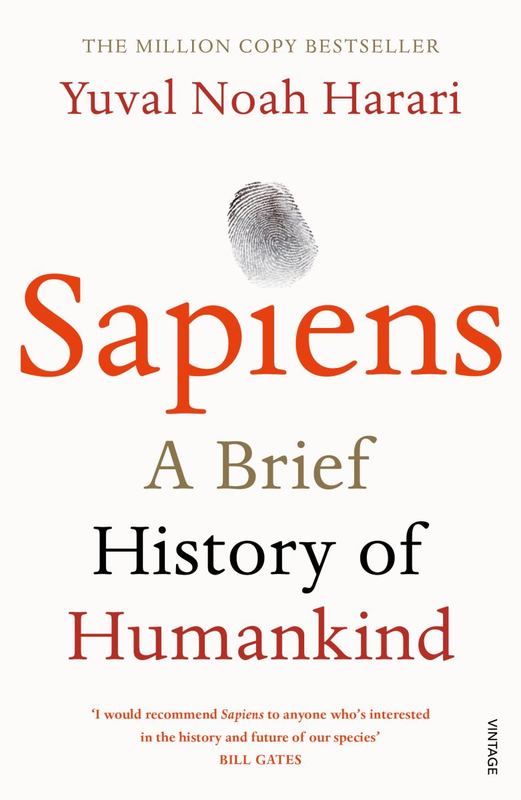
2011 Vintage Books, London
FIRE – GAVE US POWER.
GOSSIP – HELPED US COOPERATE.
AGRICULTURE – MADE US HUNGRY FOR MORE.
MYTHOLOGY – MAINTAINED LAW AND ORDER.
MONEY – GAVE US SOMETHING WE CAN REALLY TRUST.
CONTRADICTIONS – CREATED CULTURE.
SCIENCE – MADE US DEADLY.
P17
But if the Interbreeding Theory is right, there might well be genetic differences between Africans, Europeans and Asians that go back hundreds of thousands of years. This is political dynamite, which could provide material for explosive racial theories.
In recent decades the Replacement Theory has been the common wisdom in the field. It had firmer archaeological backing, and was more politically correct (scientists had no wish to open up the Pandora’s box of racism by claiming significant genetic diversity among modern human populations). But that ended in 2010, when the results of a four-year effort to map the Neanderthal genome were published. Geneticists were able to collect enough intact Neanderthal DNA from fossils to make a broad comparison between it and the DNA of contemporary humans. The results stunned the scientific community.
It turned out that 1-4 per cent of the unique human DNA of modern populations in the Middle East and Europe is Neanderthal significant. A second shock came several months later, when DNA extracted from the fossilised finger from Denisova was mapped. ‘the results proved that up to 6 per cent of the unique human DNA of modern Melanesians and Aboriginal Australians is Denisovan DNA.
P19
more tolerant towards an entirely different human species? It may well be that when Sapiens encountered Neanderthals, the result was the first and most significant ethnic-cleansing campaign in history.
P46
…some evolutionary psychologists argue that ancient foraging bands were not composed of nuclear families centred on monogamous couples. Rather, foragers lived in
communes devoid of private property, monogamous relationships and even fatherhood. In such a band, a woman could have sex and form intimate bonds with several men (and women) simultaneously, and all of the band’s adults cooperated in parenting its children. Since no man knew definitively which of the children were his, men showed equal concern for all youngsters.
P47
The proponents of this ‘ancient commune’ theory argue that the frequent infidelities that characterise modern marriages, and the high rates of divorce, not to mention the cornucopia of psychological complexes from which both children and adults suffer, all result from forcing humans to live in nuclear families and monogamous relationships that are incompatible with our biological software.
Many scholars vehemently reject this theory, insisting that both monogamy and the forming of nuclear families are core human behaviours. Though ancient hunter-gatherer societies tended to be more communal and egalitarian than modern societies, these researchers argue, they were nevertheless comprised of separate cells, each containing a jealous couple and the children they held in common. This is why today monogamous relationships and nuclear families are the norm in the vast majority of cultures,,,
…
In order to resolve this controversy and understand our sexuality, society and politics, we need to learn something about the living conditions of our ancestors, to examine how Sapiens lived between the Cognitive Revolution of 70,000 years ago, and the start of the Agricultural Revolution about 12,000 years ago.
Unfortunately, there are few certainties regarding the lives of our forager ancestors, the debate between the ‘ancient commune’ and ‘eternal monogamy’ schools is based on flimsy evidence.
P51
‘The heated debates about Homo sapiens ‘natural way of life’ miss the main point. Ever since the Cognitive Revolution, there hasn’t been a single natural
way of life for Sapiens. There are only cultural choices, from among a bewildering palette of possibilities.
P59
When an old Aché woman became a burden to the rest of the band, one of the younger men would sneak behind her and kill her with an axe-blow to the head. An Aché man told the inquisitive anthropologists stories of his prime years in the jungle. ‘I customarily killed old women. I used to kill my aunts... The women were afraid of me . . . Now, here with the whites, | have become weak.’ Babies born without hair, who were considered underdeveloped, were killed immediately. One woman recalled that her first baby girl was killed because the men in the band did not want another girl. On another occasion a man killed a small boy because he was ‘in a bad mood and the child was crying’. Another child was buried alive because ‘it was funny-looking and the other children laughed at it.
We should be careful, though, not to judge the Aché too quickly. Anthropologists who lived with them for years report that violence between adults was very rare. Both women and men were free to change partners at will. They smiled and laughed constantly, had no leadership hierarchy, and generally shunned domineering people. ‘They were extremely generous with their few possessions, and were not obsessed with success or wealth. ‘The things they valued most in life were good social interactions and high-quality friendships.*
P105
In order to turn bulls, horses, donkeys and camels into obedient draught animals, their natural instincts and social ties had to be broken, their aggression and sexuality contained, and their freedom of movement curtailed. Farmers developed techniques such as…
P111
The typical peasant developed a very strong attachment to this structure. This was a far-reaching revolution, whose impact was psychological as much as architectural, Henceforth, attachment to ‘my house’ and separation from the neighbours became the psychological hallmark of a much more self-centred creature.
P137
Between the years 3500 BC and 3000 BC, some unknown Sumerian geniuses invented a system for storing and processing information outside their brains, cone that was custom-built to handle large amounts of mathematical data, The Sumerians thereby released their social order from the limitations of the human brain, opening the way for the appearance
ties, kingdoms and empires. The data-processing system invented by the Sumerians is called ‘writing’.
P154
Throughout history, and in almost all societies, concepts of pollution and purity have played a leading role in enforcing social and political divisions and have been exploited by numerous ruling classes to maintain their privileges. The fear of pollution is not a complete fabrication of priests and princes, however. It probably has its roots in biological survival mechanisms that make humans feel an instinctive revulsion towards potential disease carriers, such as sick persons and dead bodies.
P160
Nothing was as revolting to American southerners (and many northerners) as sexual relations and marriage between black men and white women, Sex between the races became the greatest taboo and any violation, or suspected violation, was viewed as deserving immediate and summary punishment in the form of lynching,
P162
In many societies women were simply the property of men, most often their fathers, husbands or brothers. Rape, in many legal systems, falls under property violation ~ in other words, the victim is not the woman who was raped but the male who owns her. ‘This being the case, the legal remedy was the transfer of ownership ~ the rapist was required to pay a bride price to the woman’s father or brother, upon which she became the rapist’s property. ‘The Bible decrees that ‘If a man meets a virgin who is not betrothed, and seizes her and lies with her, and they are found, then the man who lay with her shall give to the father of the young woman fifty shekels of silver, and she shall be his wife’ (Deuteronomy 22:28-9). The ancient Hebrews considered this a reasonable arrangement.
P164
How can we distinguish what logically determined from what people merely try to justify through biological myths? A good rule of thumb is ‘Biology enables, culture forbids.’ Biology is willing to tolerate a very wide spectrum of possibilities. It’s culture that obliges people to realise some possibilities while forbidding others.
P172
It is particularly noteworthy that even before 1492, most societies in both America and Afro-Asia were patriarchal, even though they had been out of contact for thousands of years. If patriarchy in Afro-Asia resulted from some chance occurrence, why were the Aztecs and Incas patriarchal? It is far more likely that even though the precise definition of ‘man’ and ‘woman’ varies between cultures, there is some universal biological reason why almost all cultures valued manhood over womanhood. We do not know what this reason is.
‘There are plenty of theories, none of them convincing.
P183
Another example is the modern political order. Ever since the French Revolution, people throughout the world have gradually come to see both equality and individual freedom as fundamental values. Yet the two values contradict each other. Equality can be ensured only by curtailing the freedoms of those who are better off.
P235
[Law of Religion] First, it must espouse a universal superhuman order that is true always and everywhere. Second, it must insist on spreading this belief to everyone. In other words, it must be universal and missionary. The best-known religions of history, such as Islam and Buddhism, are universal and missionary. Consequently people tend to believe that all religions are like them. In fact, the majority of ancient religions were local and exclusive. Their followers believed in local deities and spirits, and had no interest in converting the entire human race. As far as we know, universal and missionary religions began to appear only in the first millennium sc. Their emergence was one of the most important revolutions in history, and made a vital contribution to the unification of humankind, much like the emergence of universal empires and universal money.
P236
How then to safeguard the fecundity of the flocks?
A leading theory about the origin of the gods argues that gods gained importance because they offered a solution to this problem. Gods such as the fertility goddess, the sky god and the god of medicine took centre stage when plants and animals lost their ability to speak, and the gods’ main role was to mediate between humans and the mute plants and animals, Much of ancient mythology is in fact a legal contract in which humans promise everlasting devotion to the gods in exchange for mastery over plants and animals ~ the first
chapters of the book of Genesis are a prime example. For thousands of years after the Agricultural Revolution, religious liturgy consisted mainly of humans sacrificing lambs, wine and cakes to divine powers, who in exchange promised abundant harvests and fecund flocks.
P248
Another key dualistic concept, particularly in Gnosticism and Manichaeanism, was the sharp distinction between body and soul, between matter and spirit. Gnostics and Manichaeans argued that the good god created the spirit and the soul, whereas matter and bodies are the creation of the evil god. Man, according to this view, serves as a battleground between the good soul and the evil body.
P258
‘one deeply influenced by the theory of evolution. In contrast to other humanists, the Nazis believed that humankind is not something universal and eternal, but rather a mutable species that can evolve or degenerate. Man can evolve into superman, or degenerate into a subhuman.
P263
At the same time, a huge gulf is opening between the tenets of liberal humanism and the latest findings of the life sciences, a gulf we cannot ignore much longer. Our liberal political and judicial systems are founded on the belief that every individual has a sacred inner nature, indivisible and immutable, which gives meaning to the world, and which is the source of all ethical and political authority. This is a reincarnation of the traditional Christian belief in a free and eternal soul that resides within each individual. Yet over the last 200 years, the life sciences have thoroughly undermined this belief. Scientists studying the inner workings of the human organism have found no soul there. They increasingly argue that human behaviour is determined by hormones, genes and synapses, rather than by free will – the same forces that determine the behaviour of chimpanzees, wolves and ants.
P405
…off daughters to men more than twice their age. Today, parental authority is in full retreat. Youngsters are increasingly excused from obeying their elders, whereas parents are blamed for anything that goes wrong in the life of their child, Mum and Dad are about as likely to get off in the Freudian courtroom as were defendants in a Stalinist show trial.
P434
It is true that married people are happier than singles and divorcees, but that does not necessarily mean that marriage produces happiness. It could be that happiness causes marriage. Or more correctly, that serotonin, dopamine and oxytocin bring about and maintain a marriage. People who are born with a cheerful biochemistry are generally happy and content. Such people are more attractive spouses, and consequently they have a greater chance of getting married. They are also less likely to divorce…
P440
And so would Christian theologians. St Paul and St Augustine knew perfectly well that if you asked people about it, most of them would prefer to have sex than pray to God. Does that prove that having sex is the key to happiness? Not according to Paul and Augustine. It proves only that humankind is sinful by nature, and that people are easily seduced by Satan. From a Christian viewpoint, the vast majority of people are in more or less the same situation as heroin addicts.