The Mind and Death of a Genius
by David Abramsen.
According to Weininger’s uncompromisingly dualistic philosophy, man represents the positive, productive, moral principle, while woman is absolutely negative, unproductive and amoral. The misery of mankind is caused by the bisexuality of all human beings, by the fact that each being is a mixture of male or good elements and of female or evil elements. Seeing a great humiliation and deterioration of man in his relationship with woman, Weininger advocated total abstinence and consequently the end of human physical life as a panacea.
The Mind and Death of a Genius is a psychoanalytic biography by David Abrahamsen about the Austrian philosopher Otto Weininger, who committed suicide in 1903 at age 23. The book analyzes Weininger’s personality, his controversial book Sex and Character, and attempts to link genius with mental illness, suggesting he may have had a paranoid form of schizophrenia.
https://www.google.co.nz/books/edition/The_Mind_and_Death_of_a_Genius/X24rAAAAIAAJ?hl=en
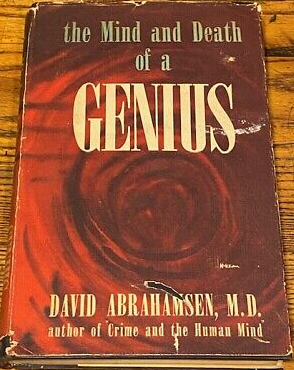
Pg 49
“It is easier for the complex man to understand another person when he has within himself simultaneously the nature of the other person and its opposite. Duality is the condition for noticing and understanding.”
Pg 61
Uncertainty “stemmed from the days when the human being first noticed that he had two contradictory currents within himself: the romantic and the realistic; the mystical and the empirical; the idealistic and the positivistic.
pg 102
…it is possible to discern between two different kinds of ideals – the one group originating in man…There is a specific masculine morality and there is a specific feminine morality in ethical dualism, not monism.
https://pep-web.org/browse/document/paq.016.0406a?page=P0406
This book by Dr. Abrahamsen is a new attempt to reinterpret the eccentric personality of the author of Geschlecht und Charakter.
It is now impossible to understand the storm of controversial discussions and heated polemics Weininger and his book produced. The enormous output of literature in defense and against his book, Sex and Character, which the author published at the age of 23, is a unique episode in cultural history of Europe. Judging by the diverse and polyglotic literature, the generation of Otto Weininger believed that a new planet had swum into the ken of psychology. That his name was soon forgotten, save for an esoteric group of faithful disciples who made attempts to keep his memory alive, is no wonder. The development of modern psychoanalytic psychology made Weininger’s philosophy partly obsolete.
Whether he was a genius, and Freud thought he was (p. 51), or just a daring precocious mind with amazing erudition and excellent journalistic style—these are problems of keen interest to any psychologist and psychiatrist.
Abrahamsen interprets Weininger’s life with much clinical acumen and in a very detached, almost academic fashion. He was fortunate to assemble new material concerning Weininger’s family background, and he utilized it very skilfully in portraying the life of the young genius-scholar. The author grasped the significance of the spirit of Vienna in those years, without which the meteoric appearance of a Weininger is inexplicable. However, one regrets the omission of the beautiful autobiography by Stefan Zweig, which views in the most eloquent way with a certain retrospective nostalgia that very intellectual climate in which Weininger was reared.
By Alfred Werner, Jan. 12, 1947. This is a digitized version of an article from The Times’s print archive.
FORTY-THREE years ago, on an October evening, a young Austrian scholar, Otto Weininger, Ph. D., killed himself in the same old Viennese house where Beethoven had died. A few months before that act of despair, 23-year-old Weininger had published an ambitious psycho- logical treatise, “Geschlecht und Character” (“Sex and Character”), a 600-page affair. It was first received with indifference or hostility, but in the course of time it attained nearly thirty German editions and was trans- lated into several languages, in- cluding English. Briefly speaking, it is an at- tempt to show the intimate con- nection between sex and char- acter. According to Weininger’s uncompromisingly dualistic phi- losophy, man represents the posi- tive, productive, moral principle, while woman is absolutely nega- tive, unproductive and amoral. The misery of mankind is caused by the bisexuality of all human beings, by the fact that each being is a mixture of male or good elements and of female or evil elements. Seeing a great hu- miliation and deterioration of man in his relationship with woman, Weininger advocated to- tal abstinence and consequently the end of human physical life as a panacea. Although himself of Jewish origin, in the same book he hurled the bitterest accusa- tions against allegedly “femf- nine” Jewry, accusations which, later on, were frequently used by anti-Semitic agitators. FRE REUD and dismissed “Sex Character” as a “rotten book” that “cannot be taken seriously,” whereas Strindberg hailed it as an “awe-inspiring book which has probably solved the most diffi- cult of all problems,” i. e., the sex problem. The average reader, however, to whom the Norwegian psychiatrist, Dr. Abrahamsen, dedicated this first Weininger bi- ography ever published in Eng- lish, would probably reject the Austrian’s unhealthy philosophy (contained in the aforementioned opus magnum and in two post- humously published collections of essays and aphorisms) with as much disgust, unchecked by an occasional flash of admiration, as he is likely to resent some of the untenable statements made in “Ecce Homo.” Both Nietzsche and Weininger suffered from de- lusions of grandeur, both even- tually believing that they were reincarnations of the Messiah. Nietzsche’s case history has been treated in many different vol- umes, whereas Dr. Abrahamsen’s book is the first attempt to in- terpret Weininger’s puzzling per- sonality with the tools of modern psychology and psychoanalytic psychiatry. We see Otto as a precocious child, then as an unusually gifted adolescent, anxiously watching the conflict between his tyranni- (Continued on Page 22)
Dualistic Philosophy
(Continued from Page 20) tical father, a famous goldsmith with extraordinary musical tal- ents, and the humble, domestic mother: “There can be little doubt that his father’s severity to his mother was instrumental in forming the devastating view of women Otto held later.” There can also be little doubt about the young scholar’s strong homosexual leanings, however desper- ately he strove to suppress them. Were his friends right who in- sisted that the philosopher showed “keine Spur von Geistes- verwirrung” (not a trace of men- tal disturbance)? Or were his opponents justified in dismissing him as a madman? Dr. Abraham- sen apparently is more interest- ed in solving this problem than in any discussion of the merits or faults of Weininger’s theories.
ONE welcomes the fact that Dr. Abrahamsen did not plan the book as a defense of Weininger’s condemnable philosophy but merely as a clinical study under- standable to both professional alienists and laymen. And yet he permits himself the statement that though Weininger’s mind was diseased, that fact did not necessarily detract from the value of his work. After all, mad- ness is madness, though there be method in it, and this reviewer clearly remembers the damage caused in Central Europe by “Sex and Character,” especially among young intellectuals some of whom went so far as to deify its author. Dr. Abrahamsen secured a great deal of personal informa- tion on the unhappy Viennese from Weininger’s sister and friends, as well as from Professor Freud, whom Weininger had vain- ly approached to ask his help in finding a publisher. To what de- gree one accepts the psychia- trist’s interpretations of “patient’s” psychopathic symp- toms will depend on how much of the of Freudianism the reader is ready to accept. One deplores in this otherwise valuable study a cer- tain negligence in the use terms, some of them being used on one page in the strictly sci- entific sense, on another in the popular sense.