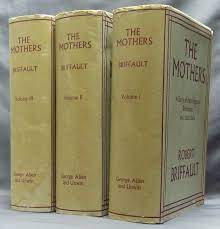
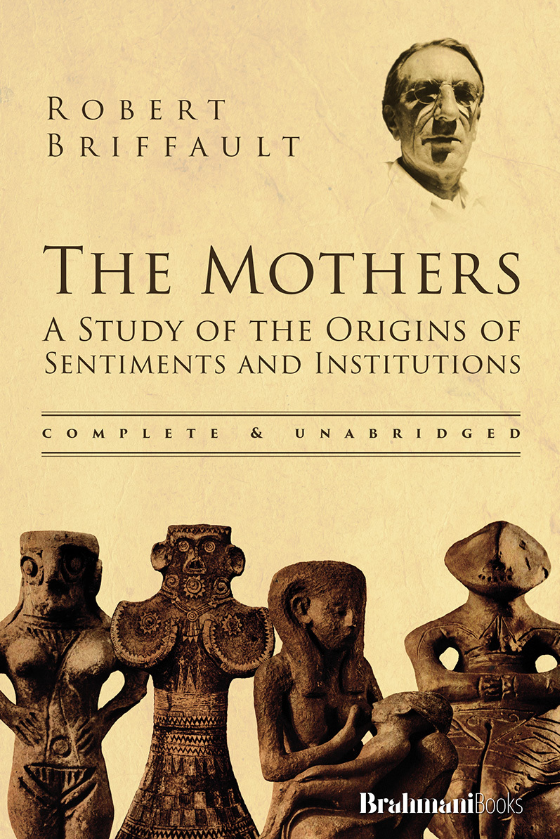
A Study of the Origins of Sentiments and Institutions.
by Robert Briffault.
The learned Swiss jurist Bachofen, who was the first to draw attention to some of the evidence showing the prevalence at one time of feminine dominance, suggests that women rebelled in disgust at the promiscuity imposed by male rule…
But nothing could be more fantastically impossible than such an occurrence. Sexual morality has for the most part been imposed by man on woman, not by woman on man. There is no tendency in woman to object to the sexual standards, whatever they may be, which obtain in her environment. The popular delusion that she in any way resents polygamy is destitute of foundation.
On Kindle: https://read.amazon.com/?asin=B089FRCTKK&ref_=kwl_kr_iv_rec_1
P16
The name, or ‘logos,’ of a thing was regarded as intimately connected with the very nature of the thing. In Plato’s famous doctrine the word, or ‘logos,’ is not a mere label or symbol, or a representation of the thing, but on the contrary it is the true reality and has an independent existence, while the sensible, material thing is but a shadow, as it were, projected by its eternal paradigm.
P85
Even social institutions which are looked upon as of paramount importance, such as the principle of private property, the institution of monogamic marriage, or the dominance of the male in the family and the subordinate position of women, tend to be viewed as founded on the natural and inherited dispositions of human nature, as having existed from the first in substantially the same form as in our own societies, and as being innate, that is, transmitted physiologically and not by social tradition. Able writers have sought to show that such sentiments as the regard for chastity, or the sentiment of modesty, are implanted by nature in the human mind.
P93
Freudian psychology, the current estimates of which are coloured by the sharp contrasts of extreme controversial appreciations and depreciations, has undoubtedly made contributions of great value to our psychological conceptions; it has emphasised facts which were in need of being emphasised, and raised questions which it was important to raise.
P101
In the same manner as the reactions of primitive protozoa and primordial marine creatures survive in the modes of activity of our physiological organism, so every idea, every institution, every custom, that has at one time become firmly established in human society, whether its origin dates back ten or ten thousand years, is perpetuated in traditional heredity; no item of that inheritance is ever lost or abolished. The social constitution may be changed, the primitive idea may become adapted to functions the very opposite of those in relation to which it originated; yet in no instance is it wiped away from the human mind.
[cf: Jung collective unconscious]
P103
When we speak of ‘human nature’ we generally mean masculine human nature. We are in the habit of regarding the evolution of humanity and of human ideas and sentiments as, in the main, products of the masculine mind.
P104
The other was the discovery that the part played in primitive society by women and their influence differed markedly from that which their place in civilised societies during historical times has assigned to them.
The latter conclusion is generally spoken of as the theory of matriarchy, a name given to it by McLennan in opposition to the current theory which traced social origins to a patriarchal age such as that represented in the Biblical descriptions of early Hebrew nomads.
P132
Dr. Havelock Ellis remarks: “It is an interesting fact, and perhaps of some significance, that among primitive races in all parts of the world, the children, at an early age, are very precocious in intelligence. … It seems that, the lower the race, the more marked is the precocity and its arrest at puberty.”
P135
The physical characters of those races would themselves seem to show the persistence of a more infantile type. The lack of pigmentation which is characteristic of them, and is exceptional in the animal kingdom, is an embryonic character; the light skin, the fair hair and blue eyes of the northern peoples whose restless energy and initiative have disturbed the world, are abnormalities in adult animals and men, but are the rule in the undeveloped foetus of darker races.
P148
The primitive, and by far the most prevalent, association of the sexual impulse is not with love, but with the opposite feelings of callous cruelty and delight in the infliction and the spectacle of pain.
P150
According to M. d’Enjoy, the kiss has developed out of the love-bite. 19 In many parts of Europe women are not convinced of their lover’s or husband’s affection unless their own bodies bear the visible marks of it in the form of impressions from their teeth.
P151
Sentiments of tenderness and affection between the sexes are not originally connected with the sexual impulse, but with an entirely different instinct, the mating instinct. The utmost confusion has resulted from failing to draw any distinction between the two. They have different origins and fulfil different functions. The operation of the sexual impulse does not demand anything beyond the performance of the sexual act; mating, or association between the sexes, is a special adaptation to the reproductive functions of the female.
P171
No greater inducement could be offered to the male to modify his sexual instincts in adaptation to the mating instinct of the female than the latter’s transferred affection, for it is the equivalent of the maternal tenderness and devotion under the aegis of which his development has taken place. The mating instinct leading to prolonged association is nevertheless entirely foreign to his sexual instincts.
P176
sluttish, and disgusting or ridiculous in her attire. Admiration for the imaginative objectivation of all ideals of what is deemed desirable is incorporated, no less than aesthetic ideals, in romantic affection, the cultural results of mental and moral development thus forming part of the sentiment. Sympathetic participation, mostly imaginary, in common tastes; the release of conventions in the freedom of intimacy, the gratifications of proprietary feelings and of vanity must be added.
P225
Masculine intellectual superiority, assuming the extremest view of its nature, has reference to mental spheres which are products, for the most part advanced products, of social evolution.
P227
True herd association, when and while it takes place, means the dissolution of the maternal group, or family. The maternal instincts are checked and rudimentary. When the mother, in obedience to the sexual impulse, joins the herd, she renounces the exercise of those maternal instincts which directly conflict with the sexual instincts, and abandons her male offspring. The family group is abolished. The circumstance of polygamy or of monogamy has no bearing on the essential constitution of the groups. The maternal instinct is not atrophied as a result of polygamous intercourse, but the polygamous group results from the atrophied condition of the maternal instinct; polygamy is an effect, not a cause.
“When polygamy obtains,” observes Mr. Pycraft, “the females are not seized and captured by the males, they are not the victims of a lecherous lord. On the contrary they seek the males, and the intensity of the desire to satisfy their natural cravings extinguishes any feelings of jealousy.”
P229
The family group can be maintained only by the segregation and retirement of the female; and, while that form of group easily lapses into the promiscuous herd, it is, on the other hand, well-nigh impossible for the herd to become transformed…
P234
The earliest human assemblages must therefore have been derived from animal groups belonging to the type of the animal family; they were not the manifestations of the sexual impulses of the male, but of the maternal instincts of the female.
P239
Whenever, among animals, such an assemblage of a large number of families takes place even temporarily, the family grouping tends to be broken up, and the constitution of larger group lapses into that of the promiscuous herd.
P240
The group would, in fact, be a patriarchal herd in which a few of the stronger males would hold the weaker ones and all the females in subjection.
P241
There is, in fact, one way, and one only, whereby the feminine constitution of the family could have been maintained, while it expanded at the same time into a larger assemblage, namely, by the sons leaving the group, and the daughters remaining and pairing with males from some other group.
P245
It is only since the end of the last century that endeavours have been made to enquire into the grounds of that belief, and to substantiate it by a reference to facts. Those attempts have resulted in complete failure; but, since that ancient belief is still sometimes…
P315
The awe with which the primitive human mother was regarded, and her natural supremacy in the group of which she was the creator, have passed away before the rule and power of the male, whether officially established or operating ‘de facto’ by virtue of his function as hunter and as warrior; even where the original relation of the mother to the family has persisted most unchanged it is a shadow of the natural hegemony which she wielded over the primordial human family.
P330
Bechuana tribes. The latter have a proverb: “Happy is she who has borne a daughter; a boy is the son of his mother-in-law.”
P335
The matriarchal character of Targi society was first noticed by the first traveller who described them in modern times, the Arab Ibn Batuta. “The women,” he says, “are exceedingly beautiful, and they are of more consequence than the men. The character of these people is indeed strange, for they are quite impervious to jealousy. None is named after his father, but each derives his descent from his uncle on the mother’s side. Only a man’s sister’s children inherit from him, to the exclusion of his own children. … As regards the women, they are not timid in the presence of men nor do they cover their faces with a veil, although they are zealous at their prayers. Whoso wishes to marry any of them may do so, but the women do not follow their husbands, and should any of them wish to do so, her relatives would prevent it.”
P343
In New Zealand a young man on marriage “continued to live with his father-in-law, being looked upon as one of the tribe, or ‘hapu,’ to which his wife belonged, and in case of war the son-in-law was often obliged to fight against his own relations. So common is the custom of the bridegroom going to live with his wife’s family that it frequently occurs, when he refuses to do so, that his wife will leave him and go back to her relatives. Several instances came under my notice,” says Mr. Taylor, “where young men have tried to break through this custom and have lost their wives in consequence.”
P380
Woman is immeasurably orthodox; revolt is alien to her nature and to her mentality. A defiant and rebellious attitude is found in women only where they already occupy a position of considerable vantage and influence; it is not found where their status is really one of oppression. However burdensome their position may be, it is accepted; it may be lamented, but it is set down to fate, not to injustice.
P383
The learned Swiss jurist Bachofen, who was the first to draw attention to some of the evidence showing the prevalence at one time of feminine dominance, suggests that women rebelled in disgust at the promiscuity imposed by male rule. “Gynaecocracy,” he wrote, “has everywhere been developed, consolidated, and maintained by the conscious and continuous opposition of woman against a debasing promiscuity.”
But nothing could be more fantastically impossible than such an occurrence. Sexual morality has for the most part been imposed by man on woman, not by woman on man. There is no tendency in woman to object to the sexual standards, whatever they may be, which obtain in her environment. The popular delusion that she in any way resents polygamy is destitute of foundation.
P384
A recent missionary account states: “Polygamy is favoured and fostered equally by men and women; in some respects the latter are the chief supporters of the system. “
P402
In the ‘Mahâbhârata,’ Pandy thus addresses his wife Kunty: “I shall now tell thee about the practice of old indicated by illustrious Rishis fully acquainted with every rule of morality. O thou of handsome face and sweet smiles, women were not formerly immured in houses and dependent upon husbands and relatives. They used to go about freely, enjoying themselves as best they pleased. O thou of excellent qualities, they did not then adhere to their husbands faithfully; and yet, O beauteous one, they were not regarded as sinful, for that was the sanctioned usage of the times. … Indeed, that usage, so lenient to women, hath the sanction of antiquity. The present practice, however, of women being confined to one husband for life hath been established but lately.”
P436
It would thus appear that, as among the savages of Australia, Melanesia, Tierra del Fuego, and as with many other primitive peoples, the first step in the limitation of the primitive status of women was associated with the arrogation by the men of the monopoly of religious and magic functions.
P473
The contest between the plebeians and patricians which occupies so considerable a place in early Roman history is not merely part of the eternal conflict between Disraeli’s ‘two nations, the poor and the rich, but also a conflict between the two forms of organisation of human society, the primitive matriarchal order and the later patriarchal order, brought about by the development of property. The transition from the one to the other appears, then, to have taken place in Rome within almost historical times.
P482
The development of durable private property, of wealth, the desire of the constitutionally predatory male to possess it and to transmit it to his descendants, are, in fact, the most common causes of the change from matriarchal to patriarchal institutions; the other most frequent motive being the desire for a monopoly of certain magical powers primitively regarded as a special attribute of women.
P492
That division of labour has not been determined wholly or chiefly by the respective powers or aptitudes of the sexes or by any physical inferiority in woman, but by the functional necessity which bound her to the care of the offspring and prevented her from undertaking pursuits entailing prolonged absence.
P498
To a large extent the secondary physical sexual characters of men and women would appear to be a product of social conditions and of artificial cultivation.
P504
Primitive women are not only as courageous as the men, but they are, it must be admitted, even more cruel and ferocious. The American Indians handed their prisoners to the women to be tortured…
P512
The question arises whether the art of flint-knapping was not a feminine invention, whether the scraping-knife preceded the axe and the lance-head, and whether man’s first weapons were not, as were his first tools, devised by women.
P543
Psychologically the desire for domination in the male retains that character; it reduces itself to imposed physical coercion. The criterion of power is the ability to compel others against their will. With woman, desire for domination assumes a different form. Her ambition is not to exercise physical compulsion, but to bend the will of others to her desire, to overcome not physical, but psychical resistances.
P551
The male partner in the economic association which constitutes the primitive group is not the husband, but the brother.
P557
frequently does not exist as a physical association. It is common in primitive society for husband and wife not to live together.
P557
Every night the husband leaves his wife and goes to the club to sleep, and as often as not his place is taken by one of the unmarried men.
P572
It is recognised by even the most fervent upholders of the theory that the group of husband and wife constitutes the primary and original unit of human society, that marriage is a social institution.
P574
Even quite uncultured people, when they speculate on the origin of their social organisation, regard marriage as having been established by the enactment of some mythical legislator.
P594
Infringement of the group’s decisions in such matters is usually regarded in primitive communities as the most heinous crime of which a person can be guilty. Any wretch so abandoned as to marry in defiance of that authority, is usually put to death.
P617
…among the Herero, who, there is reason to believe, represent in one of its most unmodified forms the original social organisation of Bantu tribes, the moral obligation of marrying one’s ‘machuna’ cousin is expressly recognised.
P619
among the savages of New Caledonia the men of one village are obliged to obtain their wives from a certain other village, and may not marry a woman either in their own or in any other village except the one to which their own…
P621
Similar arrangements for the mutual exchange of girls exist in various parts of Australia between tribes which Mr. Curr calls “associated tribes. ” Between certain tribes in Western Australia there exists, we are told, scarcely any other intercourse or relation, except the interchange of women.
P624
Between the members of the same village any suggestion of marriage or of sexual relations is regarded in the light of the most horrible incest. The unmarried males and females dwell separately in two large houses at the opposite ends of the village, and so afraid are they of incurring the suspicion that any amatory relations exist between them that they are careful to lower their eyes discreetly when they happen to meet on the road.
P624
Whenever the members of villages which are properly intermarried come together, as on the occasion of a wedding, the celebrations are, we are told, utterly scandalous in their unfettered licentiousness, and it appears that no moral blame whatever attaches to the freest extra-connubial sexual relations, provided always that they take place between members of those corresponding villages.
P634
Practices, institutions and customs continue essentially unchanged; the ‘motives’ which justify them change completely.
P658
to unregulated promiscuity. But the object of those regulations is entirely different from that which we regard as the main purpose of laws of marriage and of principles of sexual morality, namely, to safeguard claims to individual sexual possession. In their origin marriage regulations had no reference to such individual relations, but to relations between groups.
P663
But nothing could differ more from promiscuity than the elaborate sexual organisation of primitive society, and this is more particularly true of those organisations which come nearest to unmodified group-marriage. Promiscuity means properly the absence of sexual regulations and the unchecked operation of instincts; the sexual regulations of the Australian or Melanesian natives are beyond comparison more complex and elaborate than our own.
P677
Where polygyny obtains, the women are the most persistent advocates of the practice, and additional wives are in most instances acquired at the desire of a man’s wife or wives, and are very commonly selected by them.
P689
…a ‘friend’ being necessarily a tribal brother. The practice, very inaptly called ‘hospitality prostitution, is not a matter of misguided benevolence, but a necessary pledge that the guest is a friend and not an enemy. For the guest to refuse is equivalent to repudiating the assumed brotherhood, and is thus tantamount to a declaration of war.
P693
[Eskimo] polygyny is combined with polyandry. In Repulse Bay “it is a usual thing among friends to exchange wives for a week or two about every two months,” and Dr. Murdoch was informed that “at certain times there is a general exchange of wives throughout the village, each woman passing from man to man till she has been through the hands of all.”
P696
it would appear that from Manchuria on the Asiatic side to British Columbia on the American side, the principles which govern collective sexual relations are substantially identical among all tribes, and that with the large majority reciprocal sexual rights between all the males and all the females of two intermarrying groups are recognised and used at the present day, or were so until quite recent times.
P698
Marriage with a woman gives a husband marital rights over all her sisters. At the present time the number of the women greatly exceeds that of the men, owing to constant losses from warfare; but Dr. McGee is of opinion that when the tribe was more flourishing the right of blood-relatives to one another’s sexual mates was mutual, if, indeed, it is not so at the present day.
P711
Marriage is not regarded by the Tibetans as a sexual but as a social and economic relation, the two aspects being kept distinct. The sexual life of the Tibetans is for the most part unconnected with marriage, and is free from restrictions, both before and after marriage, except as regards the begetting of children.
P716
But in point of fact the women are the staunchest supporters of the system, and exclaim in astonishment and disgust on hearing that there are peculiar countries where a woman is allowed only one husband. “Don’t you think we Tibetan women are better off?” asked one lady on hearing of the strange custom.
P717
Himalayan tribes who have adopted individual marriage, this is arranged in places called ‘rambangs,’ which are a kind of club “where men and women spend the night singing lewd love songs and drinking and smoking. Married and unmarried men go there; also single women and married women up to the time that their first child is born. Girls start to go to the ‘rambang’ from the age of ten years, and practically never sleep at home after that age.”
P734
The polyandrous marriage institutions of the Indo-Aryans are referred to in every period of their ancient literature. In the Sacred Laws of the Aryans it is laid down that “a bride is given to the family of the husband, not to the husband alone.”
P758
The fact that no instance of non-fraternal polyandry, as a general custom of spontaneous and independent origin, is definitely known, and that, where such a practice is found it appears invariably to be derived from fraternal group-marriage as an adaptation and modification of the established tradition, is significant. For if, as some have supposed, polyandry were the outcome of various local and accidental conditions, such, for instance, as scarcity of women, there would be no apparent reason why such a practice should not have commonly assumed the form of a deliberate and compacted partnership between persons not necessarily related, as, in fact, it has where polyandry arises adventitiously from such conditions. But no instance is known of such an economic or otherwise deliberately devised polyandry having become customary except as a modification of already existing fraternal group-marriage.
P759
The preliminary puberty rite is originally conceived as the union of the marriageable girl with a god represented by a priest, a sacred person, a stranger, or by an idol or symbol of the god. The rite usually involves the defloration of the girl by the representative of the god.
P764
An acquired moral idea cannot be such unless it is regarded as of absolute and universal validity; and, since to admit that it was not always so regarded would be in direct contradiction with that conception, any usage opposed to that acquired moral value which was formerly looked upon as traditionally sacred must of necessity be disowned.
P776
In addition to those fraternal rights of sexual communism frequent periodical gatherings took place amid much feasting and pomp, lasting several days, during which unrestricted promiscuous intercourse took place, all women being in common to all the men, and no woman being permitted to abide with the same man for more than three nights.
P800
Sir W. В. Spencer and Mr. Gillen are therefore well justified in their remark that “this system of what has been called group-marriage, serving as it does to bind more or less closely together groups of individuals who are mutually interested in one another’s welfare, has been one of the most powerful agents in the early stages of the upward development of the human race.”
P825
The foregoing survey shows that, however rare collective sexual organisations may be at the present day, they are by no means so rare as might be supposed, and that there is scarcely a portion of the habitable globe where those forms of sexual association or the evidence of their recent existence are not to be found.
P842
In all uncultured societies, where advanced retrospective claims have not become developed, and the females are not regularly betrothed or actually married before they have reached the age of puberty, girls and women who are not married are under no restrictions as to their sexual relations, and are held to be entirely free to dispose of themselves as they please in that respect.
To that rule there does not exist any known exception.
P859
Infanticide is not regarded in the lower stages of culture as a criminal act, but is viewed from the point of view of expediency as a Malthusian measure, and no child is reared when it is inconvenient to do so.
P862
When those invalid instances are eliminated, Dr. Westermarck’s enumeration of statements concerning peoples who are said to enforce pre-nuptial chastity is reduced to very moderate dimensions, and the probability of their accuracy is diminished in an even greater degree. In several of the instances adduced, the fact that the reverse of what is suggested by Dr. Westermarck is the case is established beyond doubt; in other instances the authorities referred to by him do not say what he ascribes to them, and sometimes they say the exact opposite.
P864
“the lewdness of the women cannot possibly be carried to a greater excess. They are addicted to the most abominable practices, abandoning themselves in early youth to the free indulgence of their passions. They never marry until satiated with indulgence.”
P874
Of the Baila of Rhodesia, Messrs. Smith and Dale say: “Boys and girls are under no restraint. Whatever they may do is looked upon merely as play. Adults rather encourage than otherwise these precocious acts, for they regard them as a preparation and training for what is man’s and woman’s chief business in life. Whatever they may do during their early years, no blame is assigned.”
P896
In his detailed study of the aborigines of South Australia, Dr. Eylmann says that the girls, “as soon as the sexual instincts begin to awaken, that is between the ages of eight and twelve, give themselves to boys who are no older than themselves.
“The young of both sexes,” says Eyre, “habitually have sexual intercourse.”
P904
The Moriori of the Chatham Islands are in a much more primitive state of culture than the Maori of New Zealand, and are incomparably more secluded from contact with Europeans. Yet they are stated to have been very much laxer in their sexual relations; and whereas a Maori would not infrequently kill his wife if she were taken in adultery, the Moriori women carried on their amours without fear or restriction…
P907
Thus among the Papuans of the Trobriand Islands of New Guinea “chastity is an unknown virtue. At an incredibly early age they become initiated into sexual life. As they grow up, they live in promiscuous free-love, which gradually develops into more permanent attachments, one of which ends in marriage.
P937
When their hunger, nutritional or sexual, is satisfied, when they are sated or spent, they are indifferent to rivalry. If the opportunity of satisfying their sexual hunger is assured they are also quite indifferent to the behaviour of other individuals.
P956
…in Raratonga “adultery is of daily occurrence. Among the Moriori of the Chatham Islands adultery is so lightly regarded by the husbands that the wives are entirely undeterred from freely pursuing their amours as they please.
P977
Far from lending any countenance to the moral doctrines of seventeenth-century theology, the usages and juridic customs of uncultured societies appear to be wholly irreconcilable with those theories. Not only do the sentiments and instincts manifested by primitive people not constitute, as Dr. Westermarck supposes, a strong argument in support of those moral doctrines, but no facts in the domain of ethnology and social science rule them more definitely out of court.
P978
A considerable amount of controversial difference of opinion has existed since the eighteenth century as to the emotional forms which sexual attraction may take in primitive humanity and as to whether savages are capable of romantic passion.
P980
The sexual instincts are the most transformable, the most malleable, the most variable of all instincts, because they are the strongest and invariably potent. Let them but be repressed, let their direct aim be denied them, let the biological outlet be closed, and they will assume unrecognisable forms, from the depths of vice to the highest exaltations of art and of religion.
P980
In European societies the sexual instincts are repressed and denied their direct outlet at the very time when their operation is most insistent and powerful, and their whole subsequent character is, for the individual, determined, namely, on their first appearance at puberty. They are consequently compelled to find other outlets and assume other forms; that repression results, in European civilisation, in various forms of nervous disturbance, in romantic passion, in religious phenomena, in masturbation, in vice, manifestations which are for the most part unknown in primitive societies where no such repression exists.
P983
That radical difference was expressed long ago by Rousseau more clearly perhaps than by many a more modern writer. “Being confined to the purely physical aspect of love, and fortunate in being ignorant of those preferences which irritate the passions and increase the difficulties in the way of their satisfaction, savage men,” he says, “must needs feel less frequently and less powerfully than we do the ardours of temperament; and consequently disputes amongst them are less frequent and less cruel.
P986
In New Zealand “women frequently committed suicide on their inclinations being thwarted or their stubborness resisted.
P1027
In warlike tribes it is usually an indispensable condition of marriage that a man should have given proof of his value as a defender by killing an enemy. Thus among some Yoruba tribes of West Africa a youth is not considered eligible unless he has killed a man.
P1063
as ‘buying wives. Only at a very definite stage of cultural evolution has the man become an owner of transferable and fundable property, and in a position to drive a bargain, and to commute all contributions to the woman’s family by a lump payment.
P1085
Or again, amongst the Kamchadals, who attach great importance to the severity of the tests imposed upon the bridegroom during his probationary period of service, he is obliged, in order to establish finally his right to the bride, to undress her and touch her vulva in spite of every obstacle placed in the way of his doing so. The woman is dressed for the occasion in many layers of leather gowns and pantaloons securely sewn on her and made fast by a multitude of straps, so that she looks “like a stuffed figure”…
P1093
One of the most familiar usages that have suggested an attenuated survival of ‘marriage by capture’ is the practice of lifting the bride over the threshold of her husband’s house. The custom is very widespread.
P1096
Hence it is that that sexual selection in primitive societies is exercised by the women and by their relatives rather than by the men, that it is the man’s qualifications as a husband which throughout primitive society are so elaborately tested, and that, as throughout the animal kingdom, it is the males who vie with one another to excel in those qualities which the women admire, and adorn themselves to charm them, while primitive womankind is careless of the arts of sexual attraction.
P1107
Monogamic marriage, the product of the transition from primitive to agricultural society without any intervening pastoral stage, is thus rooted in the special conditions which have led to European civilisation.
P1120
The ‘prohibition’ of polygyny, which was thought ‘natural’ and “to be met with among all nations in a state of refinement,” was promulgated for the first time in any part of the world in the code of Justinian in the sixth century of our era.
P1144
“all the men are accustomed to have as many wives as they can support. The women are extremely lewd, and they even encourage their own daughters to live a life of unchastity.”
P1154
Dr Westermarck says that Mr. Curr “has discovered some truly monogamous tribes. ” But nobody else has; and Dr. Malinowski, Dr. Westermarck’s disciple, is compelled to contradict him, and to admit that “polygyny seems to be found in all the tribes. “
P1199
The bride per formed a certain ceremony in connection with the statue of a god which was so embarrassing and indelicate that the Roman women positively refused to go through the ritual in public, and their modesty had to be accommodated by arranging to have it per formed privately in a side-room. But that ‘religious marriage’ had nothing to do with ‘farreo’ marriage,
P1208
The most distinctive character of the human mind and of human behaviour lies, as we noted at the outset, in the dualism presented by the transmitted products of social tradition on the one hand, and inherited impulses and instincts on the other, and in the constant control exercised by the former over the latter. Man is a moral animal; he is the only moral animal, for ‘morality,’ as commonly understood, consists in that regulation and inhibition of natural instincts, and there is nothing equivalent to it in the mental operations and the behaviour of animals.
P1214
Only when the primitive constitution of society becomes sapped by the establishment of private property, and the instincts on which it is based are consequently supplanted by individualism, do social laws and the formulation of principles of social morality become necessary.
P1219
At public executions it was difficult to restrain the eagerness of the spectators to dip their handkerchiefs in the blood of the victim; and late in the last century, in Berlin, men drank the blood of an executed malefactor in the belief that it was a remedy for all ills. The reason undoubtedly is that a condemned criminal is a ‘sacred’ person.
P1225
Throughout the diversity of primitive tabus there is, in fact, one class which is invariably present, however much other tabus may vary, and which occupies an even more fundamental place in uncultured communities than any other, for indeed their whole organisation is founded upon them. Those are the tabus referring to women and to sexual intercourse.
P1270
In primitive conceptions those things which have come to be generally regarded as ‘sacred’ and holy, in the best acceptation of those terms, are as often as not looked upon with horror and repulsion; and those, on the other hand, which have come to be conceived as utterly evil and ‘impure’ are as commonly regarded as partaking of a ‘sacred’ or divine character and as proper objects for veneration.
P1276
…point to the conclusion that the veto imposed by women upon the masculine impulses during their periodical unfitness for sexual functions was the earliest formulated prohibition imposed upon the operation of natural instincts, and embodied in human tradition. It was therefore the prototype of all such prohibitions or tabus. In the evolution of those specific psychological characters of human mentality, as in all other evolutions, it is the first step that counts.
P1276
…for of all moral restrictions on human behaviour none are regarded as of such transcendent importance as those which have reference to the restraint of the sexual instincts, and morality is in the highest cultures currently understood to be synonymous with sexual morality.
P1289
The actual connection between the physiological and the lunar cycle is in all probability due, as Darwin suggested, to the fact that animal life developed during the greater part of its evolution in the sea. The vital rhythm, impressed once for all during incalculable ages upon all physiological functions in primitive marine forms of life by the periodical changes in the environment produced by tidal phenomena, has persisted in the periodical variations of all their descendants.
P1355
All human associations that have subsequently arisen have been bound by loose and feeble ties compared with the primitive maternal clan. Political organisations, religious theocracies, States, nations, have endeavoured in vain to achieve real and complete social solidarity.
P1364
One of the most fundamental and startling differences between the mentality of primitive humanity and the current conception of human nature, is the degree, almost inconceivable to us, in which the sentiment of individuality is undeveloped in the primitive mind.
P1379
Sir James Frazer has, among his many contributions to our better understanding of the development of human ideas, familiarised us with the fact that one of the chief, if not indeed the chief function of all primitive priest-kings was the control of the weather, and more particularly of the rainfall.
P1392
The power derived from the exercise of magical and religious functions has, we shall presently see, often given rise to a contest and competition between the sexes for the possession of that power; and those functions are accordingly frequently reserved to one or the other sex, the opposite sex being rigorously excluded. But such a monopoly is not characteristic of those societies which have reached a considerable degree of development under undisturbed matriarchal rule. In those instances men are seldom strictly excluded from religious ceremonies.
P1433
It is, of course, not inconsistent with the character of a young and beautiful woman to be bewitching. The Arabs, indeed, are convinced that a man, when he falls in love, is invariably the victim of magical practices.
P1435
The special liability of women to hysterical manifestations appears, in point of fact, to be far less pronounced in primitive than in civilised races. Hysterical women are for the most part idle and pampered women suffering from the effects of unnatural inhibitions of their sexual functions.
P1437
That same power, used in a dread-inspiring manner, was primitive woman’s natural means of enforcing her authority when circumstances demanded its exercise; it was her substitute for physical force. Her power was that of pronouncing curses, of casting spells. It was by that power, if our conclusions are correct, that were originally imposed upon mankind those dreaded sexual tabus which have played so momentous a part in the history and development of the race.
P1437
The authority which the natural constitution of primitive human groups assigned to the women, and especially to the elder women, was naturally enforced by woman’s traditional weapon, her tongue; and the dread which she inspired was chiefly associated with her faculty of uttering curses or, what in primitive conceptions is the same thing, of bewitching and performing incantations. It was a dreaded power.
P1535
It is implied in the foregoing myths, as in well as with its perishable nature. the narrative of Genesis, that men lost, or gave up, their hope of immortality owing to their fatal subjection to women and to their sexual passions.
P1733
No man can become a rain maker except he is born of a rain-making woman.
P1734
In the same manner as primitive emotions and sentiments have become transmuted into the products of creative art by the intellectual operation of the masculine mind, so primitive magic and superstition have been transformed by the male intellect into theological religions.
P1810
It was the great development of agriculture that laid the foundations of Western civilisation, which gave rise to the preeminent position which the Great Goddesses occupied at the dawn of our culture.
P1860
She is habitually referred to as ‘The Virgin,’ ‘The Holy Virgin,’ ‘The Virgin Mother.’ The term ‘virgin’ is, if course, used in those titles in its primitive sense as denoting ‘unwed,” and connoting the very reverse of what the term has come to imply. The virgin Ishtar is also frequently addressed as ‘The Prostitute’; and she herself says, “A prostitute compassionate am I.” She wears the ‘posin,’ or veil, which, as among the Jews, was the mark of both ‘virgins’ and prostitutes. The hierodules, or sacred prostitutes of her temples, were also called “the holy virgins.”
P1862
The character of Virgin, in its primitive sense of free and unwed, is everywhere the denotation of the independence of the goddess in the phase of her supremacy.
P1881
…festival for the multiplication of buffaloes. Promiscuous intercourse took place during the magical ceremony. They state that the festival was instituted by the women.
P1890
But although the bull is a natural emblem of fertilising power, it appears, I think, conclusively that the primary ground for the equation and for the widespread identification of gods with bulls was the assimilation of the horned animal to the moon.
P1891
…earth’s fertility by ritual magic. The belief that the sexual act assists the production of an abundant harvest of the earth’s fruits, and is indeed indispensable to secure it, is universal in the lower phases of culture.
P1892
Men and women then assembled naked, and at a given signal ran a race, and every man had intercourse with the woman he caught.
P1892
…chief religious festival, or Kamaruko, concludes with a general sexual orgy. Among the tribes of the plains of North America and of the lower Mississippi valley the harvest festivals were attended with general licence, and the old men and women exhorted the younger ones to indulge without restraint.
P1893
The Holi festival, which is celebrated in every part of Hindustan in honour of the goddess Vasanti is an occasion on which “the most licentious debauchery and disorder reign throughout every class of society. It is the regular Saturnalia of India. Persons of the greatest respectability, without regard to rank or age, are not ashamed to take part in the orgies which mark this season of the year.”
P1896
Festivals of promiscuity, or of general relaxation of sexual moral codes, reminiscent of such promiscuity, have survived in most countries in relation to what originally were agricultural festivals to evoke the magic powers of fertility. The Roman Saturnalia were the feasts of sowing, and there is every reason to believe that in earlier times the general relaxation of ordinary decorum and the freedom granted even to slaves included, as in other similar festivals, the suspension of sexual codes and general promiscuity. The Carnival is the old licence festival.
P1896
The licentious character which marked the cults of the Great Mothers throughout Mediterranean countries appears to have survived in some parts of Italy down to the present day.
P1897
If a chief was ill, some young girls were chosen to perform the sacred rites of promiscuity. Young women vied for the honour of being chosen and were filled with pride in consequence.
P1898
The principle that the anger of the gods might be averted by promiscuous sexual intercourse was, however, as clearly recognised by them as by the savages of…
P1898
Why should the removal of all tabus on sexual relations, and indulgence in unrestricted promiscuity be regarded as pleasant to the gods, who are generally credited with having imposed those very restrictions? The reason is, I think, plain when those usages are considered in correlation with other facts. By the removal of personal claims to individual women, the latter are, as it were, offered to whomsoever it may please to take them, and therefore to the god or gods, who are given the same opportunity as any other person.
P1899
In many of the rites of sacred prostitution among uncultured peoples and in the ancient world, the man who is invited to take advantage of them is expressly described as a ‘stranger.” To the primitive mind there is always a possibility that a stranger may be a god in disguise, and that when the stranger is honoured, a god has been entertained unawares.
P1899
The rites known as Sakti-puja are practised by most Brahmans and by about three-fourths of the Hindu population of Bengal. A number of couples meet in the middle of the night. The goddess Sakti is represented by a nude woman adorned with jewels, and is worshipped with strange ceremonies. A banquet takes place, and is followed by promiscuous intercourse, “all distinctions of caste, rank, and kindred being temporarily suspended. During their orgiastic religious rites, every man present is, according to their pantheistic notions, Siva himself, and every woman there none other than Siva’s consort.”
It was thought by earlier anthropologists that rites of promiscuity were an atonement for the breach of primitive communal rights by the appropriation of women in individual marriage. That view is now generally discredited. Those practices, nevertheless, essentially consist in a surrender of individual rights; but that surrender is made not so much in view of the rights of other men as in view of the rights of the gods. Sacred prostitution is, in fact, the equivalent of a propitiatory and piatory sacrifice.
P1900
The deity is the real giver of children as well as of food. Women not only belong to the god by right, he being, as we have seen, their real husband, but the functions of women cannot be properly exercised without that sacred union, however mystically effected.
P1900
In the primitive rites of fertility we do not come upon free love and sexual promiscuity only; even where that is absent, even where the rites are carried out by women alone, and men are, as is so often the case, excluded, those rites are invariably characterised by what to us is indecency and obscenity. All the primitive magic ceremonies of women are indelicate.
P1900
…the same charge is repeatedly brought. Nothing can exceed their obscenity; the rites are performed by the women naked, and it is even said that masturbation regularly takes place.
P1904
The union of men with goddesses plays virtually no part in those conceptions and practices. It is to women that the sacred marriage with the Divine Bridegroom is a functional necessity; men do not require to be united with a divine bride in order to fulfil their functions But every religion, from the most primitive to the highest, is pervaded with the idea that union with a god, a ‘hieros gamos,’ or ‘Holy Matrimony,’ is a necessity to every woman.
P1904
It is a universal rule that a witch, in order to perform her incantations effectually, must divest herself of all clothing. In ancient Greece and Italy witches stripped when performing their magical operations.
P1905
And, in fact, all witches actually believed that they had intercourse with the superhuman power whence they derived their faculties. At the Sabbath they had carnal intercourse with him, sometimes in human form, sometimes in the form of a goat, and witch-children were pointed out as the offspring of such unions. Satan is, of course, the homologue of gods in older religions, and the union of the witch with him was in its original form the mystic union of the priestess with a god.
P1908
Some priestesses have as many as half a dozen men in their train at one time, and may, on great occasions, be seen walking in state followed by them.”
P1913
It is a fundamental rule of the latter that the hierodule is not free to choose her temporary partner, but is under the obligation not to refuse any man who proffers the appointed price.
P1915
As in New Guinea, in New Zealand, in India, the signs of a woman’s puberty are the effects of her intercourse with the moon-god, so among the Déné Indians, it is necessary that she should have intercourse with some stranger before her ‘moon’ can appear.
The union of a woman with the divine power, which is regarded as a necessary preliminary or accessory to her human marriage, is sometimes effected directly by her marriage to the image of the god himself, as in the defloration of brides by the sacred ‘lingam’ in India.
P1916
They spend the night in the temple of the god, who, impersonated by one of his priests, visits them in the darkness. “Fully convinced that the god has deigned to have intercourse with them, the poor creatures return home enchanted, flattering themselves that they will soon procure for their husbands the honour of paternity.”
P1916
Others, who have entirely lost all sense of decency, go there in order to testify their reverence for the deity of the place by prostituting themselves, openly and without shame, even at the very gates of the temple.” Similar practices obtained as late as the end of the eighteenth century in southern Italy.
P1917
…in Egypt. Every girl of a noble family was, before marriage, and indeed, before the age of puberty, appointed to serve for a period in the temple of the god, and gave herself to any stranger who paid the required amount into the temple treasury. That promiscuous intercourse ceased when the first menstruation appeared, and the young woman was then married as befitted her station.
P1919
The eagerness of savages to offer their women to white men proceeds, no doubt, in part from such a notion. In Australia, among the northern tribes, the mothers, we are told, were particularly anxious to get white men to deflower their daughters.
P1920
The practice generally known as the Nasamonian custom, namely, that the bride, before her husband exercises his rights, should yield herself to all the wedding guests, is in some respects analogous to the obligation that every woman should prostitute herself to a stranger before her marriage.
P1924
Thus the Brahman priests officiating in the temples constantly have intercourse with the hierodules, although these are also public prostitutes.
P1925
In Egypt, saints, or ‘maslub,’ go about stark naked, and women who are desirous of having children kneel before such a holy man, when they meet one. Should the saint come upon a troop of women, he will frequently seize one, and have connection with her there and then in the public street;
P1926
The latter had to be released and sent back to the city, “where he was permitted to indulge his depraved propensities without limit or restriction as to time, place, or condition; violating, it is even said, the sanctity of the Great Mosque, when women passed through it as a thoroughfare.
P1926
The holy rishis, the paradigms and predecessors of the Brahmans, are constantly represented in the Mahabharata as being requested by kings and nobles to honour them by having sexual connection with their wives and daughters. Holy men, or ‘yogis,’ instead of performing wonders of ascetic penance, sometimes “make a vow to deflower two or three thousand girls, and go about performing this charity, wherefore they are held in great veneration
P1927
The practice constitutes the ‘jus primae noctis’ assigned to priests and chiefs; but although it may, under systems of established despotism, have sometimes assumed the form of a tyrannous claim, the facts show that this was not its original character. The people are, in archaic societies, as eager that their daughters and their brides should be united to the priestly or kingly representative of the god as they are to induce strangers to act in that capacity. Kings themselves are no less anxious than their subjects to seek out a representative of the god to deflower their brides. In ancient Ireland it was not only a right, but a duty of the king to deflower brides before they were handed over to their husbands; and King Conchobar is praised in an ancient record for his punctilious devotion to his duties in having taken the virginity of every maid in Ulster.
P1932
Among the Bohindu of the Congo it is a rule that no relations are permitted between husband and wife immediately after marriage; in the interval between that event and her betrothal, the bride “prostitutes herself until she is with child,” when she informs the bridegroom that she is ready to receive his embraces.
P1943
But it may be said that nowhere, except in a few advanced phases of patriarchal society, is the solemnisation of a marriage regarded as in itself a religious act; and, indeed, it is only in Christian times that such a view of marriage has become definitely developed and emphasised.
P1944
…the wedding party should proceed out of doors, and the essential act by which the bride and bridegroom were joined took place “under the tent of heaven. “
P1945
[in Kurdistan] During the great yearly festival, when the men and women assemble in a large room which serves as a temple, the lights are suddenly turned out, and promiscuous sexual intercourse takes place.
P1945
The religious or sacred character which the contract of marriage has assumed in the more pronounced patriarchal societies, contrasting as it does with the secular and business nature of the institution in primitive social phases…
P1946
The conception of marriage as a sacred and religious bond did not, however, attain its clear expression until Christian times, and did not indeed become an established dogma until the sixteenth century of our era.
P1948
…and a religious ceremony was not made a condition of the legality of a marriage in England until the passing of Lord Harwicke’s Act in 1753.
P1948
…the “sacrament of the Woman and the Beast. ” The Holy Matrimony came thereby to be regarded as a sacrament of the Christian Church. Thus was reached the culmination of the regulations imposed from the dawn of primitive society upon sexual relations. Not only was the economic aspect of the relation conjoined with the sexual aspect from which it was originally distinct, but those two aspects of the institution were themselves blended with the magic and religious conceptions which formerly had reference to a divine marriage separate from, and even directly opposed to, the human economic union; and the full force of the primitive tabus came to extend to all sexual relations save those of the Holy Matrimony of a woman with one man acting as the representative of her God.
P1954
The paradox is not peculiar to uncultured society; it is no less marked in our own, and it is only the very sanctity with which our tabus are invested which prevents us from perceiving amongst ourselves the same incongruity which strikes us so forcibly in primitive societies.
P1954
When we speak of morality we are understood, nine hundred and ninety-nine times out of a thousand, to refer not to abstention from fraud, violence, or injustice, or any principle of social utilitarian ethics, but to sexual morality. Sexual morality belongs to a different order of moral principles from utilitarian ethics.
P1954
It is not on the injury or suffering that may be caused to others that the notion of sexual morality depends. Sexual immorality may, it is true, and frequently does, involve the infliction of suffering. But the suffering so inflicted is to a large extent the effect of the very condemnation which attaches to the offence; it is the punishment meted out by social disapproval or by social conditions which repudiate such conduct.
P1955
But whatever latitude and force may be allowed to those considerations, the fact remains that it is not upon them that sexual morality rests. It lies outside the sphere of utilitarian and rationalistic sanctions; its moral values refer to absolute and categorical imperatives, or, what is the same thing, to what are termed ‘natural sentiments.’
P1955
It is manifest from such facts as we have had abundant occasion to review that standards of sexual morality are products of social evolution; they differ widely in primitive and in civilised humanity.
P1955
They have originated from certain primitive tabus, but those tabus have been greatly reinforced and extended by the development of masculine proprietary claims. If my view is correct, the first tabu prohibition imposed, and the prototype of all subsequent prohibitions, was the curse pronounced by women in repulsing sexual intercourse at such times as they were physiologically unfitted for it. The tabu against incest was probably also imposed by women, actuated by maternal jealousy. Tabu prohibitions were thus from the outset directed against sexual functions; the disproportionate importance attached to sexual tabus is thus part of the original nature of tabu prohibitions in general. Those tabus were imposed by women, not by men; the dread and awful character with which they are regarded is the character attaching to the curse of a witch. No stronger foundation for a moral prohibition could exist in the primitive mind.
P1956
a bias towards principles of chastity. Generalisations as to the respective physiological dispositions of the sexes are very unreliable, owing chiefly, I believe, to the fact that the character of the sexual instincts tends more than any other to be equally transmitted to both sexes, and thus equilibrated, any excessive development of those instincts in the male being communicated to the female also, and vice versa.
P1957
Feminine morality consists in unquestioning assent to established estimates and usages. Woman is constitutionally orthodox; all heresy is alien to her character.
P1958
…feminine conservatism defends polygamy and sexual freedom as staunchly as it does monogamy and morality. The only influence which the relative sexual indifference of woman may have had on the course of development of standards of sexual morality is manifested in the ease with which she accepts a change in those standards when once that change is duly recognised. Women, as compared with men, are easily corrupted and easily reformed.
P1959
Those societies where the influence and power wielded by women have been greatest are, on the contrary, uniformly characterised by greater sexual freedom as compared with patriarchal societies. Bachofen, who supposed that matriarchal society had become established as a result of a revolt of women against conditions of promiscuity, recognised, with a strange inconsistency, that ‘hetaerism’ is a characteristic of all matriarchal societies.
P1965
with regard to the Australian aborigines. The habitual communal defloration of girls previous to marriage takes place in the presence of all concerned. Any native man will, on request, call a woman from the camp and copulate with her before the visitors and any other witnesses without the slightest manifestation of embarrassment or self-consciousness on the part of either the man or the woman. In Tahiti, as Cook testifies in detail, copulation commonly took place in public, and the highest ladies of the Court looked on…
P1970
The Eskimo, says Father Petitot, “is completely ignorant of morality, and cannot imagine that what is natural and necessary should not be done openly,” The women “are so accustomed from birth to see themselves in the costume of Eve that they manifest no shame. They learn from their parents the most cynical indifference. Where, then, should they learn sentiments of modesty or decency?
P2013
The motives and ideas which have led to the adoption of measures to protect or conceal the sexual organs are, then, entirely different from those which have subsequently become assumed as the purpose of that practice. Primitive ‘modesty’ has no reference to any notion of ‘impurity’ attaching to the organs or their functions, but to the magical influences which may affect them or emanate from them.
P2015
It may be doubted whether the tabus of modesty have at any stage of culture had a restraining or regulative effect upon sexual relations. Ethnological and social history afford no indication that the development of clothing and modesty has at any time promoted sexual morality; and if any correlation is exhibited between the two, it is, as has been remarked of African peoples, an inverse one.
P2023
Apart from the consideration of fertility, the desirability of a woman is often thought to be enhanced by her being sought after by many lovers. Thus among the Indians of Carolina a girl who had many lovers was much in request as a wife; “the more whoreish, the more honourable. “
P2040
This in New Zealand a girl or a widow is ‘noa,’ that is to say, free from all tabu. She is under no obligation to any man to observe chastity; sexual relations are, in fact, wholly unrestrained, and she is valued all the more for having proved her fertility. “I don’t think that the young woman knows when she was a virgin,” says Mr. Tregoar, “for she had love-affairs with the boys from the cradle.” 1141 Such recognised liberty in an unbetrothed young woman was taken so much as a matter of course that even in the latter part of the last century, among the Christianised Maori round mission stations, different notions had not succeeded in establishing themselves.
P2060
The religious, mystic, paramount character which makes sexual morality “morality” par excellence, the conceptions of ‘impurity’ and of ‘sin,’ were as unknown in Rome as in any other society, primitive or civilised. Those conceptions are the products of the Christian religion.
P2113
As among the American aborigines, one of the fundamental ideas underlying those customs was the primitive desirability for a woman and her family of acquiring the noble blood of a distinguished warrior.
P2113
…women’s solicitations. Throughout the romances of chivalry, as in the more archaic tales from which they derived, the first advances come, as a general rule, from the women, and they are as direct and crude as is possible.
P2124
In the later Middle Ages and thereafter the word ‘bastard’ is one of the most offensive which it is possible to use, and is accordingly a favourite term of abuse. It is significant, however, that through out the earlier heroic sagas, not only was no dishonour attached to bastardy, but it appears to have been almost obligatory for every heroic and exalted personage to be a bastard.
P2130
Even more explicitly it is stated on the authority of the Countess of Narbonne that “conjugal affection and the true love between lovers are two absolutely different things which have nothing in common, and have their source in wholly different sentiments. … … We say definitely and considerately that love cannot exist between married people. “The opinion is endorsed by Eleanor of Aquitaine, afterwards the queen of Henry II, one of the leading patronesses of poetry.
P2131
In the North as in the South, throughout the romantic literature of the Middle Ages, the passion of love is understood to refer exclusively to extra-conjugal and illicit relations. The love-stories which for ages thrilled the imagination and stirred the emotions of European populations, in Saxon and Norman England as in Italy and Spain, are, without an exception, from Tristan and Iseult, Lancelot and Guinevere, Eric and Enid, to Paolo and Francesca, presentments of illicit relations.
P2140
That reluctant character of the lover in Celtic myth and his repulse of the advances of divine women were transmitted to the mediaeval romances which derived from those stories, and were used with effect in the later re-editing of the myths, when the attitude was easily interpreted as arising from regard for chastity.
P2199
The moral standards applied to sex relations are the residual product of that exaltation of ritual purity which pronounced a curse upon sex, stigmatised woman as the instrument of Satan, and poured scorn upon motherhood. It is in the doctrines of Ambrose and of Origen, of Augustine and of Jerome that European sexual morality has its roots.
P2202
Those achievements which constitute what, in the best sense, we term civilisation, have taken place in societies organised on patriarchal principles; they are for the most part the work of men. Women have had very little direct share in them. Women are constitutionally deficient in the qualities that mark the masculine intellect. Where all values are relative, it is as irrelevant as it is invidious to speak of superiority and inferiority. Feminine differs from masculine intelligence in kind; it is concrete, not abstract; particularising, not generalising. The critical, analytical, and detached creative powers of the intellect are less developed in women than in men.
P2204
It was, on the contrary, from the women’s sphere of interest and activity that the group-mind derived its chief stimulus; it was by these that its features and contents were moulded. With women were chiefly connected those mysterious magical powers that were accounted paramount in the control of human life and destiny.
P2214
In our advanced patriarchal society the fundamental patriarchal principles have, in the eyes of many women as well as of many men, lost their ancient axiomatic authority. The modern woman is ’emancipated’ from the traditional fiction, and looks upon it with the scorn of the neophyte of free-thought who has just ‘found out’ his old creed We live in a patriarchal society in which patriarchal principles have ceased to be valid.