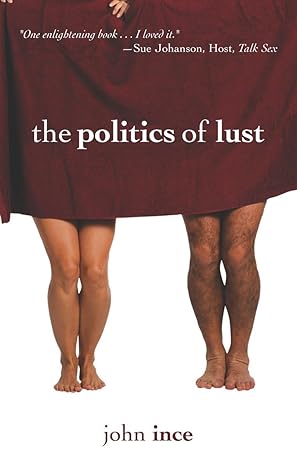
The politics of lust
by John Ince. 2003, Vancouver : Pivotal Press.
Scriptural antisexual dogma legitimates erotophobia, makes it seem moral and valid. Further, such dogma insulates erotophobic attitudes from rational debate.
John Ince is a lawyer, journalist, and co-founder of The Art of Loving (www.artofloving.ca), a sexuality center in Vancouver, B.C. He is also the founder of The Erosha School of erotic massage (www.erosha.com). A member of the Bar for 23 years, he is one of the few lawyers in Canada expert in laws pertaining to sexuality. His victorious 1985 court battle against Canada Customs resulted in the most sweeping changes to Canadian sex media law in a generation.
https://archive.org/details/politicsoflust0000ince/page/n5/mode/2up
page 11
Antisexualism has much in common with intolerant behavior aimed at racial or religious minorities.
In the same way that racism promotes racial prejudice, antisexualism breeds erotophobia.
page 15
“They discovered that they were naked. ” Their world was full of fascinating things to attract their notice, but instead the Bible informs us that their attention was pulled immediately to their erotic organs. Adam and Eve now feel shame and hide their genitals behind fig leaves.
Genital fear thus appears twice in the western world’s creation story.
…
This book follows that road less traveled. It shows that the biblical correlation is amazingly accurate. Erotophobia tends to be absent from social environments that are harmonious and peaceful, and tends to afflict cultures that are conflicted and authoritarian.
page 24
highly erotophobic people are very ignorant about sex. Many clinical studies show that erotophobia impairs a person’s ability to think clearly when sex is an issue. The more potent a person’s genital aversions, the less likely they will be able to make intelligent decisions about contraception, pregnancy risk, and sexual ethics. 12
page 45
The concept of majority rule has long been tempered by another equally important democratic precept: the duty of tolerance. The concept of “live and let live” has been recognized for thousands of years, but it never emerged as a coherent ethical philosophy until the nineteenth century. Its classic expression is in On Liberty written in 1859 by the great English philosopher John Stuart Mill.
…
Mill developed a supreme moral standard: the greatest good for the whole society, not just any temporary majority. Groups or individuals are free to craft moral rules to govern their own behavior, but they must not impose those moral rules on everyone in society unless such rules clearly benefit the collective interest of a nation of diverse moral viewpoints.
page 77
Author Nancy Friday conducted extensive research into such erotic daydreams and discovered that they are heavily infused with domination and abuse. Women fantasize about being sexually violated because it allows them access to pleasure without admitting that they are “bad.” As Friday writes in the 1998 introduction to My Secret Garden, “The rape fantasy fools them into thinking the loss of control isn’t their fault.”
page 79
If you harbor delusions that lust is inherently sinful you will likely not want other people to experience it, just as you would not want them to be greedy or dishonest. Lust phobia also motivates attacks on the people who wantonly elicit lust for profit or attention. Prostitutes, pornographers, and even scantily-clad pedestrians attract the scorn of those who fear carnal desire.
page 82
[shame displacement] …many scholars of Catholic history have observed a form of prurience in the passion with which priests enforced sexual rules on their flock. In Sacred Pleasure, Riane Eisler notes that confessors regularly inquired into the sexual lives of their parishioners and developed highly detailed penances for specific sexual acts. This allowed the priests to obsess about sexuality while still claiming to be pure.
page 85
They are also often inconsistent in their application of their own religion’s moral rules. Thus in the same Old Testament book of Leviticus that declares homosexuality an “abomination” and adultery a capital offense, the meat of the pig is declared unclean; shellfish, too, is taboo. Leviticus also says, “When any man reviles his father and his mother, he shall be put to death. ” Rare is the Christian who avoids eating pork or favors the death penalty for disobedient children, but many Christians still dogmatically assert the sexual ideology found in their Scriptures, such as the statement of Jesus that a man commits sin simply looking at a woman with lust.
Both types of moral inconsistency – in selectively practicing the duty of tolerance and in selectively following the moral rules of one’s religion – are not accidental or random.
They are the result of lust phlobia.
Erotophobia gives powerful emotional incentives to inconsistently embrace religious antisexual dogma while rejecting other religious rules. Scriptural antisexual dogma legitimates erotophobia, makes it seem moral and valid. Further, such dogma insulates erotophobic attitudes from rational debate. Because God’s law ranks above mere human reason, religious antisexual dogma does not have to make sense, and hence neither do the erotophobic sentiments it supports.
page 88
Restricting sex to marriage has two key benefits. It identifies the father of any offspring, and it minimizes the transmission of sexual disease.
page 87
the youthful author of the conservative bestseller A Return to Modesty, Wendy Shalit: “In the past, women secured the chances of lasting love by forming a kind of cartel: they had an implicit agreement not to engage in premarital or extramarital sex with men.
page 92
There are also opportunistic motives behind attacks on non-marital sex, and they act as a catalyst for these infection cycles. For example, stigmatizing non-marital sex provides important advantages for social elites, such as the hierarchy of the Catholic Church. Because the rule against non-marital sex is so unreasonable, many Catholics violate it. Their “sin” produces shame within them, and they relieve that shame through confession, a service that is a specialty of the Catholic Church.
page 94
Controlling private sexual acts is an important type of psychological domination that enhances the authority of the power elite. In 1968 the Pope rejected the right of Catholics to use artificial birth control for the reason that such devices would threaten “hierarchical authority.”
page 97 -98
sexual researcher, Seymour Fisher, says: “It is important to underscore that masturbation is more than a sexual act. It is also simultaneously a challenging statement of body ownership and therefore carries power implications.”
The more you feel shame about your autoerotic behavior, the more compliant you are likely to be. Masturbation shame grooms people for the political structure of dominance and submission.
..
page 99
Anti-masturbation ideology flows mainly from three sources: religious authorities, secular philosophers, and doctors. Most religions are uncomfortable with masturbation. Ancient Jewish authorities considered it the severest sin recorded in the Scriptures. The Talmud specifically forbids masturbation and any conduct that might encourage it. The Roman Catholic Church has also long regarded autoeroticism as a sin.
…
Secular philosophers also condemn masturbation. Perhaps the most famous is Immanuel Kant (1724-1804), who on supposedly rational grounds opposed all sex outside marriage. Of masturbation he states: “The practice is contrary to the ends of humanity and even opposed to animal nature. By it man sets aside his person and degrades himself below the level of animals. ”
page 100
Philosophers in the modern era also knock masturbation. Roger Scruton is an example. In his 1986 book Sexual Desire, he asserts that masturbation creates “a compliant world of desire, in which unreal objects become the focus of human emotions, and the emotions themselves are rendered incompetent to participate in the building of personal relations. Like Kant, Scruton purports to be asserting fact, and like Kant he never offers confirming evidence.
page 101
The Boy Scout Handbook has denigrated masturbation to generations of American youth. Because approximately one-fifth of American boys are exposed to the book, its negative message has significant impact. Early editions indicated that masturbation violated the laws of nature and that a boy who practices it:
feels the foundations of his manhood undermined. Не notes that his muscles are becoming more and more flabby; that his back is weak; his eyes after a time become sunken and ‘fishy,’ his hands clammy; he is unable to look anyone straight in the eye.”
By 1959 the Handbook editors had dropped such nonsense…
page 102
Only a few modern feminist sexual pioneers, such as Betty Dodson, Loni Barbach, Joani Blank, and a few others, offer an overtly pro-masturbation point of view.
page 124
James Dobson, founder of Focus on the Family, instructs teens to avoid pre-marital sex on another bogus ground: sex is addictive. “It is every bit as addictive as heroin or cocaine or any other drug. You get hooked on it, and you move further and further in that direction. I have seen lives absolutely destroyed by the addiction to a sexual kind of геsponse that is irresponsible, especially for boys.
…
In July 1998 three academic researchers using meta-analysis techniques on existing studies published an article in the prestigious and peer-reviewed publication Psychological Bulletin challenging several assumptions about adult-child sexual contact. The first was the idea that such contact produces lasting, intense symptoms. In fact, the researchers discovered that such sexual experience correlated poorly with long-term maladjustment. The study also challenged the idea that children who had sexual contact with adults would not like it. In fact, 37% of boys reacted positively, 29% neutrally, and 33% negatively. Third, the researchers suggested that characterizing all adult-youth sexual contact as “abuse” was misleading, and proposed terms such as “adult-child sex” or “adult-adolescent sex.”
page 125
A second similar controversy greeted the publication in 2002 of the book Harmful To Minors by journalist Judith Levine.” Subtitled “the perils of protecting children from sex,” she documents the harm done to children by laws and policies supposedly designed to protect young people. All commercial book publishers rejected the manuscript.
page 129
Since the dawn of civilization, communities have used sexual prohibitions to draw social boundaries to define specific groups within the community. The classic example is the taboo against sexual contact between members of the same clan in many tribal societies. If you are a member of the “raven” clan, then you can copulate only with members of the “bear” clan.
page 130
The great sociologist of childhood, Philippe Aries, showed how this need to emphasize childhood status tends to vary from culture to culture, from generation to generation. For example, prior to the 1600s, explicit sexual jokes were commonly told in front of children. But over the next century children came to be perceived as “innocent” and in need of protection, especially from any exposure to sexual information.”
…
Another motive for creating and exaggerating social boundaries is to formalize relationships between members of different groups so that they can interact through social roles rather than as individuals, thus avoiding the spontaneity and uncertainty of intimacy. Adults frightened of intimate, non-roled relationships with children will thus favor boundary-creating rules, such as those denying children the right to engage in sex.
page 131
Sexual prohibitions also help adults dominate children. Denying children sexual rights powerfully symbolizes adult control over them.
page 143
Some evolutionists argue that humans are genetically programmed to react negatively to any sexual excursion by their mate. The leading theorist in this area is David Buss, author of The Dangerous Passion: Why Jealousy Is As Necessary As Love And Sex.” One need not be an evolutionary
page 145
ancient rabbinic interpretation of the Torah held that the commandment against adultery (for which violators could face the death penalty!) applied only to women. A husband having sex with an unattached woman committed no sin. Jesus radically re-interpreted the anti-adultery provision, applying it to both men and women. To Christ, even sex after divorce and with a new spouse, constitutes adultery: “A man who divorces his wife and marries another commits adultery; and anyone who marries a woman divorced from her husband commits adultery”.
page 205
In any phobic culture, political advantages always accrue to those who attack the object of phobia. In a culture where delusions about porn are rampant, attacking porn will make an erotophobic community feel more secure.
page 206
In the same way that denying women the right to abortion is a powerful symbol of male dominance over women, prohibiting all porn is a powerful symbol of female power over men. Men have done exactly that for eons. An attack on a male prerogative evens the score, and appeals to many feminists for that reason alone.
…
For example, the Indianapolis bylaw sponsored by Andrea Dworkin, mentioned above, attracted the support of constituencies traditionally hostile to feminist concerns, such as religious, law en forcement, and conservative political groups. The passage of the law marked the first time feminists had cooperated with fundamentalists and conservative Republicans to attack erotic material.
page 230
Several times in the history of the feminist movement some of its members have been guilty of opportunistic attacks on prostitutes. For example, in the U.S. in the 1840s anti-prostitute campaigns initiated thousands of women into the political process, as they gave speeches, organized meetings, and lobbied for criminal laws against commercial sex. One of the key motives for the initiative was a symbolic one: to attack male prerogatives. The prevailing sexual ethic imposed a powerful double standard, allowing men much sexual freedom (especially with sex workers), but denying “good” women any sexual outlet except in marriage.
page 248
Sexual assault is epidemic in western culture. Freud was the first social scientist to unearth the problem after he heard his female patients frequently report that they had been sexually abused as children. Such allegations so contradicted Freud’s perception of social reality that he rejected the reports as false, and created preposterous theories to explain them, such as that children naturally fantasize about having sex with adults. Fifty years later Kinsey reported that almost one quarter of the females in his survey had a childhood sexual experience with an adult, but his startling revelation attracted very little attention.
…
The leading expert on child sexual abuse, David Finkelhor, estimates at least 20% of girls and 5% to 10% of boys suffer sexual abuse.” The abuse figures rise when people who have been sexually traumatized as adults are included. Depending on the definition of “sexual assault,” which ranges from rape to unwanted genital fondling, one-quarter to one-third of all females in modern western nations have been sexually assaulted.” Experts estimate that approximately one in six men suffer the same.
page 257
This is one reason why erotophobic medical and religious authorities favor genital mutilations. Consider, for example, this statement appearing in the British Medical Journal in 1935:
Civilization…requires chastity, and the glans of the circumcised rapidly assumes a leathery texture less sensitive than skin. Thus the adolescent has his attention drawn to his penis much less often. I am convinced that masturbation is much less common in the circumcised.
page 261
The idea that common personality traits can produce negative sexual attitudes has a long intellectual history, and four different intellectual traditions have a perspective on the issue: Freudians, Reichians, transpersonal psychologists, and personality empiricists.
page 262
aristocratic girl will be plagued by sexual fear in her adulthood. In Freud’s words:
“The differences which ensue in these two destinies in spite of the common experiences undergone, arise because in one girl the ego has sustained a development absent in the other…. This higher moral and intellectual development in her ego has brought her into conflict with the claims of her sexuality.”
page 263
Reich asserted that sexual anxiety is generated by two related personality conditions. The first is chronic physical tension, or what he called body armor. Sexual arousal and indeed all manner of playful, spontaneous experience is an expansive energy, moving from deep within the viscera to the periphery of the body. Reich observed that such out-flowing feeling causes pain when it collides with rigid muscles.
Second, he discovered that those who are chronically tense usually become psychologically attached to their armor through a complex process by which they incorporate the sensations produced by their tense body into their inner sense of self. A person with such an “armored identity” experiences the expansive flow of sexual energy as a threat, a challenge to the very boundaries of their being. Reich concluded that sexual expression caused fear only in people with armored personality traits, only to those with a body and identity that could not “let go.”
…
independently developed a roughly similar theme. The discipline formally emerged in the 1940s, drawing on an explosive increase in cross-cultural information. It now has a rich intellectual heritage and is generally known as “transpersonal psychology.” An excellent introduction to it is Ken Wilber‘s groundbreaking book Up From Eden: A Transpersonal View of Human Evolution.
page 264
One of the few studies in this regard is the work of H.J. Eysenck. Не developed a method to determine specific personality traits and then administered questionnaires to determine the sexual attitudes of people with such personality traits. Не discovered that individuals with high levels of what he called neuroticism, indicated by moodiness, sleeplessness, nervousness, inferiority feelings, and irritability, have many anxieties about sex. Eysenck reports that such people “have strong guilt feelings, worry about sexual activities, have fears and difficulties associated with contact with the opposite sex and often see sex as both troublesome and disgusting.”
…
Another body of research identifies a correlation between erotophobia and conservative political attitudes, including racist beliefs. The most famous of these is the work of a group of psychologists in the 1950s who investigated the personality traits of anti-Semites. In The Authoritarian Personality, Adorno and his colleagues conducted psychological surveys of thousands of people who harbored racist attitudes about Jews. Their study revealed that anti-Semites tend to be sexually anxious and that both traits tend also to appear with several other attitudes, such as conventionalism, obedience to authority, emotional toughness, and cynicism. Later studies show that negative attitudes towards sex correlate with rigid conventionality, achievement aspirations, harm avoidance, and the desire for order and hard work. Women who conform to traditional feminine roles tend to be sexually inhibited. So are highly dogmatic people.”
page 268
Alan Watts shows that a preoccupation with “concentrated attentiveness, with a type of thought which is analytic, divisive and selective” produces an identity frightened by emotion of any sort, but especially sexual passion. To Watts, St. Augustine’s hostility to sexuality is the product “of the mode of attention which grasps and orders the world by seeing it as one-at-a-time things, excluding and ignoring the rest.”
page 269
Yet ironically, the very dominance of Plato’s abstract mind rendered him incapable of a rational examination of sexual life. For the reasons discussed above, nobody so consumed by a mental-linear cognitive style could feel comfortable with sexuality, and Plato is no exception.
His writings reveal his hostility to the body, to physical pleasure and especially to sex. For example, Plato holds that a “true philosopher is temperate and refrains from all pleasures of the body, and does not give himself up to them. Не contends that “the world would benefit enormously” if sexual pleasures were starved, and in his utopian state, sex would only be practiced for purposes of procreation, or at worst, only between married couples. Further, Plato sees a dangerous animal lurking in the human mind:
When the gentler part of the soul slumbers and the control of reason is withdrawn, then the wild beast in us, well-fed with meat or drink, becomes rampant and shakes off sleep to go in quest of what will gratify its own instincts. As you know, it will cast away all shame and prudence at such moments and stick at nothing. In fantasy it will not shrink from intercourse with a mother or anyone else, man, god, or brute, or from forbidden food or any deed of blood.
This philosophy by which reason is valued over feeling and pleasure is often called “dualism,” and has dominated the western mind.
page 271
A person with such a rigid ego will perceive sexual arousal as threatening because it undermines the sense of self-control. As sexual excitement increases, so does the sense that we are being “captured” by the experience, that we are simply surrendering to powerful sensations rather than willfully controlling the event.
Sex impulses have long been recognized as having a power independent of the ego. St. Augustine recognized this as well. Erotic passion, he said, “rises up against the soul’s decision in disorderly and ugly movement. Time and time again he notes that sex impulses, even when they appear in dreams, interfere with conscious human will. Speaking of his own erotic arousal, he states: “Surely I have not ceased to be my own self… and yet there is still a great gap between myself and myself…. Oh that my soul might follow my own self… that it might not be a rebel to itself.” Modern science supports such insights. Researchers confirm that the sexual trance “is not a consciously chosen decision but is experienced as the captivation of consciousness by the delights of the sexual contact episode… volitional concentration is left behind.” This relinquishment of control is often felt as an “oceanic feeling of oneness, dissolution of self-boundaries.
page 280
The Puritan culture is legendary for its fear of sex. H.L. Mencken often referred to the “Puritan distrust of whatever is bodily pleasant. Indeed, the term Puritanism is often used as a synonym for sexual fear. Interestingly, Puritan dogma was not hostile to all sexual pleasure. Edmund Leites, in The Puritan Conscience And Modern Sexuality, shows that Puritan moralists actually supported sexual passion as long as it was confined to the marriage bed.” Puritan leaders in fact encouraged their followers to “keep up your Conjugal Love in a constant heat and vigor.”
page 281
breed rigid personalities. For example, in a culture afflicted by war, or rapid technological change, or even plague or famine, most people suffer from high chronic anxiety, and this in turn generates powerful aversions to sex.
Several historians have examined this correlation of social instability and erotic anxiety. For example, Jayme A. Sokolow shows in Eros and Modernization: Sylvester Graham, Health Reform and Origins of Victorian Sexuality in America how in the mid 1800s self-styled “purity reformers” such as Sylvester Graham (inventor of the cracker that bears his name) adopted rigid antisexual morality as a way to find security in a society in which traditional religious and secular institutions were losing authority.
page 284
The ultimate cause of erotophobia is a specific type of political structure, hierarchy, that exists to differing degrees in different social groups. Hierarchic pecking orders produce large volumes of three types of phobigenic forces: opportunistic antisexualism, nasty sex, and rigid personality traits.
Such catalysts breed sexual fear independently of the infection cycle. They are not so rife in democratic social groups, and hence erotophobia is less common there.
page 285
In a patriarchal family, the man holds the levers of power, and his wife and children submit to his commands. Institutional patriarchy is found in laws or religious traditions that deny women the same rights as men or that authorize the indoctrination or physical abuse of children.
The degree of patriarchy in any culture, group, or family can be roughly gauged by determining the relative rights and powers of men compared to women, and adults compared to children.
page 286
Patriarchy is also highly conducive to opportunistic sex intolerance, which in turn breeds erotophobia. Arbitrary sexual prohibitions are a powerful tool of any stratified social system. While status “symbols” such as crowns or uniforms are often used to designate positions on a pecking order, stratified cultures have for millennia also imposed sexual restrictions as a way to define social boundaries. A common example discussed several times in this book is the process of expressing the inferior status of children by denying them access to sexual experience and information.
When an adult intervenes into the private life of a child and punishes masturbation or sexual play with peers, the adult expresses power over the child. Sexual prohibitions communicate the message “I have control over you,” and this helps make the victim of the prohibitions more pliable, not only with regard to sex, but also in the non-sexual course of life.
page 287
Sexual assault, a highly phobigenic force, is also rife in patriarchy.’ The lower the status of women and children, the more likely that their superiors will sexually abuse them. Consider a few reasons this occurs.
In a patriarchal culture, marital rape is not a crime. A wife’s role requires her to be sexually submissive to her husband; if she refuses his advances he can legally force sex on her. Similarly, in a patriarchal culture a woman’s testimony is of little value. If she complains of rape [unlikely to be believed]
page 288
As Riane Eisler discusses at length in Sacred Pleasure, patriarchal societies breed men who want to inflict sexual pain and women who want to receive it. When sex is not boring in patriarchy, it is rough and abusive, and this ultimately is unsatisfying as well, as each party plays out a sexual role rather than enjoys the spontaneous flow of sexual energy.
…
The patriarchy / antisexual link is discussed in detail in Sex in History by G. Rattray Taylor”, Saharasia by James DeMeo, and Beyond Power: On Women, Men and Morals by Maryiln French. In Sex and Reason the jurist and social theorist Richard Posner provides many examples of how sexual prohibitions are closely correlated to the status of women.”
page 291
Third, ethnic stratification often breeds a complex form of antisexualism by which low-status groups are viewed by high-status groups as highly sexual and thus worthy of domination. For example, the Nazis often described Jews as lascivious, highly sexed animals out to destroy the honor of Aryan women. Generations of American whites perceived black people as sexually ravenous.
page 292
Further, a religious tradition that sees nature as inferior will look down on sexuality because our carnal lusts flow from our animality. Also, jealous Gods need propitiation, usually through a sacrifice. Renouncing the pleasures of sex as a way to curry favor with a controlling God is a common practice in many hierarchic spiritual traditions.
page 295
Third, the maintenance of order in bureaucratic organizations often requires prohibitions on sexual activity between members of different ranks to prohibit the sexual coercion that is endemic in social pecking orders and to prevent the formation of sexual bonds and loyalties that interfere with hierarchical command. Military rules against sexual or non-sexual “fraternization” are an example of such segregation.
page 297
The people with the most power in society and who write institutional sexual policies thus have a special emotional agenda to draft intolerant sexual regulations. As Alex Comfort puts it, the “least sexually adapted and most inhibited element” in society “expresses and ventilates its maladaption in the codifying of laws restricting the activity of others.
”
Further, the shame that normally results from erotophobia also advances bureaucratic power. As discussed several times in previous chapters, sex prohibitions tend to generate erotophobic shame in anyone upon whom they are imposed. Shame is uncomfortable; it seeks relief. A common way to try to fill the void that shame creates is to curry favor with social superiors, to please them by conforming to their dictates.”
Jeremy Bentham recognized that process two hundred years ago:
“The more fear in the breasts of the subject, many the more power in the hands of the ruling few. When the people are in a shivering fit, the physician of their souls is absolute.”
Wilhelm Reich explores this link between sexual anxiety and social conformity in more detail than anyone else, but many other authors have perceived it too.29 For example, George Orwell, in his masterful study of modern totalitarianism, 1984, contends that dominant groups (like the “Party” in his novel) deliberately create sexual shame to further their own power: .
“The Party was trying to kill the sex instinct or if it could not be killed, then to distort and dirty it…. For how could the fear, the hatred, and the lunatic credulity which the Party needed in its members be kept at the right pitch, except by bottling down some powerful instinct and using it as a driving force.”
page 298
Reay Tannahill, author of Sex in History, shows how the development of the concept of sin in the Christian Church beginning in the medieval реriod, diverted attention from terrible crimes committed in the name of God:
“By some mysterious alchemy, sexual purity came to neutralize other sins, so that even the moral oppression and physical barbarity that became characteristic of the Christian church in the later medieval and Renaissance times scarcely appeared as sin at all in comparison with the sins of sex and heresy. It was, indeed, a remarkable achievement.”
page 300
“A woman’s lack of sexual confidence overflows into the rest of her life: it makes her passive, dependent,” says Carol Cassell, author of Swept Away: Why Women Fear Their Own Sexuality. Women who have trouble reaching orgasm tend also to be submissive, obeying conventional feminine roles. Orgasmic women, in contrast, tend to be assertive.”