The Pre-war world of Europe by Robert Briffault
There is Lady Cressiden, who manages to live in luxury as a procuress of well-born girls; there is the beautiful, fibreless nymphomaniac Lady Kattie de Nivelle; there is Sylvia Chantrey, a young provincial painter who becomes successful and by degrees monstrously cynical and depraved…
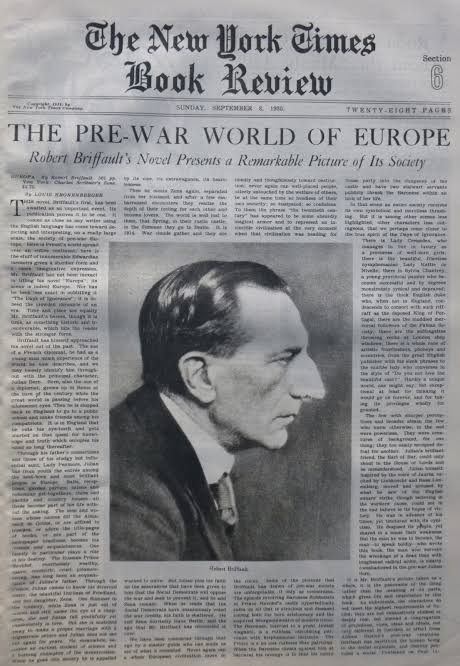
Dr Robert Brifault
THIS novel, Briffault’s first, has been awaited as an important event. Its publication proves it to be one. It comes as close as any writer using the English language has come toward depicting and interpreting, on a really large scale, the society of pre-war Europe. Here is Proust’s world spread over an entire continent; here is the stuff of innumerable Edwardian memoirs given a sturdier form and more imaginative expression.
Mr. Briffault has not been inexact in titling his novel “Europa”; its scene is indeed Europe. Nor has he been less exact in subtitling it “The Days of Ignorance”; it is indeed the crowded chronicle of an era. Time and place are equally Mr. Briffault’s heroes, though it is time, as something historic and irrecoverable, which hits the reader with the stronger force. Briffault has himself approached his novel out of the past.
The son of a French diplomat, he had as a young man much experience of the world he now describes, and we may loosely identify him throughout with the principal character, Julian Bern. Bern, also the son of a diplomat, grows up in Rome at the turn of the century while the great world is passing before his adolescent eyes. Then he is shipped back to England to go to a public school and make friends among his compatriots. It is in England that he cuts his eye-teeth and gets started on that quest for knowledge and truth which occupies his mind so long thereafter.
Through his father’s connections and those of his stodgy but influential aunt, Lady Penmore, Julian has from youth the entrée among the best-born and most brilliant people in Europe. Balls, receptions, garden parties; salons and bohemian get-togethers; clubs and yachts and country houses-all these become part of his life without the asking. The men and women whose names fill the Almanach de Gotha, or are affixed to treaties, or adorn the title-pages of books, or are part of the newspaper headlines, become his friends and acquaintances.
One family in particular plays a rôle in his destiny. The Russian Prince Nevidof, enormously wealthy, suave, eccentric, cruel, pleasure-loving, has long been an acquaintance of Julian’s father. Through the Prince, Julian comes to know his divorced sister, the beautiful Duchess of Friedland, and her daughter, Zena.
One Summer in the country, while Zena is just out of school and still under the eye of a chaperon, she and Julian fall youthfully yet passionately in love. But she is snatched away to make a proper marriage with a degenerate prince and Julian does not see her again for years. He, meanwhile, becomes an earnest student of science and a burning champion of the downtrodden. When he goes into society he is appalled by its vice, its extravagance, its heartlessness. Then he meets Zena again, separated from her husband, and after a few embarrassed encounters they realize the depth of their feeling for each other and become lovers. The world is well lost to them, that Spring, in their rustic castle; in the Summer they go to Berlin.
It is 1914. War clouds gather and they are warned to leave. But Julian pins his faith on the assurances that have been given to him that the Social Democrats will oppose the war and seek to prevent it; and he and Zena remain. When he reads that the Social Democrats have unanimously voted the war credits, his faith is shattered. He and Zena hurriedly leave Berlin; and the age that Mr. Briffault has chronicled is over.
We have been conducted through that age by a master guide who has made us see of what it consisted. Never again can a whole European civilization move so blindly and thoughtlessly toward destruction; never again can well-placed people, utterly untouched by the welfare of others, be at the same time so heedless of their own security; so dissipated; so credulous. To them the phrase “the twentieth century” has appeared to be some absurdly magical armor and to represent an invincible civilization at the very moment when that civilization was heading for the rocks.
Some of the pictures that Briffault has drawn of pre-war society are unforgettable, if only as melodrama. The episode involving Baroness Rubinstein at Prince Nevidof’s castle hyperbolically sums up all that is atrocious and diseased among both the born aristocracy and the acquired bourgeois wealth of modern times. The Baroness, married to a great Jewish magnate, is a ruthless, calculating parvenue with kleptomaniac instincts. The Prince is a no less ruthless Slav patrician. When the Baroness cheats against him at baccarat his revenge is to take his entire house party into the dungeons of his castle and have two stalwart servants publicly thrash the Baroness within an inch of her life.
In that scene an entire society receives its own symbolical and merciless thrashing. But it is among other scenes less highlighted, other characters less outrageous, that we perhaps come closer to the true spirit of the Days of Ignorance. There is Lady Cressiden, who manages to live in luxury as a procuress of well-born girls; there is the beautiful, fibreless nymphomaniac Lady Kattie de Nivelle; there is Sylvia Chantrey, a young provincial painter who becomes successful and by degrees monstrously cynical and depraved; there is the thick English duke who, when not in England, condescends to consort with such riff-raff as the deposed King of Portugal; there are the muddled mercurial followers of the Fabian Society; there are the suffragettes throwing rocks at London shop windows; there is a whole race of artistic fourflushers, phoneys and eccentrics, from the great English publisher with his sleek phrases to the exaltée lady who converses in the style of “Do you not love the beautiful rain?”
Hardly a unique world, one might say; but exceptional at least for thinking it would go on forever, and for taking its privileges wholly for granted. The few with sharper perceptions and broader ideals, the few who knew otherwise, in the end were powerless. They were creatures of background, for one thing; they too easily accepted defeat for another. Julian’s brilliant friend, the Earl of Bar, could only shout in the House of Lords and be misunderstood. Julian himself, inspired by the voice of Jaurès, excited by Liebknecht and Rosa Luxemburg, moved and aroused by what he saw of the English miners’ strike, though believing in the workers’ cause, could not in the end believe in its hopes of victory.
He was in advance of his times, yet tinctured with its cynicism. He despised its people, yet shared in a sense their weakness. But the man he was to become, the man-to speak boldly-who wrote this book, the man who surveys the wreckage of a dead time with toughened radical ardor, is clearly foreshadowed in the pre-war Julian Bern.
It is Mr. Briffault’s picture taken as a whole, it is the panorama of the thing rather than the meaning of its parts, which gives life and importance to this book. As individuals, the characters do not meet the highest requirements of fiction; they are not exhaustively studied or deeply real, but instead a congregation of prejudices, vices, ideas and ideals, not very different in function or effect from Aldous Huxley’s post-war creatures.
Briffault has sacrificed the human being to the social organism, and thereby provided a social (Continued on Page 14)
(Continued from Page 1) canvas as complex and revealing as Proust’s. He lacks, it is true, what else Proust had to give in terms of psychology, sensibility and characterization; he is primarily a chronicler, where Proust is a novelist as well; and “Europa” is less created than re-created.
But on his own ground Briffault has written a remarkably mature and telling book, whose occasional journalism and melodrama and exaggeration fade out against the richness and density of the whole. There is, besides, a powerful moral impact to the book: the lesson of Europe’s heedless past points straight at the future; her irresponsible drifting of a generation ago emphasizes the need for lucid thought and action today. “Europa” is not least valuable as a lamp of experience by which to guide our feet.