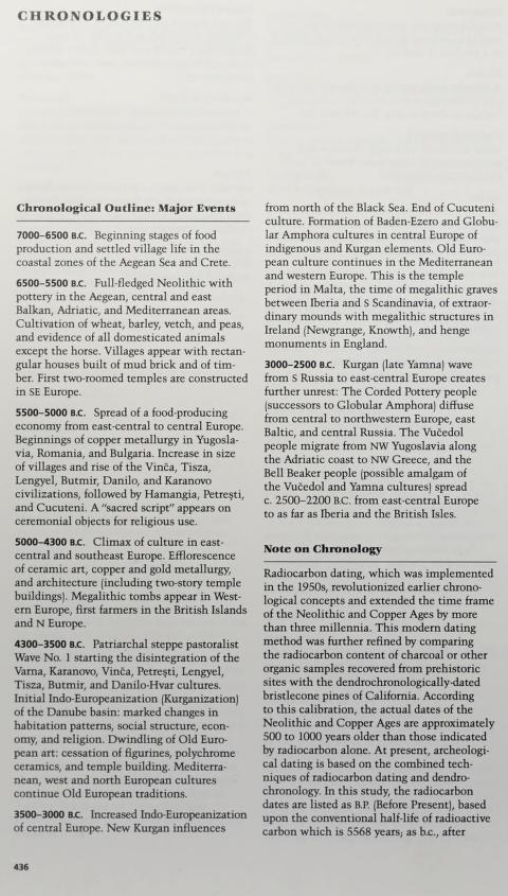
The civilization of the goddess: the world of Old Europe
by Marija Gimbutas.
The difficulty with the term matriarchy in 20th century anthropological scholarship is that it is assumed to represent a complete mirror image of patriarchy or androcracy – that is to say, a hierarchical structure with women ruling by force in the place of men. This is far from the reality of Old Europe.
https://archive.org/details/civilizationofgo0000gimb
PREFACE
The civilization that flourished in Old Europe between 6500 and 3500 B.C. and in Crete until 1450 B.C. enjoyed a long period of uninterrupted peaceful living which produced artistic expressions of graceful beauty and refinement, demonstrating a higher quality of life than many androcratic, classed societies.
…
The primordial deity for our Paleolithic and Neolithic ancestors was female, reflecting the sovereignty of motherhood. In fact, there are no images that have been found of a Father God throughout the prehistoric record. Paleolithic and Neolithic symbols and images cluster around a self-generating Goddess and her basic functions as Giver-of-Life, Wielder-of-Death, and as Regeneratrix. This symbolic system represents cyclical, nonlinear, mythical time.
The religion of the Goddess reflected a matristic, matrilineal, and endogamic social order for most of early human history. This was not necessarily “matriarchy,” which wrongly implies “rule” by women as a mirror image of androcracy. A matrifocal tradition continued throughout the early agricultural societies of Europe, Anatolia, and the Near East, as well as Minoan Crete.
…
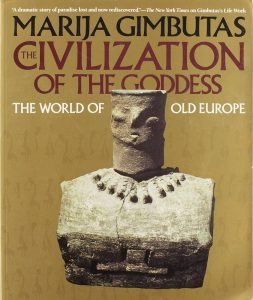
6,500 BC to 3,500 BC
P2
Milder conditions of Boreal period during 8th millennium (before 7999 BC), dramatic sea level rise. Sheep domesticated, then cows and pigs…Natufians lived in caves and open air settlements along eastern Mediterranean coast 10,000 – 8,0000 BC harvesting wild wheat & barley.
P160
Large villages such as Passo di Corco housed at one time about 200 inhabitants. The digging of deep ditches must have involved well organized communal labour. At Passo di Corco, the external ditches, which served for protection against wild animals, run for 5 km and are 5 m wide and 4 m deep. Tine has calculated that their excavation involved the removal of some 100,000 cubic meters of material.
P204
The largest known menhir is Le Grand Menhire Brise at Locmariaquer in Brittany. This enormous stone would have stood about 17m when erect and weighs nearly 350 tons. Moreover, it is not of local stone, the nearest source is almost 4 km away.
CHAPTER 7 The Religion of the Goddess
Page 222
According to myriad images that have survived from the great span of human prehistory on the Eurasian continents, it was the sovereign mystery and creative power of the female as the source of life that developed into the earliest religious experiences. The Great Mother Goddess who gives birth to all creation out of the holy darkness of her womb became a metaphor for Nature herself, the cosmic giver and taker of life, ever able to renew Herself within the eternal cycle of life, death, and rebirth.
…
The very earliest symbols engraved on rocks and articles of bone or horn reflect a profound belief in a life-generating Goddess who represents One Source while pictured in many forms. From as early as 25,000 B.C., She is depicted with exaggerated breasts, vulva, and buttocks, indicating the centers of emanation of her procreative powers. A study of symbols in Paleolithic art demonstrates that the female, rather than the male, was the deity of creation. In fact, there are no traces in Paleolithic art of a father figure. The bearing and nourishing of offspring – plant, animal, and human – was the primary model for the development of the image of the Goddess as the all-generating deity.
Miniature sculptures of female figures carved from ivory or soft stone were not “Venuses,” as they tend to be identified in literature, nor were they “fertility charms” designed to arouse male sexuality. Their functions were considerably more important: the giving and protection of life, as well as death and regeneration. The Goddess personifies the eternally renewing cycle of life in all of its forms and manifestations.
…
Page 223
prehistoric male deities make up only three to five percent of the corpus of Neolithic sculpture….
If the role of the father was understood in ancient times, there is no archaeological evidence that this was given any importance.
SNIP
It was not always necessary for the Goddess’s entire figure to be carved, for it was typical in prehistoric periods to depict only those body parts that emitted her generative powers: vulva, pubic triangle, buttocks, and breasts. It was sufficient to carve her vulva into rock, to find a stone shaped like a triangle, or to make a bone amulet shaped like breasts or buttocks. Such symbols represented the potency of her generative powers.
Attempts to explain the representation of vulvas, breasts, and buttocks have resulted in fantastic hypotheses. For the most part, these images have been viewed through the lens of 20th century bias. One explanation of the “beginning of art” is that manual love play-the touching of vulvas, buttocks, and breasts-stimulated art creations some
30,000 years ago.5 To conclude that these Paleolithic symbols were objects created for the erotic stimulation of males completely ignores their religious and social
context. Attention must be paid to how they are rendered, with what other symbols they are associated, and whether their depiction extends over long ages.
The symbol of the vulva does not end with the Aurignacian period, but can be traced from the Upper Paleolithic, through the whole of the Neolithic, Copper, and Bronze ages, up to historical times. It is pictured as a supernatural triangle, lozenge, or oval, often together with aquatic signs-meanders, zigzags, wavy parallel lines-or as seeds depicted as a dot in the center of an enclosure. Sometimes the branch of a plant is shown as a substitute (some Neolithic figurines have a little branch or budding
tree in place of a vulva).
In all prehistoric art, the vulva is never to be seen as a passive object but as a symbol of the source of life itself. It is the cosmic womb, analogous to the blossoming of a bud, from which all birth and new vitality unfolds. Figurines representing the generative forces of the Goddess are always depicted with large vulvas or pubic triangles. The Birth-giving Goddess, shown in birthing posture, has an enlarged, swollen vulva. (FIGURE 7-1) She is well evidenced in Paleolithic and Old European art, including examples in Malta. (FIGURE 7-2) Vulva and seed patterns depicted alone may have represented her, or had an amuletic quality, especially when portrayed as pendants.
…
Page 236
The snake of Old Europe, however, represents the antithesis of Christian, Semitic and Indo-European religions.
…
Page 244
The degradation of the Goddess in all of her forms, which began during the period of Indo-Europeanization of Old Europe in the 4th and 3rd millennia B.C., continued throughout the historical period, with great intensification by the entire array of Hebraic-Christian traditions. In spite of extreme attempts to eradicate her during historic times, especially by the European Inquisition of the Middle Ages in which virtually every woman of wisdom and influence was burned, her importance in life and storytelling did not disappear. The Goddess of Death and degeneration was demonized and degraded into the familiar and highly publicized image of the witch. She came to represent all that was denied and considered evil within this relatively recent mythology of dualism. This was a complete reversal of the religion of Old Europe which conceived of life and death and all cyclic polarities as sacred and inseparable. No longer was the earth considered our Divine Mother, from whom we are born and to whom we return in death. Deity was removed into the heavens and earth became a place of exile.
…
Beliefs in the body’s “traveling womb” in the form of a frog occur widely from Egypt, Greece, and Rome, to northern Europe during the historical period and, in some places, to this day. The very ancient character of this image is confirmed by bone carvings from the Upper Paleolithic in the form of half woman, half frog. In the Neolithic and later periods, frogs are pictured frequently with anthropomorphic features, with a vulva or human head. Sometimes the head is replaced by a bud.
…
[The witch-Goddess] controls human sexuality, which intensifies men’s fear of her. The witch kills infants, because both the newborn and the dark womb remain in her domain for forty days.
Page 324
There is no evidence in all of Old Europe of a patriarchal chieftainate of the Indo-European type. There are no male royal tombs and no residences in megarons on hill forts. The burial rites and settlement patterns reflect a matrilineal structure, whereas the distribution of wealth in graves speaks for an economic egalitarianism.
Early research on the societies of the ancient world, as represented by the work of J. J. Bachofen (1815-87) and R. Briffault (1873-1948), was based on a study of early historical records, archeology, myth, and ethnographic parallels.1 These men concluded that ancient European society was matrilineal (the structure in which inheritance takes place through the female line) and matriarchal. In the 20th century no large scale interdisciplinary work has been done beyond George Thomson’s The Prehistoric Aegean: Studies in Ancient Greek Society, 1949.2 Recent studies focus on separate geographic regions, mainly western Europe3 or central Europe.4
A serious and continuous obstacle in the study of ancient societies is the indolent assumption that they must have resembled our own. Bachofen warned in 1859 that “the scholar must be able to renounce the ideas of his own time and transfer himself to the mid-point of a completely different world of thought,”5 but the existence of “a different world” is the hardest thing to admit.
The difficulty with the term matriarchy in 20th century anthropological scholarship is that it is assumed to represent a complete mirror image of patriarchy or androcracy-that is to say, a hierarchical structure with women ruling by force in the place of men. This is far from the reality of Old Europe. Indeed, we do not find in Old Europe, nor in all of the Old World, a system of autocratic rule by women with an equivalent suppression of men.
Rather, we find a structure in which the sexes are more or less on equal footing, a society that could be termed a gylany. This is a term coined by Riane Eisler (from gyne, referring to woman, and andros, man, linked by the letter l for lyein, to resolve, or lyo, to set free). Gylany implies that the sexes are “linked” rather than hierarchically “ranked.”6 I use the term matristic simply to avoid the term matriarchy, with the understanding that it incorporates matriliny.
…
Page 334
Most exceptional graves that were rich with ornaments and symbolic objects were those of girls and female infants… High degree of endogamy (marrying inside the lineage) in this society…some male graves were distinct in foreign features.
…
Page 342
There follows a resume of the three main aspects of the Goddess.
Mistress of Nature
This goddess is a manifestation of life-giving and life-destroying energies of nature. Her pattern is cosmic-the endlessly repeated cycle of birth, death, and rebirth, corresponding to the phases of the moon and to spring, summer, and winter. She was worshiped in nature-on mountain tops, in caves, at wells, brooks, and streams-and in tombs and temples as a Regeneratrix.
Goddess of Fertility
The Pregnant Goddess, rising and dying with vegetation, is a metaphor of the death and renewal of plant life. She was worshiped at bread ovens in courtyards or in houses as bread giver.
Goddesses as Symbols of Perpetual Life
The Bird and Snake Goddesses are incarnations of life energy and a link between the ancestors and living members of the family. These house and temple goddesses developed from the beginning of agriculture and settled life into protectresses of the family and hearth.
Male Deities as Partners of Goddesses
There are no sculptures of male gods in the Paleolithic, and there are no male gods associated with life and birth giving or death wielding throughout the Neo-lithic period.
…
The representation of copulation in Neolithic imagery may be connected with Sacred Marriage. Such a sculpture of a female embracing a male was found at Çatal Hüyük in central Anatolia from the 7th millennium B.C.,59 while a similar sculpture from the 5th millennium B.C. was found in Gumelnița, Romania.
In the Near East, an “erotique” statuette from the Natufian culture was discovered at Ain Sakhri, which sets the beginning of this imagery at nearly 10,000 B.C.
The hieros gamos was celebrated in erotic hymns at Sumer (Inanna’s stories and hymns were published by Diane Wolkstein and Samuel Noah Kramer, 1983). A strong continuity of hieros gamos persists in myth and ritual throughout history and well into the 20th century. A ritual mating with the local goddess has been the basis of inauguration of each of the 150 tribal kings reigning in Ireland in the first centuries A.D. The earliest traditions about Medb identify her as the Goddess whose wedding periodically created a king at Tara. A similar tradition of kings mating with the Goddess is known in Scandinavia prior to the late 5th century A.D. There is also the celebration of Beltane in the British Isles and the marriage of a May Day Queen and King in rituals practiced in Germany in the 19th and early 20th centuries.
…
Page 343
Greek and all other European mythologies describe the Goddess as lawgiver, who insured a high standard of moral conduct among her followers. She condemned lying, the breaking of promises, and lack of proper respect for sacred things and for people. One cannot deceive the Goddess…Early historic records speak of sisterhoods of virgins or enchantresses who could exercise great power through incantation, singing, and dancing…Women’s rituals inherited from matristic cultures in which men are not allowed…
…
Page 344
Although these sisterhoods or communities of women were endowed with great power, they seemed to have functioned as collective entities, not as autocracies…The brother of the Queen (or priestess, as representative of the Goddess), rather than her consort, played a major role.
…
Page 346
As Briffault remarked, “Spartan women were entirely unrestricted in their social and sexual relations. Virginity was not demanded of a bride. Children born out of wedlock were called ‘virgin born’ and were regarded as equal to those born in wedlock. The Spartans practiced fraternal polyandry, and their marriage was matrilocal.
…
Page 347
Accounts of Greek and Roman writers give further evidence of these facts and, more importantly, they indicate how the high status of women frightened them. Their writings express the view that the relations between men and women and their differing attitudes toward sex create a conflict, since strong women were seen as a threat to the power of the state.
According to his [Theopompus] report, Etruscan women took great care of their bodies, often excising in the nude with men and with each other, which was not considered shameful. They were very beautiful, and it was not uncommon for them to recline publicly at dinner with men other than their husbands. These women liked to drink…they raised all their children…whether or not they knew who the fathers were.
…
Page 348
All these marks of equality shocked the Greeks, who took them as signs of immorality.
…
Page 349
In conclusion, the sources from Herodotus in the 5th century B.C. to Strabo in the 1st century A.D. speak of: 1) matrilineal structure, inheritance in the female line, successor of the throne in the female line (queenship passed from mother to daughter); 2) endogamy, matrilocal marriage and group marriage combined with common ownership; 3) metronymy (naming through the mother, father not recognized); 4) importance of the queen’s brother, no husband (only a consort); 5) the general high status of women, particularly in Minoan and Etruscan societies.
Conclusion
Summing archeological, historical, linguistic, and religious evidence, we visualize Old European society organized around a theacratic, communal temple community, and a higher female status in religious life. This was an endogamous society guided by a highly respected elder-Great Mother of the clan and her brother or uncle, with a council of women as a governing body. The structure was matrilineal, with succession to leadership and inheritance within the female line.
…
Page 352
We can begin to speak of “Kurgan people” when the conquered the steppe region north of the Black Sea around 4,500 BC…
No weapons except implements for hunting are found among grave goods in Europe until c. 4,500- 4300 BC, nor is there evidence of of hilltop fortification of Old European settlements.
…
Page 399 – 400
Differing Beliefs in an Afterlife
These two systems exhibit very different sets of beliefs concerning an afterlife. The Old Europeans had a strong belief in cyclic regeneration in which the main idea in grave architecture is “tomb is womb.” Graves are egg shaped, uterus shaped, or anthropomorphic, the latter being conceived as the body of the Goddess. The generative triangle also figures in grave and shrine outlines and architecture. Engravings on stones of megalithic graves are symbols of regeneration, life-giving water and life energy (cupmarks, concentric circles with central dot, concentric arcs, winding snakes, snake coils, bull heads as uteri, triangles, lozenges, hourglass shapes, zigzags,
lunar cycles); or images of the Goddess of Regeneration herself engraved with labyrinths, vulvas, and breasts. It was thought that the afterworld was in the West, and that a barrier of water existed between this world and the next that was crossed by ships, themselves symbols of regeneration.
…
The Indo-Europeans believed in a linear continuity of the individual from this world into another “life” in the world of the dead. Therefore, mortuary houses were built in which the dead took their belongings-tools, weapons, and ornaments that represented their rank-to the afterworld. Royal tombs and those of other important members of the society were lavishly equipped, providing the dead with status. Death in battle was particularly glorified. Kings and chieftains were often buried with their entire households-wives, servants, children-and animals, including horses, teams of oxen, and dogs. Gifts of food continued to be made after the funeral, considered necessary for the well-being of the shades.
…
P401 Conclusion
The clash between these two ideologies and social and economic structures led to the drastic transformation of Old Europe. These changes were expressed as the transition from matrilineal to patrilineal order, from learned theocracy to a militant patriarchy, from a sexually balanced society to a male dominated hierarchy, and from a chthonic goddess religion to the Indo-European sky-orientated pantheon of gods.