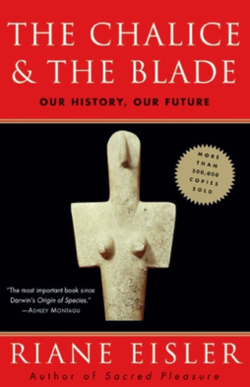
The Chalice and The Blade: Our History, Our Future
by Riane Eisler.
“a woman who behaves as a sexually and economically free person is a threat to the entire social and economic fabric of a rigidly male-dominated society.”
https://archive.org/details/B-001-001-118
https://en.wikipedia.org/wiki/The_Chalice_and_the_Blade
Eisler highlights the tension between what she calls the dominator or domination model and the more naturally feminine partnership model. Eisler proposes tension between these two underlies the span of human cultural evolution. She traces this tension in Western culture from prehistory to the present.
INTRODUCTION
page xv
We are all familiar with legends about an earlier, more harmonious and peaceful age. The Bible tells of a garden where woman and man lived in harmony with each other and nature— before a male god decreed that woman henceforth be subservient to man. The Chinese Tao Te Ching describes a time when the yin, or feminine principle, was not yet ruled by the male principle, or yang, a time when the wisdom of the mother was still honored and followed above all. The ancient Greek poet Hesiod wrote of a “golden race” who tilled the soil in “peaceful ease” before a “lesser race” brought in their god of war. But though scholars agree that in many respects these works are based on prehistoric events, references to a time when women and men lived in partnership have traditionally been viewed as no more than fantasy.
…
page xvii
The title The Chalice and the Blade derives from this cataclysmic turning point during the prehistory of Western civilization, when the direction of our cultural evolution was quite literally turned around. At this pivotal branching, the cultural evolution of societies that worshiped the life-generating and nurturing powers of the universe — in our time still symbolized by the ancient chalice or grail — was interrupted. There now appeared on the prehistoric horizon invaders from the peripheral areas of our globe who ushered in a very different form of social organization. As the University of California archaeologist Marija Gimbutas writes, these were people who worshiped “the lethal power of the blade” — the power to take rather than give life that is the ultimate power to establish and enforce domination.
…
page 3
Similarly, in the Cogul rock shelter in Catalonia, we find a scene of women, possibly priestesses, dancing around a smaller naked male figure in what seems to be a religious ceremony.
…
page 6
Leroi-Gourhan’s conclusion that Paleolithic art reflects the importance our early forebears attached to their observation that there are two sexes was based on analysis of thousands of paintings and objects in some sixty excavated Paleolithic caves. Even though he speaks in terms of sadomasochistic male-female stereotypes and in other respects follows earlier archaeological conventions, he verifies that Paleolithic art expressed some form of early religion in which feminine representations and symbols played a central part. In this connection, he makes two fascinating observations. Characteristically, the female figures and the symbols he interpreted as feminine were located in a central position in the excavated chambers. In contrast, the masculine symbols typically either occupied peripheral positions or were arranged around the female figures and symbols . 14
Leroi-Gourhan’s findings are in line with the view I proposed earlier: that the vagina-shaped cowrie shells, the red ocher in burials, the so-called Venus figurines, and the hybrid woman-animal figurines earlier writers dismissed as “monstrosities” all relate to an early form of worship in which the life-giving powers of woman played a major part. They were all expressions of our forebears’ attempts to understand their world, attempts to answer such universal human questions as where we come from when we are born and where we go after we die. And they confirm what we would logically assume: along with the first awareness of self in relation to other humans, animals, and the rest of nature must have come awareness of the awesome mystery – and practical importance – of the fact that life emerges from the body of woman.
…
page 21
In many of the earliest known creation stories from very different parts of the world, we find the Goddess-Mother as the source of all being. In the Americas, she is the Lady of the Serpent Skirt— of interest also because, as in Europe, the Middle East, and Asia, the serpent is one of her primary manifestations. In ancient Mesopotamia this same concept of the universe is found in the idea of the world mountain as the body of the Goddess-Mother of the universe, an idea that survived into historic times. And as Nammu, the Sumerian Goddess who gives birth to heaven and earth, her name is expressed in a cuneiform text of circa 2000 b.c.e. (now in the Louvre) by an ideogram signifying sea. 13
The association of the feminine principle with the primal waters is also a ubiquitous theme. For example, in the decorated pottery of Old Europe, the symbolism of water — often in association with the primal e 8g— is a frequent motif.
…
page 39
In Minoan Crete the entire relationship between the sexes not only definitions and valuations of gender roles but also attitudes toward sensuality and sex — was obviously very different from ours. For example, the bare-breasted style of dress for women and the skimpy clothes emphasizing the genitals for men demonstrate a frank appreciation of sexual differences and the pleasure made possible by these differences. From what we now know through modern humanistic psychology, this “pleasure bond” would have strengthened a sense of mutuality between women and men as individuals . 32
The Cretans more natural attitudes toward sex would also have had other consequences equally difficult to perceive under the prevailing paradigm, wherein religious dogma often views sex as more sinful than violence. As Hawkes writes, “The Cretans seem to have reduced and diverted their aggressiveness through a free and well-balanced sexual life. 33 Along with their enthusiasm for sports and dancing and their creativity and love of life, these liberated attitudes toward sex seem to have contributed to the generally peaceful and harmonious spirit predominant in Cretan life.
…
page 46
The archaeological evidence thus supports the conclusion that it was not metals per se, but rather their use in developing ever more effective technologies of destruction, that played such a critical part in what Engels termed “the world historical defeat of the female sex.” Nor did male dominance become the norm in Western prehistory, as Engels implies, when gathering-hunting peoples first begin to domesticate and breed animals (in other words, when herding became their main technology of production). Rather, it happened much later, during the millennia-long incursions of pastoral hordes into the more fertile lands where farming had become the main technology of production.
…
page 48
With the appearance of these invaders on the prehistoric horizon— and not, as is sometimes said, with men’s gradual discovery that they too played a part in procreation — the Goddess, and women, were reduced to male consorts or concubines. Gradually male dominance, warfare, and the enslavement of women and of gentler, more “effeminate” men became the norm.
…
page 49
these findings indicate that in some Kurgan camps the bulk of the female population was not Kurgan, but rather of the Neolithic Old European population. 25 What this suggests is that the Kurgans massacred most of the local men and children but spared some of the women, whom they took for themselves as concubines, wives, or slaves. Evidence that this was standard practice is found in Old Testament accounts from several millennia later, when the nomadic Hebrew tribes invaded Canaan. In Numbers 31:32-35, for example, we read that among the spoils of war taken by the invaders in their battle against the Midianites, there were, in this order, sheep, cattle, asses, and thirty-two thousand girls who had had no intercourse with a man.
…
page 51
the European prehistorian V. Gordon Childe describes the same general pattern. Childe characterizes the culture of early Europeans as “peaceful” and democratic,” with no hint of “chiefs concentrating the communities’ wealth.” 34 But then he notes how all this gradually changed, as warfare, and particularly the use of metal weapons, is introduced.
…
page 80
been pursuing Orestes. And now a jury of twelve Athenian citizens presided over by the goddess Athene is to decide whether he shall be acquitted or die. But because their vote is evenly divided, Athene casts the deciding vote: Orestes is acquitted on the grounds that he has not shed kindred blood.
The Oresteia thus takes us back to a time when there occurred what classical scholars like H. D. F. Kitto and George Thompson call the clash between matriarchal and patriarchal cultures . 7 In our terms, it traces — and justifies — the shift from partnership to dominator norms.
As Rockwell writes, it takes us from “full consent to the justice of Clytemnestra’s case in the first play to a point where her daughter is forgotten, her ghost is eclipsed, and her case is non-existent, because women do not have those rights and attributes which she had claimed .” 8 For “if a mighty creature like Clytemnestra, with the provocation she has in the murder of her child Iphigenia, has not the right to take revenge, what woman has?”
Through the lesson of what happened to this “uppity” woman, even with such just cause, all women are effectively restrained from even entertaining the idea of rebellious acts. Moreover, Athene’s role in this normative drama is, as Rockwell puts it, “a masterful bit of cultural diplomacy; it is very important in an institutional shift that a leading figure of the defeated party is seen to accept the new power .” 9
With Athene, as both the direct descendant of the Goddess and the patron deity of the city of Athens, declaring for male supremacy, the shift to male dominance must be accepted by every Athenian. And so also must the shift from what was once a basically communal or clan-owned system of property (in which descent was traced through women) to a system of private ownership of property and women by men. As Rockwell writes: “If the first trial at the new Court of Homicide proves that matricide is not a blasphemous crime because no matrilineal relationship exists, what better argument for sole patrilineal descent ?” 10
In the Oresteia every Athenian could see how even the ancient Furies, or Fates, finally gave in. The male-dominant order had been established, the new norms had replaced the old, and their fury was of no avail. Completely defeated, they retire to caves under the Acropolis, as Athene “persuades” them to remain in Athens — having reiterated the remarkable argument that the killing of one’s mother is not the shedding of kindred blood and cast the deciding vote.
…
page 96 – 97
The real purpose of this whole system of “moral” sexual customs and laws is even more brutally demonstrated in Deuteronomy 22:13 – 21. These verses deal with the case of a man who alleges that since he has discovered his bride is not a virgin he “hateth her” and wishes to get rid of her. The legal remedies provided in the Bible to deal with this kind of situation are as follows: If the wife’s parents can produce “the tokens of the damsel’s virginity” and “spread the cloth before the elders of the city,” the husband has to pay the bride’s father one hundred silver shekels. And he may not send his wife back to her parents as long as she lives. But if the bride’s virginity is not satisfactorily established, the husband can indeed get rid of her. For the law required that “they shall bring out the damsel to the door of her father’s house, and the men of her city shall stone her with stones that she die.”
We are informed in the Bible that there is a good reason for the killing of a woman who was not a virgin when she marries. This is that “she has wrought folly in Israel to play the whore in her father’s house.” Translated into contemporary language, she is to be killed as punishment for bringing dishonor, not only to her father, but to her larger family, the twelve tribes of Israel. Only what does this dishonor consist of? What injury or damage did the loss of the girl’s virginity actually cause her people and her father?
The answer is that a woman who behaves as a sexually and economically free person is a threat to the entire social and economic fabric of a rigidly male-dominated society. Such behavior cannot be countenanced lest the entire social and economic system fall apart. Hence the “necessity” for the strongest social and religious condemnation and the most extreme punishment.
…
page 109
For example, Xenophanes is said to be the first source of what the philosophical historian Edward Hussey calls the “radical monotheism so foreign to the traditional Greek religion.
…
page 112
In this connection it is surely significant that we know from Aristoxenus that Pythagoras received most of his ethical lore from a woman, Themistoclea, who was a priestess at Delphi. It is also said that Pythagoras introduced ancient mysticism into Greek philosophy and even that Pythagoras was a feminist . 22 In his reform of the Orphic mystery religion Pythagoras also seems to have stressed the worship of the feminine principle . 28 And Diogenes tells us that women studied in the Pythagorean school along with men, as they did later in Plato’s Academy . 29
It is also significant that much of Platonic philosophy, as the classical historian Jane Harrison notes, is based on Pythagorean influences, as well as Orphic symbols, which preserve elements of preandrocratic religion and morality . 30 The Platonic conceptions of an orderly and harmonious ideal universe lying beyond the “dark cave” of human perception seems to come out of that same tradition. And Plato’s advocacy of educational equality for women in his ideal state in the Republic is certainly not an idea congruent with androcratic thinking, in which above all else women must be suppressed . 31
…
page 130
“Despite the previous public activity of Christian women,” Pagels observes, “by the year 200, the majority of Christian communities endorsed as canonical the pseudo-Pauline letter of Timothy, which stresses (and exaggerates) the anti-feminist element in Paul’s views: ‘Let a woman learn in silence with all submissiveness. I permit no woman to teach or to have authority over men: she is to keep silent.’. . . By the end of the second century, women’s participation in worship was explicitly condemned: groups in which women continued on to leadership were branded as heretical.” 31
As Pagels further writes, “Whosoever investigates the early history of Christianity (the field called ‘patristics’ — that is, study of ‘the fathers of the Church’) will be prepared for the passage that concludes the Gospel of Thomas: ‘Simon Peter said to them (the disciples): Let Mary leave us, for women are not worthy of Life.’ Jesus said, ‘I myself shall lead her, in order to make her male, so that she too may become a living spirit, resembling you males. For every woman who will make herself male will enter the Kingdom of Heaven.’ ” 32
…
page 131
Already by 200 C.E., in this classic case of spirituality stood on its head, Christianity was well on its way to becoming precisely the kind of hierarchical and violence-based system Jesus had rebelled against. And after Emperor Constantine’s conversion, it became an official arm, that is, the servant, of the state. As Pagels writes, when “Christianity became an officially approved religion in the fourth century, Christian bishops, previously victimized by the police, now commanded them.” 33
…
page 138 – 139
An even more remarkable forerunner of the analysis of history in terms of the struggle between so-called feminine and masculine values is G. Rattray Taylor’s Sex in History .’ 0 But, as with Adams, to use Taylor’s data we must go beyond what he says he is describing to what he is in fact describing. Following the well-known theories of Wilhelm Reich 11 and other psychologists who primarily see patriarchal societies as sexually repressive, Taylor argues that historical swings from sexually permissive to sexually repressive attitudes are what underlie the alternation between freer, more creative and more authoritarian, less creative periods. 12 But what his book in fact documents is that underlying these cycles are shifts between values he himself refers to as either mother- or father-identified.
Indeed, Taylor’s terms matrism, or mother-identification, and patrism, or father-identification, which he had to devise because of the lack of words for what he was looking at, describe the same configurations as gylany and androcracy. Matrist periods are those when women and “feminine” (what Taylor calls mother-identified) values are accorded higher status. These periods are characteristically intervals of greater creativity, less social and sexual repression, more individualism, and social reform. Conversely, in patrist periods the derogation of women and femininity is more pronounced. These periods, when father-identified, or “masculine,” values are once again on the ascendant, are more socially and sexually repressive, with less emphasis on the creative arts and social reform.
…
page 140
Another otherwise inexplicable aspect of medieval history acquires a comprehensible — and critical — political meaning. This is the Church’s extreme vilification of women, in the words of the Malleus Maleficarum or Hammer of Witches (the Church-blessed Inquisitor’s manual for the hunting of witches), as the “carnal source of all evil .” 18
…
page 141
But the most repeated, and revealing, charge is that the witches were quite simply accused of being sexual; for in the eyes of the Church, all the witches’ power was ultimately derived from their “sinful” female sexuality . 22
Typically, this pathologically misogynistic view of women as a sex is presented as merely an irrationality of sexually frustrated men. But the Church’s “moral” condemnation of women was far more than a psychological quirk. It was a justification for male dominance — an appropriate, and in that sense of the word also rational, response by the androcratic system not only to the remnants of earlier gylanic traditions but also to the recurrent gylanic surges that, as Taylor writes, threatened to “overturn the father’s authority .” 23
page 212 (1994)
But here we are moving into the subject of the book that I have just finished, which, as it turned out, will not be called Breaking Free but Sacred Pleasure. Because during the past eight years my focus has increasingly been on our intimate relations — particularly on the interrelationship between sexuality, spirituality, politics, and economics— and even beyond this, on how the social construction of pain and pleasure is very different in societies orienting primarily to partnership rather than domination.