The Noxious Legacy of Andrea Dworkin
The failure of feminists to disavow Dworkin reveals the movement’s extreme misandry.
by Janice Fiamengo.
Her special focus was the degradation for women of sex itself: regular sex, the commonly accepted, normalized indignity that men allegedly inflict on women every day. Tempering her words in the white-heat of her revulsion, Dworkin became feminism’s anti-sex evangelist.
https://fiamengofile.substack.com/p/the-noxious-legacy-of-andrea-dworkin

A friend wrote a couple of days ago to say that he had seen shiny new copies of works by feminist author Andrea Dworkin (1946-2005) in Munro’s Books, one of Canada’s premier independent bookstores. One of the books was positioned on a shelf with the cover facing out to indicate that it was being showcased.
It is both shocking and unsurprising that Picador Books decided to reprint three of Dworkin’s texts in the past year, calling her a “prescient and visionary writer” who was “ahead of her time.” Anti-male paranoia is a sanctioned, cultivated taste more popular now, perhaps, than ever before, and Andrea Dworkin is its most notorious propagandist.
Known for her physical bulk, impassioned rhetoric, unkempt hair, and lesbian-identified overalls, Dworkin was a feminist icon in the 1980s and 90s, loved and hated in equal measure. No one did more to outline and consolidate the modern feminist understanding of sex than she, writing on the subject obsessively and with unparalleled fervor in books with titles such as Woman Hating (1974) and Pornography: Men Possessing Women (1981). The MeToo movement is almost unimaginable without the influence of Dworkin’s pronouncements.
Like other radical feminists, Dworkin wrote about rape, pornography, and prostitution, but her special focus was the degradation for women of sex itself: regular sex, the commonly accepted, normalized indignity that men allegedly inflict on women every day. Tempering her words in the white-heat of her revulsion, Dworkin became feminism’s anti-sex evangelist.
**
Sex, Dworkin believed, embodied nothing less than men’s hatred of everything female: “Intercourse is the pure, sterile, formal expression of men’s contempt for women” (p. 175). This is the thesis of her most representative book, Intercourse, which was first published in 1987 when Dworkin was 41 years old. Dworkin’s characterization of heterosexual sex as the ultimate enactment of misogyny has had an enduring impact on North American culture.
Intercourse set out to illuminate, through select readings of literary texts, what Dworkin believed to be a constant of male culture: the “hatred of women, unexplained, undiagnosed, mostly unacknowledged, that pervades sexual practice and sexual passion” (pp. 175-76). The phrase she most often used in the book to refer to intercourse was “the fuck,” which was meant to signify the raw dehumanization that supposedly characterized it.
Dworkin nominated herself the expert on male contempt for women because she had been its victim. “Specifically, am I saying that I know more than men about fucking?” she asked defiantly in the book’s preface, and answered, “Yes, I am […] the way anyone used knows the user” (p. xxxi).
While she also claimed in the preface that the book “does not say that all men are rapists or that all intercourse is rape” (p. xxxii), she does essentially say that, if not in quite those words. As she asserted only a page after the denial, “Intercourse conveys […] what it means that men—and now boys—feel entitled to come into the privacy of a woman’s body in a context of inequality” (p. xxxiv).
In another segment, she clarified that most, even the vast majority, of men were sexually abusive. She charged that men object to feminist criticism of pornography and prostitution because “So many men use these ignoble routes of access and domination to get laid,” that “without them the number of fucks would so significantly decrease that men might nearly be chaste” (p. 61). The implication was that men who objected to her arguments about the omnipresence of sexual exploitation were themselves sexual abusers who didn’t like the thought of their exploitation being curtailed.
This was the Dworkin who made feminists swoon with admiration: bombastic, hyperbolic, and incandescent with accusatory rage.
**
Where did the rage come from? In middle age, Dworkin made a bizarre allegation about having been drugged and raped in a Paris hotel room; even devoted admirers found it difficult to believe—and it capped a lifetime in which Dworkin claimed to have been frequently abused by men. She said she had been molested or raped at around 9 years of age, later abused by New York City prison doctors at age 18 after her arrest during a Vietnam War protest, and then badly beaten and sexually tortured many times by a man she had married in Amsterdam in the early 1970s. There are no records to substantiate her claims.
Though she escaped the allegedly abusive husband and carried on a life of writing and advocacy in the United States, where she became closely associated with feminist leaders such as Susan Brownmiller, Gloria Steinem, and Catharine MacKinnon, Dworkin’s feminist advocacy was always distinguished from these other leaders’ by its unmitigated anti-male animus.
Most feminist leaders have been undisturbed by Dworkin’s fury, justifying it as understandable and necessary, even inspiring. “People who […] raised their eyebrows at her supposed extremism or her intransigence or her fire took secret glee from that,” feminist activist Robin Morgan has stated, adding that, like Malcolm X, Dworkin’s was “the militant voice, […] the voice that would dare say what nobody else was saying . . . and it can’t help but say it because it is speaking out of such incredible personal pain” (quoted in the foreword, Intercourse, pp. xix-xx).
That Dworkin had pain seems undeniable—she was eating to fill some kind of emotional void—but whether its sources were as she claimed has never been ascertained.
**
Many of Dworkin’s friends and admirers were surprised to discover upon her death, in 2005, that for 30 years, she had lived with and eventually married a man, John Stoltenberg. Stoltenberg claimed that Dworkin’s gender radicalism saved his life and allowed him to be the man he didn’t want to be. He published a book in 1989 called Refusing to Be a Man, which he dedicated to Dworkin. In turn, she often spoke of herself as a lesbian.
As an antipornography activist, Stoltenberg used to offer college workshops in which he would encourage men to assume the positions in which women were posed for pornography in order to make the men feel the women’s alleged humiliation (Intercourse, p. xxiii). The very fact of Stoltenberg’s masculinity-evacuating adoration undermines much of what Dworkin claimed about male nature but that, of course, hasn’t diminished her reputation as a truth-teller.
In the foreword to Intercourse, feminist journalist Ariel Levy claimed that “Dworkin’s profound and unique legacy was to examine the meaning of the act most of us take to be fundamental to sex.” Levy hedged that, “If you disagree with her answers, you may still find yourself indebted to her for helping you discover your own” (p. xv). This was Levy’s attempt to distance herself from Dworkin’s anti-male generalizations while still praising the author’s insights.
But Dworkin never examined anything: on the contrary, she pontificated, hectored, accused, eviscerated, and damned from her self-chosen pulpit as the excoriating prophet of inherent male sin, and her encouragement to thousands of other women to hate with equal passion remains her most destructive legacy, one that is as disabling and poisonous as it is patently false.
In Intercourse, Dworkin broke every rule of responsible literary and cultural analysis, reading works of literature as if they directly reflected the author’s life or opinions. If the author described a character who hated women, that must mean that the author hated women and endorsed such hatred. If the author described a character who hated men, that showed how despicable men were.
Women were never admitted to be capable of sadism, cruelty, callous indifference, or selfishness. “Women have a vision of love that includes men as human too,” she bragged (p. 162). Men couldn’t even manage a negative virtue: “When will they choose not to despise us?” (p. 177).
Throughout Intercourse, Dworkin always employed the most reductive explanation possible for all male attitudes and responses, as for example when she claimed that “Most women are not distinct, private individuals to most men; and so the fuck tends toward the class assertion of dominance. Women live inside this reality of being owned and being fucked” (p. 83). And, “The hatred of women is a source of sexual pleasure for men in its own right” (p. 175). And so on and on.
The writing is occasionally witty, but more often erratic, repetitive, and feverish, with chains of assertions carried along by Dworkin’s exultant, self-perpetuating anger. It is testimony to the delusional bitterness of feminist ideology that such ranting has been taken as perceptive, and one need only read testimonials upon her death and glowing commendations of her legacy to see how many feminists are still unashamed to admire Dworkin’s openly expressed hatred.
At times in Intercourse, Dworkin suggested that a loving sexuality between men and women might be possible. But the only concrete example she was willing to provide was self-admittedly female-supremacist: it was a model imagined by 19th century American feminist Victoria Woodhull, whom Dworkin called “the great advocate of the female-first model of intercourse” for whom “women had a natural right—a right that inhered in the nature of intercourse itself—to be entirely self-determining, the controlling and dominating partner, the one whose desire determined the event, the one who both initiates and is the final authority on what the sex is and will be” (p. 171).
Here we see the deliberately asymmetrical logic of feminist advocacy: only when women control sexuality entirely can it approach “equality.” At other times in the book (see especially pp. 156-158), Dworkin seemed to assert that the physical reality of intercourse—which involved an alleged violation of the integrity of the female body—made it innately unequal, and therefore always to some degree an indictment of male power over women.
**
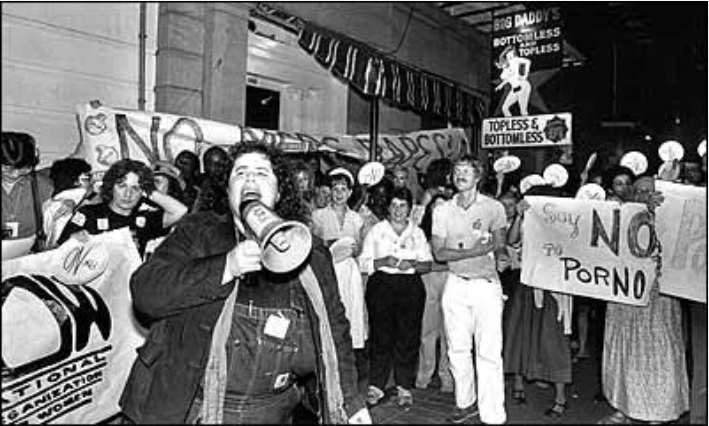
In 1983, 500 men gathered in St. Paul, Minnesota, to hear Dworkin give a speech at the Midwest Regional Conference of the National Organization for Changing Men (now the National Organization for Men Against Sexism). The speech was called “I Want a Twenty-Four-Hour Truce During Which There is No Rape.” As the men might have expected, Dworkin pulled no punches, granted them no exemptions as pro-feminist men who wanted to “change” men.
She ripped into them, telling them that if they thought the problem of misogyny, abuse, and exploitation was “out there,” they were wrong. It was “in you,” she told them. “The pimps and the warmongers speak for you” (“I Want a Twenty-Four-Hour Truce,” p. 165). And she told them that as men they were full of “contempt and hostility in [their] attitudes towards women and children” (p. 166).
She harangued them, derided them, and threatened them that if they couldn’t end rape at least for one day they could never claim to believe in equality or to care about women. They had not ended rape thus far because they clearly did not really want to. And therefore, she said, “The shame of men in front of women [was] an appropriate response both to what men do and to what men do not do” (p. 170). Until they could “end rape” and call off their side, as she called it, their shame and guilt “were not good enough” (p. 170).
That was what Dworkin had to offer men: shame and guilt, endless denunciation, and the impossible task of ending rape, which she claimed was “so little” to ask.
**
Male followers of Dworkin could also live like her self-declaredly gay husband, writing articles and books about how they had renounced manhood, encouraging other men to do the same. Even then, they would have to look every day, metaphorically, at least, as Stoltenberg had actually looked, at the words “Dead men don’t rape” (Intercourse, p. xxii), the poster that Dworkin had placed above the desk where she wrote her furious fulminations.
No wonder Stoltenberg could not bear to be a man. Even renouncing manhood was not enough for Andrea Dworkin and the legions of her followers.
I am sorry, but satisfied, to see Dworkin’s books reprinted. They offer a powerful revelation of feminism’s black heart.