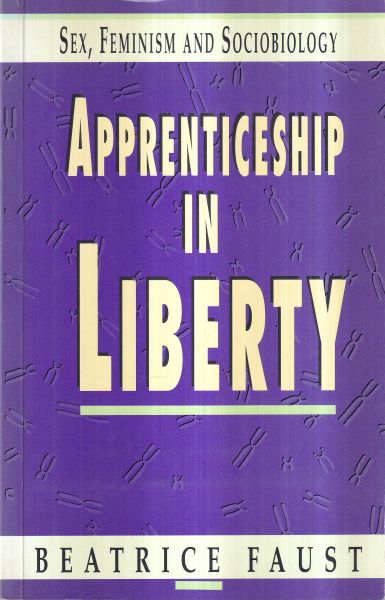
Apprenticeship in Liberty by Beatrice Faust
Instead, lesbians used the same arguments as 19th century feminists: men’s horridness forces woman to seek more congenial alternatives and women who persist in consorting with men are sleeping with the enemy. The second wave critique of sexual mores, already fuelled by justifiable resentment among women who abandoned the New Left, was exacerbated by the needs of gay feminists to justify their sexual preference. The critique made no allowances for straight sisters, much less unreconstructed housewives.
Physical book in personal library.
Page 195 – 196
Accounts of male sexuality varied. Just over a decade after the Grimkes published their letters, Elizabeth Cady Stanton told a convention that man was “infinitely woman’s inferior in every moral virtue, not by nature but made so by a false education. In carrying out his selfishness, man has greatly improved woman’s moral stature, but by an almost total shipwreck of his own”. Where Sarah Grimke blamed man for womens frailties, Mrs Stanton credited him for her virtues, foreshadowing modern feminists such as Mary Jane Sherfey in her claim that men imposed moral constraints on women to prevent them developing their full sexual capacity. Mrs Stanton argued that men simply pretended to believe that woman lacked erotic passion and that chastity is more congenial to female natures than male. The pretense allowed men to indulge themselves more freely.
Page 296
Feminism’s most underrated success was not in any part of the masculine sphere, but in extending it’s influence to the entire area of sexual morality. Woman did fail to gain parity in the cash-nexus system but except among assimilationists this was not a significant goal. In effect, they left money to men and arrogated morals to themselves. Men were quite happy with this trade off, because it is cheaper to pass unenforceable declaratory blue laws then it is to bring in equal pay and other costly reforms.
Page 331 – 332
And mothers were the primary caregivers who socialised children into sex-negative attitudes and conduct. The sexual revolution was overtly a revolt against the alleged sexual repressiveness of capitalism; covertly it was a rejection of feminine domesticity and domestic feminism. Domestic feminism created the situation that male revolutionaries would find intolerable and they would in turn create a situation that female revolutionaries would rebel against – often using the same rhetoric.
Page 336
Lesbians in second wave feminism, needing to justify their choice, could have used old fashioned civil liberties defences or Kinsey’s radical biological argument. He observed that since variation is intrinsic to mammalian sexual behaviour there is no need to justify such phenomena as homosexual contacts. The real problem is to explain why all individuals do not exercise all their options. Instead, lesbians used the same arguments as 19th century feminists: men’s horridness forces woman to seek more congenial alternatives and women who persist in consorting with men are sleeping with the enemy. The second wave critique of sexual mores, already fuelled by justifiable resentment among women who abandoned the New Left, was exacerbated by the needs of gay feminists to justify their sexual preference. The critique made no allowances for straight sisters, much less unreconstructed housewives.
Page 339
Given the wealth of information available, how do we explain the profound conviction among feminists that they have been deprived a vital knowledge? Do the facts support the belief that there has been a masculine conspiracy to keep woman ignorant of their own bodies and to deprive them of pleasure? The most simple explanation is it there has always been a barrier between individuals and sex education, that women are more constrained by the barrier than men, and suffer more from their lack of knowledge.
…
But modesty and ignorance of how to seek knowledge do not explain this peculiar blindness. Most feminist clitorid apologists were at least as well educated as Marie Stopes
…
They seem to have had a vested interest in creating a theory of sexuality that would justify women’s rebellion against men. In other words, they continued the 19th century tradition of puritanism within a revolutionary consciousness. Their theory of female sexuality is as much an ideological construct as the belief that were attacking.
Page 362
Yet the fact that The Female Eunuch was as enormously successful as the Hite Report indicates that there must be at least two sexual styles available to women. Style is not to be confused with preference for female or male partners; it is a way of relating to a sexual partner with intimacy or distance, love or lust. These sexual styles could equally well appear in gays or in straights.
The difference between woman who do and don’t like it and women who do and come back for more is at least as important as the difference between women and men. Both sets of differences relate to inter uterine organising hormones and adult activation interacting with life experiences.
Page 365
Feminism had defined rape as ‘not about sex but about power’, and identified pornography as the theory and rape as the practice. As an explanation of women’s oppression this simply will not do; female oppression exists independently of pornography. It is possible to imagine a world totally free of pornography in which supporting mothers and their children still live in poverty and aspiring female managers still hit a glass ceiling in the great corporations.
The catchcries ignore two fundamentals of sexual biology: first that male visual arousal is inevitable and, second, for males and for species, sex and power are not alternatives – sex is related to power. To say that rape is about power and not about sex is to invoke a false dichotomy. At the biological level, the same hormones mediate both, the brain structures that encode these functions are closely related and the functions themselves, basic to all vertebrates, have endured because they are essential to species – although not individual – survival.
Page 380
Those feminists who are enthusiastically heterosexual or can at least co-exist with men and not find sex problematical, are not motivated to put a great deal of thought into sexual issues. They tend to accept revolutionary / conservative views without looking at them critically or examining their likely consequences. Thus, heterosexual reformist women are led to accept programs that are based on anti-heterosexual principles formulated by separatists.
Page 384
The male Reichians of the New Left tried to establish sex as a recreational activity, divorced from love. Woman found it increasingly difficult to esteem love. What might happen if women demanded a reintegration of the two capacities?