Europe in love, love in Europe : imagination and politics between the wars
by Luisa Passerini.
Briffault’s adventurous life starts with a mystery. He maintained, possibly in order to be able to enter the army, that he had been born in London in 1876, but there are some indications that in fact he was born earlier on.
…
[in 1926] As a consequence of these blows and overwork Briffault went through a period of severe mental stress and experienced trances lasting up to 20 minutes.
https://archive.org/details/europeinlovelove0000pass_n7g3/mode/2up
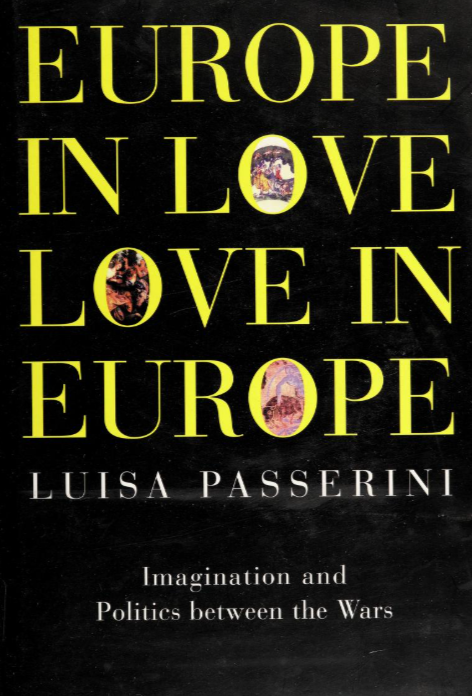
Luisa Passerini explores the emotional basis of the idea of a united Europe between the world wars, uncovering the meanings of European identity and European unity. She investigates the idea of a united Europe in connection with a discourse on love which had been developing in the West since the seventeenth century. These ideas were debated by literary scholars, novelists and poets, who focused on the theme of courtly love and its connections with romantic love. In a tour de force of political and cultural exploration, Luisa Passerini rediscovers the points of convergence between these two strands of thought, finding one of the symbols of their encounter in the myth of Europa, the Phoenician princess seduced by Zeus in the shape of a bull and brought westward.
Page 15 — A fourth itinerary explores the idea that Europeans had invented both the literature and sentiments of courtly love in twelfth-century Provence, ideas which then spread to many other countries in Europe — from Portugal to Italy, Germany and England — and later led to the development of romantic literature and love. In interwar Britain, among those who approached this theme were Dawson, Robert Briffault in his then well-known anthropological work The Mothers (see Chapter 4), and, most important, C.S. Lewis in his Allegory of Love (see Chapter 5). The three represent a range of different approaches to the question of the Europeanness of courtly love: Dawson supported the Arabic origins of what he called the “ideal of romantic love” and insisted that there was nothing particularly Christian or European in it, because he was keen to exalt Catholic marriage and to rule out the relationship between Catholicism and what he considered a type of “Platonic” relationship. Briffault accepted that at the basis of Provençal poetry and love there was a mixture of influences from Celtic oral literature to heroic romances and Arabic poetry, and vehemently accused Christianity of having not only removed the sensuous pleasure from love as sung of by the early troubadours, but also of having physically destroyed the flourishing civilisation of Southern France with the Albigensian crusade led by Simon de Montfort in 1208-29. For Lewis, the Europeanness of courtly love was unquestionable, in the sense that Provençal love was the starting point of a line of sentiments that, adequately purged, produced the cultural and moral predominance of Christian values in their British version.
Page 17 — To complete the presentation of the itineraries of research, something must be said about the methodological approach, which changes according to the object and problem tackled. Certain lines of research have required a micro-historical procedure. The first example is the chapter on Mottram, which focuses on a single text, its reception and its place in the production and life of the author. The approach is not social, as it has often been the case with micro-history, but cultural — inspired by psycho-analytical literary criticism — and it uses in a larger sense the interpretive tools developed by this method. Similarly treated way are Dawson, Briffault and Lewis; however, in this last case the chapter also contains an excursus on the dispute about the origins of courtly love which is more in the line of a history of ideas, and an analysis of the role of Provence in the European imaginary which belongs more appropriately to cultural history. The combination of procedures in this same chapter is required by the change of object and of viewpoint. A micro-historical approach is also the only kind that could do justice to the types of sources (private letters) and of historical object (intimate relations) in the treatment of a love correspondence (see Chapter 7). The parts of the book dealing with political and psycho-analytical debates adopt the approach of a cultural and intellectual history over the short and medium term (see Chapters 2, 3 and 6). The combination of approaches makes visible both the distances between different ways of treating the same question and the affinities between distant fields and positions.
Page 18 — surface of literature and that, thanks to the indeterminacy of the past, can be rescued, interpreted, and elaborated. A corollary of the idea of exploring the indeterminate and hidden aspects of the past has to be an interest in the marginal, the unrepresentative, the interstitial. It is not my intention to reduce what is unconscious to the level of the peripheral, in spite of the strong inclination of the unconscious to find a place among the apparently secondary, or even the irrelevant. However, it is true that the two often coincide, as it happens with commonplaces shared by many people and with attitudes held by small and very small minorities, in a combination which it is not always easy to disentangle. In fact, how is it possible to find what is hidden, at least partially, even to those involved? It becomes possible by combining some techniques which are well-known to historians and social scientists with others which originate from literary criticism and psycho-analysis. Thus I have followed procedures which are usual in historiography, such as reading secondary sources and going through journals that cover publications of all sorts such as the Times Literary Supplement. The texts that I fished out in this traditional way were novels and essays, both directly and indirectly relevant to the subject. The ones I decided to take into consideration — through choices in which my own ego-histoire, understood as the historian’s reflections on her work, certainly played a central role — sometimes had to be treated, according to my hypothesis, as symptoms of repressed themes. One example of this is the interpretation of the novels by Mottram and by Briffault, where the connection between Europe and love and sexuality is alluded to through the myth of Europa and the bull. These novels have not been treated as the basis for generalisations, but rather as symptoms of something subterranean such as the presence of Europe in British culture, in both its contradictory and ambivalent aspects. Briffault’s novels express the element of anti-Britishness contained in the British love for Europe as well as the lack of hope in the destiny of European civilisation. Mottram’s novel owes its privileged position in this book to its undeveloped, mysterious, and somehow obscure character, its use of the myth of Europa in an implicit and allusive way; so that it may be taken to symbolise the atmosphere of Britain towards Europe at the beginning of the 1930s, an atmosphere where the idea of Europe and things European seemed distant and suggestive, buried under many layers and yet deemed essential to the resumption of meaningful life after the horrors of war.
Page 21 — In the course of this book we shall find numerous examples of convinced supporters of European unity or of the importance of European culture, whose positions were flawed by forms of dogmatic ethnocentrism, if not racism. An important example was the attitude of Count Coudenhove-Kalergi who, in his book Pan Europa (1923), which launched the organisation of the same name, proposed that the nations involved in the future federation of European states bring their colonies with them and share the spoils of their exploitation, with a form of Eurocentrism which contained elements of racism towards non-European peoples. The most evident form of internal racism, very often coupled with Europeanism, was anti-Semitism, traces of which appear, among the authors and groups treated here, not only in those who made it a point of their programme such as Oswald Mosley and the British Union of Fascists, but also in Briffault, T.S. Eliot, Gogarty, Ormiston Curie, J.B. Priestley, New Europe; unfortunately this list is long. The fact that these traces are often slight does not reduce their weight. Britain was no exception in the European context. While I do not accept the thesis that the idea of Europe cannot be separated from European fascism and the Nazi Holocaust and I consider this book a testimony to the contrary, it is undeniable that the discourse on Europeanness has often included antisemitism. However, it would be completely ahistorical to confuse the diffused type of antisemitism which was rife in public and private discourses in Europe during the first decades of our century and the violent antisemitism of Fascists and Nazis. On the contrary, I believe that Jewish culture and the Jews have been such essential components of European culture that one could paraphrase Cioran’s “a town without Jews is a dead town” into “a Europe without Jews is a dead Europe”, which also means that the attempted annihilation of Jews dealt a mortal blow to the idea of Europeanness and a united Europe. However, this terrain is fraught with difficulties, signaled for instance by the very fact that the quotation from Cioran comes from a…
Page 23 — It may seem strange to advocate a gender point of view in a book where women appear rarely. In fact those present here can be counted very rapidly: from those whose action and thought are better documented — such as Margaret Storm Jameson, Margaret Ormiston Curie and Barbara Wootton — to those about whom we know much less in spite of their having been active in the New Europe group — such as Winifred Gordon Fraser, Lilian Slade or Valerie Cooper — or their having supported a man in intellectual and material ways, as Herma Briffault did, to the authors of “grey” literature such as the travelling books about Provence. No doubt more research would reveal much more. But I would also like to contend that women are present in this book as audiences capable of suggesting certain views with implicit requests (for instance the ambivalent position of Briffault towards feminists or Mottram’s intention to create a protagonist expressing women’s conditions); if audiences are not passive, we must assume their influence on authors. I am convinced that in this process the high level of women’s emancipation in Britain — when compared with…
Page 75 — such as Edward Carpenter, eminent in the arts and crafts movement (Love’s Coming of Age, 1896), and Havelock Ellis, who wrote Man and Woman (1894) and Studies in the Psychology of Sex (first volume 1896), the last of these influencing Sigmund Freud. Such authors were widely quoted when the debate intensified after the First World War, which had accelerated the processes of economic and moral change. In the 1920s the crisis of marriage had become more acute and rates of divorce had increased not only in the United States but also in European countries such as Holland, Sweden and Denmark. When Dawson was writing, in 1930, the debate had been revived by the publication in the previous years of various relevant texts by Calverton, Russell, Freud, and Briffault. Dawson used Malinowski’s Sex and Repression in Savage Society (1926) in his criticism of Freud’s Totem and Taboo (1912-13), in order to prove that the psychological complex derives from a social structure and not vice versa, Malinowski having shown that the repression at the root of social life is not the prehistoric Oedipus tragedy, but a deliberate constructive repression of anti-social impulses.
Page 149 — This passage is taken from the second page of the novel Europa by Robert Briffault, published in London in 1936, but already a bestseller in the United States since 1935. The 572-page novel presented a vast fresco of Europe between the 1890s and the 1920s, through a picture of the social life of Russian aristocrats at home and abroad, and was largely based on the autobiographical experience of its author, son of a retired French diplomat. The title played on the multifarious meanings of “Europa”: a mythological creature, an artistic image, a princess, a continent in turmoil. The real subject of the novel was the turmoil and destiny of…
Page 150 — Europe. Iconographically, the imagined sculpture “Europa” referred to the figurative climate of the second half of the nineteenth century, when classical mythology permeated Victorian social discourse. Why was Princess Nevidof nicknamed Europa? Certainly because of her beauty and her royal aspect, but perhaps also on the basis of her personality, which combined authority with irreverence, a provocative lack of prejudice with an aristocratic genealogy. She came from the East, like her mythological Phoenician predecessor, but the East was now Russia, the place of revolution and of a new order, with which Briffault identified. As in many other cases, the image of a woman was used in the novel to symbolise an identity, this time a continental one, and its epochal change in culture and politics. Daria Nevidof stands for both Europa and the fate of Europe in the novel, because her character alludes both to a process by which decadence give way to the hope of a new world, and to a power which women once had and might in some ways regain in the course of a vast process of liberation.
Page 150 — When Europa was published Briffault was at least sixty, and already well known for other works; he had led a nomadic and cosmopolitan life, travelling widely and speaking many languages — French, German, and Italian, besides of course English — but he also knew Latin, Greek, Dutch and Provençal. There is ambiguity about his age, because Briffault’s adventurous life starts with a mystery. He maintained, possibly in order to be able to enter the army, that he had been born in London in 1876, but there are some indications that in fact he was born earlier on. A Certificate of Baptism for Robert Stephen Briffault was issued on 8 November 1874 at St Mary’s Church, Parish of Walton-on-the-Hill, in the town of Kirkdale, Lancaster. His father had been People’s Representative at the French Legislative Assembly of 1849 and chief of the presidential secretariat of Louis Napoleon, but he had retired after the coup d’etat. He became naturalised British and married Margaret Man Stewart, a Scot thirty-five years his junior — daughter of a captain and granddaughter of a banker — and they went to live in Florence. Here, Robert attended a private school; he continued his education in Germany, then in Liverpool, and began medical studies in London, where he graduated as a Bachelor both of Medicine and of Surgery.
Page 150 — Some years after his father died in Florence (in 1887), Robert Briffault and his mother moved to New Zealand, where he practiced as a surgeon, married Anna Clarke and had two daughters and a son. In the First World War he served at Gallipoli, in France and in Flanders, and was decorated twice. After the war, his wife died in the influenza epidemic, and Briffault went to live in London where, while continuing to be a doctor, he started his career as a writer of essays in social psychology. The following years were hard, his work alternating between the hospital and writing his magnum opus in social anthropology, The Mothers. In 1924 his mother died, as…
Page 151 — did shortly afterwards — probably in 1926 — one of his daughters, Muriel; as a consequence of these blows and overwork Briffault went through a period of severe mental stress and experienced trances lasting up to 20 minutes. Only the support and care of his other daughter Joan allowed him to emerge from this difficult period, having given up medical work in order to finish The Mothers, which appeared in three volumes in 1927 and made him famous (in that year he became a member of the PEN club). As he wrote in the preface to the first volume, “it has been my lot to write books in situations fantastically unsuitable”; he was “spared no drudgery” while writing the book, and only his daughter “unwaveringly shared his sacrifice”.
Page 151 — In his first book, The Making of Humanity (1919), a political elaboration of scientific data with virulently polemical tones — on which he had worked first in the trenches and then at the British Museum — Briffault had offered a rapid historical exploration of human evolution, a sort of genealogy of European civilization. His brilliance in giving a literary form, drawing from a commanding vocabulary, to a “galaxy of information” earned him both the applause of The English Review, which considered him “one of the new men of the coming new order”, and the antipathy of The Tablet, whose comment on the book was laconic and revealing: “… we decline to discuss with him”. His second book, Psyche’s Lamp: A Revaluation of Psychological Principles as Foundation of All Thought (1921) — written in a ship’s cabin — was an attempt to assert the priority of society over the individual and to reformulate psychological principles along materialist lines. Briffault’s approach to psychology had been influenced by Alexander Faulkner Shand (1858-1936), an author who had a strong interest in philosophy and philosophical psychology, was never an academic, and became known mainly for his book The Foundations of Character, Being a Study of the Emotions and Sentiments, published in 1914. Shand derived the bases of his thought from Herbert Spencer and John Stuart Mill, whose philosophies impelled him to find the principles of a science of character, for him an essential part of a complete science of the mind. He believed that he had found such a principle in the general law that “mental activity tends, at first unconsciously, afterwards consciously, to produce and sustain system and organization”. Shand distinguished between emotions and sentiments; love for him was the most conspicuous of the systems of sentiments, i.e. a system of tendencies, each giving rise to its own emotions, such as fear, anger, joy and sorrow. His was an objective psychology, which studied “human nature from the outside” and used introspection for the purposes of interpretation and hypothesis. Shand was original in making a distinctive use of popular opinion and of literary material, largely derived from English and French literature, on the basis of his belief that poets had much more insight than philosophers into the complex nature of love.
Page 152 — The positivistic and evolutionist psychology elaborated by Shand was therefore far removed from that which Freud had been formulating in the decades since the end of the nineteenth century, by transforming introspection into material for psycho-analysis and using as a basis the dynamics of individual emotions, lids was one major reason why Briffault preferred Shand to Freud. In Psyche’s Lamp he argued in his usual vividly antagonistic and provocative way that the human mind is a social product. In an invective against “the illusion of individuality”, he harangued his readers, claiming that “the individual life is only one step, one link, one phase” in the chain of life, and stated aggressively: “the only line of demarcation between you and the continuity of Life is that of your cognitive experience”; “you are, quantitatively regarded, a measured portion of energy”. In this perspective, the subject — both the “I” and the “we” — appears a mere illusion, like individuality, and Descartes’ formula cogito ergo sum is seen as fictional and deceptive: there is nothing in us over and above “the extra-individual, impersonal forces that move us”. In his subsequent work Briffault would transpose these concepts to the anthropological field, continuing with a philosophical-political outlook rather than adopting an experimental or field-based approach.
Page 152 — In The Mothers, about one-and-a-half million words long, with a bibliography of 5,000 titles, Briffault amassed a large body of anthropological knowledge about the origins and development of European civilisation. However, the quantity of illustrative material overwhelms the discursive structure, and this accounts for an impressive array of themes, but also for a certain lack of system. In the subtitle, A Study of the Origins of Sentiments and Institutions, Briffault takes up Shand’s major theme, and coherently begins his exposition with the human mind: this is viewed as a social not a biological product, and he asserts that its “social characters are traceable to the operation of instincts that are related to the functions of the female and not to those of the male”. Differently from Shand, he is interested in institutions, so that the gender characteristics of the mind lead him to reconsider the early developments of human society and of its fundamental institutions and traditions “in the light of the matriarchal theory of social evolution”. But Briffault did not follow Bachofen blindly on the thesis of an original stage of universal “Mutterrecht” (1861); in opposition to the theory of social origins in the patriarchal age of biblical description, he believed that primitive social organisation had as its fundamental unit not the state or the family, but the mother and child within a group of kinsmen. “Matriarchy” was to be understood not as gynaecocracy, the domination of women over men, but as a state in which women and their influence are much more relevant than in the current so-called civilised societies, where their status is defined by the inequalities typical of a patriarchal social order. Briffault tried to prove his beliefs by a vast tour de force covering the cultures of many places.
Page 153 — The Mothers are for him “the heads of primordial groups, magic women and priestesses credited with supernatural powers, sacked queens in whom the mystic virtue of royalty was thought to reside, fateful goddesses who were the divine counterparts of earthly womanhood”. He finds them in anthropology, in mythology and in literature; he examines the Chinese and Japanese, the Semites, the ancient Egyptians, the Aegeans and Greeks, the Teutons, the Celts and the Romans, as well as many primitive societies. Concerning these last, he is a convinced supporter of the existence of group or collective marriage and of sexual communism. The second volume of The Mothers includes chapters on primitive jealousy and love, the evolution of monogamous marriage, the tabu, the totem, and primitive cosmic religion. Finally, Briffault inquires into the magical origin of queens, the great goddesses of many religions, and he analyses the concepts of modesty and purity, as well as romance. Among the many themes treated in The Mothers, two are particularly relevant for the connection between Europe and love: the theses on marriage and the interpretation of love and romance.
Page 153 — Briffault treats European monogamy as a late development, characterized by the subordination of women, as contrasted with their ancient status of power and influence. The sexual repression of modern times is also contrasted with the greater freedom both of the primitives and of the pagan past. Among Briffault’s targets a primary place is given to the Finnish sociologist Edward Westermarck, author of the History of Human Marriage (1891), whom he accused of scientific dishonesty in his support for a theory of “eternal monogamy” and in lending credence to the objectives of Christian apologists and traditional moralists. This simplification was strongly rejected by Westermarck, who had worked on a polygynous society in Morocco and claimed never to have held the position alleged. He maintained that his arguments were based on his research, not on principles (he accepted divorce and favoured its extension), and confirmed his theory of the family as the earliest social unit and of monogamy as the predominating form in primitive marriage. Westermarck also retorted that Briffault’s references, which he had checked, were often inadequate or incorrect.
Page 153 — A pupil of Westermarck and Malinowski, Ashley Montagu, intervened because he felt that Briffault was doing great injustice to Westermarck at the same time as being himself misunderstood on his interpretation of matriarchy. Montague wrote to Briffault, became a friend of his, and organised a meeting between the three men. As a consequence, Briffault gave a paper in Westermarck’s seminar at the London School of Economics, and developed a relationship with Malinowski. According to Ashley Montagu, the personalities of Briffault and Malinowski were not…
Page 154 — dissimilar: “both were Europeans rather than nationals in any narrow sense, they were urbane, witty and bons vivants”. Malinowski even tried to find a job for Briffault, and his first effort in this direction was to ask Briffault to join him in a series of broadcasts which he had been invited to give on BBC radio in 1931. In this series the two men argued over the history of marriage, disagreeing so deeply that in the end Malinowski completed the programme alone. The ground for agreement between them was really narrow if it amounted, as Malinowski said in his last broadcast, to the recognition that marriage “can be maintained only at a great personal sacrifice of husband and wife” and that maternity is of decisive value in all questions of marriage and parenthood.
Page 154 — The disagreement between Malinowski and Briffault should be placed in the context of the debate on the crisis of marriage, already encountered in the chapters on Mottram and Dawson, the background to this being the growing divorce rate in Western European countries and the USA, and reforms in the Soviet Union abolishing church weddings and the marriage legal contract. The issue of marriage in present times was mixed with the debate on anthropological theories adopted by the Communists on the basis of Engels’s Origin of the Family (and therefore indirectly of Lewis H. Morgan’s Ancient Society), theories which included a criticism of the “bourgeois” conception of the family, the doctrine of the economic determination of all human institutions, and references to primordial sexual communism. In the BBC broadcasts, Malinowski argued that marriage and the family are rooted in the deepest needs of human nature and society and are associated with spiritual and material progress. He strongly disagreed with the interpretation of the original domestic institution as a communal body, the maternal clan, based on group-marriage and joint parenthood. For him the individual family, based on marriage in single pairs even in the case of polygyny, was primeval, while Christian monogamy was a later development; but even for the most primitive peoples marriage was regarded as a sacrament, always had an individual character, and often included love. Therefore he implicitly dismissed Briffault’s suggestion that marriage had its foundation in economic relations and that particularly in the lower stages of society it could be reduced to an economic transaction. He considered it a distortion of truth to attack marriage on the premise that it is an enslavement of woman by man; on the contrary, primitive marriage was a contract safeguarding the interests of the woman as well as granting privileges to the man. To the theses of the “prophets of family doom” — such as those of the behaviourists, whom he ironically labelled misbehaviourists — Malinowski replied with a single word: “rubbish”. Not only did he believe that in Fascist Italy and in Soviet Russia there would be a return to the old order of marriage and family in the end; he was also convinced that the crisis in the Western World was much more talk than reality.
Page 155 — Briffault brilliantly defended his positions, giving a political turn to his talks: he started by declaring that the criticism of marriage did not come from the Bolsheviks or the behaviourists, but “chiefly from the women of England”, constrained by legal and economic disabilities and obliged to assume their husbands’ names and nationalities; he contrasted their status with that of women in matrilocal societies, where the women never leave their social group and people. Among many peoples, he said, the common and poor bring up large families without marrying, “and live at their pleasure in concubinage”; only where property is at stake does the legitimacy of marriage and children gain in importance. He also asserted the “absence of romantic love among savages” — as we shall soon see in more detail — because in their close communities they do not feel the desperate need to be loved which is typical of the “essentially lonely” civilised man. Ashley Montagu later supported Malinowski’s views, stating that Briffault was brilliant and erudite, but not a scientist, and often inaccurate. According to a Communist interpretation given by Marxism Today the organisation of the broadcasts reflected the existing “bourgeois” hierarchies: Briffault was given a shorter time than Malinowski, to whom the concluding session was attributed, and he was not allowed to include The Mothers in the bibliography appended to the subsequent publication of the debate in The Listener. However, Montagu asserted that Briffault’s criticism of the marriage laws had influenced legislative opinion in the direction of liberalising marriage and divorce. In spite of his belief in a crude sexual division of labour and his ambiguities towards feminism, Briffault forcefully denounced the injustices inflicted upon women throughout history.
Page 155 — However, given his paradoxical literary temperament, as Havelock Ellis put it, he “even contrived to alienate in some measure the very sex which he has come forth to champion”. First, in spite of maintaining that some of the crucial functions in primitive societies, such as education, are fundamentally feminine, Briffault assigned to women only a small role in the establishment of civilisation. Second, his statements about the licentiousness of women in various peoples inevitably “aroused horror in the breasts of many feminists, who still cherish the ideals of prim feminine responsibility”. While Briffault would probably have agreed with Ellis on the latter point, on the former — which was more serious — he came under heavy criticism from Ernest Jones as well. Jones wrote a generally positive review of the book in the International Journal of Psycho-analysis, but found unconvincing Briffault’s sexual division of labour according to which women were responsible, as a result of the maternal instinct, for the development of love and affection as well as of societal bonds, but were considered “constitutionally deficient in the qualities that mark the masculine intellect” — abstract and generalising, as opposed to concrete and particularising — so that the process of civilisation, a fundamentally intellectual one, was for the most part the work of men. Only several years later…
Page 156 — was Briffault to accept ‘the view stressed by feminists’ that the mind of woman was the product of a tradition which had deformed it in order to conserve irrational attitudes, making it entirely different from what that mind could have been if allowed to develop under rational conditions. Briffault deemed it extremely difficult to determine the extent to which psychic sexual differences are cultural and the extent to which they are biological. But at that point he believed that the feminist view was ‘in a very large measure true beyond doubt’.
Page 156 — On the question of love, Briffault’s basic assumption was that ‘the emotional complex which we speak of as love bears no resemblance to a primary and universal impulse of life’. Briffault demonstrated at length the origin of love as passion as distinct from the maternal instinct as well as its distance from sexual relationship. On the basis of a great abundance of anthropological material, he maintained that strong societal bonds exist in primitive societies and, because of this, that romantic love or jealousy were unnecessary.
Among people such as the Eskimos, the Northern and Southern American Indians, the New Zealand Maori, and the Eastern, Western and Central African tribes, ‘love as understood by the people of Europe’ was unknown and was only now appearing ‘little by little’, having been ‘created’ by missionaries and colonisers. Among those peoples, courtship, the kiss as a preliminary to love-making, and love-songs were all unknown. ‘That in uncultured societies above the lowest levels ‘falling in love’ occasionally exists among the young people appears probable; but the sentiment, owing to the unfavourable conditions, seems to have no depth and no stability Even among Orientals, according to Briffault, no synthesis between the sexual instincts and other sentiments was to be found. On the contrary, among non-Europeans the love of mothers for their offspring was highly developed.
But only in certain conditions imposed by the process of civilisation did it give rise to that ‘transferred affection’ that has become associated with sexual relations; on such affection literature and tradition have had a decisive influence. This means that for Briffault the sentiment called ‘romantic love’ emerged only as a consequence of repression, like that exercised by the patriarchal family and the Church, and therefore he regarded it as a product of the middle ages and Renaissance. This position explains his ambivalent attitude towards love, and can be seen in his novels.
Page 156 — In the third volume of The Mothers, Briffault dedicates two long chapters to ‘Romance’, analysing the pre-history and origins of courtly love, from Celtic oral literature to heroic romances and to Provencal poetry. This love, he insists, was first to be found in literary works ‘in theoretical and abstract form’ and was only subsequently extended to actual life. Historically, the repression that created love as an idealized feeling was the ‘crusade’ led by Simon de Montfort against the Cathars, which destroyed the flourishing civilisation of Southern France and removed the sensuous
Page 157 — In a long footnote, Briffault faces the question of the influence of Arabic poetry, through Spain, on the Provencal troubadours; he admits that the romance specialists do not regard the question as settled, and invokes the contribution of an Arabist, but seems quite inclined to accept this influence, since he recognises the similarity of the feelings expressed in Moorish and in Provencal poetries, and even refers to the ‘elegant semi-Oriental culture of Provence’.
During the Second World War Briffault enlarged and rewrote the two chapters on Romance in French in order to produce his book on Les Troubadours (1945) showing a remarkable knowledge both of this language and of Provencal poetry as well as of the literature upon it. In Les Troubadours he states quite clearly that ‘la scolastique amoureuse courtoise tirait de l’Islam son origine’. The very long and complex dispute in favour of and against the Arabic influence on Provencal poetry and sentiments had lasted throughout the nineteenth century, and can be considered a touchstone of Eurocentrism (see Chapter 5).
It is significant that Briffault, whose Eurocentrism was evident in the field of courtly /romantic love, took an anti-eurocentric position on this vexed question. In general, he believed, as he made abundantly clear in many of his writings, and particularly in the attack on nationalism in culture to which he devoted a whole chapter of Reasons for Anger (1937), that ‘every one of the European cultures which pretends today to preserve itself pure and undefiled from alien contamination owes its own growth and development to international contacts’.
Page 157 — What is interesting in this conception is first of all that Briffault indicates the circularity between literature and public taste (the former having imposed on the latter standards that would later be imposed on the former by the latter) as a factor in the genesis of courtly and romantic love, since ‘ultimately it is not possible to separate literature from life’.
Secondly, he insists on the role of violence and cruelty in enforcing and diffusing the notion of ‘platonic love’ and the idealisation of marriage, a violence that cancelled two of the main themes of Provencal poetry, those of physical pleasure and of the difference between love and marriage; it was ‘the
Page 158 — persistent and strenuous influence of Patristic ideals in their fiercest, crudest, and most uncompromising form’ for over ten centuries which transformed the heritage of early European poetry into the ‘insane vilification of sex and the visionary exaltation of virginity’ and introduced ‘the sentimental idealisation of the sex relation’ into the tradition of European sentiment. The only merit that Briffault awards to romanticism is that in the period following the French Revolution it acted as a revolt, particularly on the part of women, against marriages arranged for reasons of property.
Page 158 — Not only is romantic emotion the product of very recent cultural processes; its power is also being eroded, due to the much greater freedom of social intercourse between women and men, and the greater physical activity and development of sport. In European civilisation the repression of the sexual instincts has resulted in nervous disturbances, religious phenomena, romantic passion and masturbation, all features — of both the highest and the most deplorable sides of our culture — unknown in primitive societies. Therefore, the personal character of sexual attraction is not the cause of monogamous society, but its product.
Gordon Rattray Taylor, who edited the abridged version of The Mothers, commented that the whole picture is rendered incomprehensible by the lack of strong fathers and of the Oedipal complex as an explanation of incestuous fears, since The Mothers only studies societies where women were dominant, and ascribes this to the fact that Briffault derived his psychology from Shand and not from Freud. As Briffault had summarized in the first volume of The Mothers his criticism of Freud, he could not accept the concept of the unconscious, which he reduced to ‘no other than the natural biological mind as physiologically inherited’; as a consequence the idea of an endopsychic conflict was unknown to Briffault, for whom it was only ‘the socially and traditionally acquired mind’ that exercised a repressing action on the natural mind.
Page 158 — The reception of The Mothers was mixed, with several criticisms which Briffault resented, but the book was also praised and its author became very well known. The Times Literary Supplement considered it ‘a swing back to Bachofen’, but acknowledged it as a testament to the value of the historical and relativist standpoint. Ernest Jones reviewed it, as we have seen, in the International Journal of Psycho-analysis, while Freud and Suttie used it for their work.
Jones, however, was critical not only of Briffault’s positions on the sexual division of labour but also of the lack of psycho-analysis underlining his work; the index included neither Totem and Taboo nor Group Psychology by Freud. While this was consistent with Briffault’s ideas, it was much less clear why he did not give adequate recognition to the ‘number of distinguished workers in this field who have argued along lines similar to his own — of some of the most notable he speaks disparagingly’, as Havelock Ellis also noted in the New York Birth Control Review. Ellis thought that this was because Briffault liked to feel
Page 159 — But he also felt a growing sense of isolation and estrangement from his own country, a physical and not simply intellectual loneliness. ‘He was made to feel as though he were almost a pariah’. Julian had at first imagined ‘with a simplicity which afterwards made him smile, that his own scientific work might be regarded as qualifying him for some teaching post — if not at one of the universities, at least in some school or other If we may transpose a similar hope to Briffault, it is true that The Mothers did not bring to him — either in novels or in life — any academic recognition or any post, although it did bring some fame to its author.
Page 160 — Europa, the mythological figure revived in Briffault’s most successful novels, is already present in The Mothers in connection with the theme of the divine bull in ancient Middle Eastern religion, where it represented the soul of the world residing in the moon and symbolising the source of generative power. Such a cult was to be found in Crete, ‘as the myths of the Minotaur and of Europa show’. Briffault insisted on the matriarchal character of society in Crete, a veritable ‘Isle of Women’, on the self-possessed independence of Cretan women, and their dominant role in religion, which he inferred from the predominance of female over male figures in art.
Briffault added that in other cultures too, for example the Celtic and North American, an identification was established between the horns of cattle and the lunar crescent, and a contrast was formed between women and bulls, the latter representing agriculture — as pullers of the plough — and being connected with the transfer of agricultural work from women to men. Therefore the myth of Europa was understood by Briffault as a part of the larger mythology of the ‘Great Mother’ or the ‘primitive goddess’ associated with the functions and activities of women in early human societies. This interpretation is a clue to understanding the identification between the protagonist of his first novel and the Phoenician princess.
Page 160 — In the following scene she meets the only two people in the room who have a sense of art and beauty, the painter Martin, who will admire Daria’s competence in art, and young Julian, protagonist of the novel (and a fictional representation of Briffault himself), who remains dazed at the sight of her, since ‘he had never seen, he thought, such beauty’. Daria turns out
Page 161 — We are not told in how many of those paintings Daria was portrayed as Europa. But the connection through art between the continent and the woman continues in another feature: the two share the tragedy of decline. Daria is perfectly well aware of the fact that she belongs to a sinking world; given her lucid intelligence she has a very clear picture of the global situation, but she also perceives that her fate is doomed like that of the continent, although at the same time she rejoices at the concurrent end of injustice and corruption.
The imagined sculpture of Europa/Daria which opens the novel is associated with decay: not only does it end up in an agglomerate of useless objects described by Briffault in negative terms — ‘clutter’, ‘bric-a-brac’, ‘decayed’, ‘seedy’ — it is also a biscuit reproduction of a marble original. In the epoch of the mechanical reproducibility of art works analysed by Walter Benjamin, it is all too coherent that Briffault gives a central role in his novel to a ‘reproduction’, alluding at the same time to decay and to a type of art reproducible for the masses.
At the end of Europa in Limbo — the follow-up Briffault wrote after the great success of the first volume — the equivalence between the woman and the culture she represents is proclaimed explicitly. Daria is by now in Soviet Russia, directing the hospital for civilian women and children into which she has transformed her ancient palace; of all her works of art she has kept only a reproduction of Peugh’s statue of herself as Europa. Almost unrecognisable physically due to fatigue and premature ageing, she is still powerful, indeed more so, thanks to her forceful insight. It is almost as if the spirit of continent, in the form of the usual allegory that artists used for Europe, a beautiful and majestic woman, were speaking through Daria’s lips:
Page 162 — Such a tone is possible because the author of these lines considered himself a communist — although never joining the Communist Party — and felt himself a part of the new world emerging from the ruins of the old. If the East for Mottram’s Europa and her promise of regeneration of the male /female relationship was the fabulous Orient concentrated in Venice, Briffault’s Europa cannot but come from Russia, and reflect its contradictions.
In his other book. Breakdown: The Collapse of Traditional Civilisation, Briffault saw the end not only of the cycle of Western civilisation based on class divisions, but of ‘traditional civilisation itself’, although he was still very optimistic about the whole process: ‘when traditional civilisation shall have crumbled down, an opportunity will for the first time be afforded for the re-education as well as for the organisation of mankind’. To create a new humanity ‘will require exactly one generation, though it may take longer for the present race of malicious maniacs to die out’.
Not only did Briffault defend the censorship of the classics applied by the new education in Soviet Russia; he believed that the classics of Russian literature, which were — like the whole of Western literature — ‘saturated with the insane and immoral premises of traditional civilisation’, should be not merely expurgated, but ‘withheld entirely from the new humanity’, so that the mind of the human race would be allowed time to recover. The Times Literary Supplement reacted negatively to these views as ‘entirely mechanic’, millenaristic and devoid of any understanding of the attendant philosophical problems.
Page 162 — While Briffault saw the signs of the collapse of European civilisation everywhere in the continent, Europa translates this view into a narrative form. The narrating first person is that of an English journalist, friend of the protagonist Julian Bern, through whose eyes, as a boy, Daria /Europa is first seen. The journalist is writing in London during the early 1920s, when he meets an artist — the sculptor Peugh, maker of ‘Europa’ — whose flash-backs introduce us to Julian’s family’s life in the 1890s.
Other flash-backs are provided by the journalist, remembering what his friend Julian has told him about his own childhood and adolescence, so that reminiscences in the first person alternate with a third person or impersonal narration. Peugh reappears at various times in the novel, and is significant in its structure, although the sculptor does not play any specific role in the plot. For instance, he reappears at the centre of the novel, at the exact point where the protagonist meets Daria again, after having drifted away from her and her daughter, and starts the slow process of getting in touch with
Page 163 — Zena again. The novel opens with the casual encounter between Peugh and the journalist in a fashionable cafe in London, where the aftertheatre crowd is a mixture of elegant ladies and art critics. Peugh recalls Bern, Julian’s father, modelled on Briffault’s father Charles, paralleling Julian’s link with Briffault himself. Mr Bern is presented in a flattering light as somebody who never made a real career out of his diplomatic post in spite of being ‘a man carved in the grand manner’, who would have deserved to be made ambassador.
But he was ‘a bit queer’, almost ‘a little mad’, and had ‘curious notions far too original for the fellows in Downing Street’, such as the idea that England ought to compel Europe to disarm and federate. As we saw in the previous chapter, this idea had been revived during the 1920s and 1930s. We do not know whether Charles Briffault actually thought this; however, we know that he was a confidant of very important politicians and a friend of the Prince of Wales (one of Robert’s earliest recollections was having breakfast with the future Edward VII).
His double in the novel is portrayed as closely associated with the European idea, and the association reappears in Europa in Limbo: when in Switzerland Julian meets an English feminist participating in a women’s congress for permanent peace, and she tells him that they are going to campaign for a League of Nations, he reacts ironically and exclaims: ‘Shade of my father! What is a nation?’
Page 164 — The Europe presented by Briffault is a continent of blindness and folly. The novel takes place in an aristocratic cosmopolitan ambiance, seen through the eyes of Julian, who does not belong to it by birth, although his paternal aunt has married into it, becoming the conservative and narrow-minded Lady Penmore. She has paid for Julian to continue his education, after a private school in Rome, in an English public school, the only way — she deems — to become an English gentleman.
There Julian discovers ‘the atrocity of education’ designed to keep the minds of the boys ‘entirely undergrown’, while women are often more intelligent simply because they are less subjected to education. He then proceeds to Cambridge to study biology and starts a scientific career under the guidance of Sir Anthony Fisher, whose views are similar to those of Michurin and Lysenko on the interaction between the germ plasm and the surrounding environment. Such biological views, materialist and dialectical, were actually formulated in the 1930s: Briffault often attributed to his characters ideas which were not current until later.
Page 165 — Julian does not share his father’s hopes for a united Europe, because for him, just like Briffault, Europe is doomed, and its significance lies mainly in the set of traditions that go back to ancient Rome and medieval Christendom). However, in many ways, Julian is a good European. Since adolescence he has been accustomed to moving freely through Europe, and to speaking and reading many languages: the novel includes expressions in Russian, French, Italian, German, Latin and ancient Greek. Julian feels that
Page 165 — In spite of feeling at his ease everywhere, Julian casts on Europe the eye of a stranger. From Rome to the Cote d’Azur, from London to Berlin, from Paris to Bayreuth, he moves in high society and observes its vacuity, its perversions, its dissolute living. But he is not happier with the lower classes. He sees the misery of the English working class as well as its servility; when he goes to Wigan to follow the coal-strike, he recognises the courage of many workers, but also notices their lack of connection with the other classes, of political education, and of adequate strategy.
He also remembers meeting ‘a collier’s son, an exceptionally brilliant and genial fellow’ who had succeeded in getting an education and becoming a teacher and a writer. Briffault thus introduces D.H. Lawrence — without mentioning his name — Julian meeting him in the offices of the English Review. Julian asked him about the coal strike, but he was ‘not in the least interested. He was interested in sex, in some queer, muddled, mystically materialistic views of his which sought to reconcile sexual sensuality with the sublime’; Julian reacted by lecturing the man on his ‘two million brothers fighting for their mere bread’, but the writer just smiled benevolently.
Page 166 — Julian himself, however, did little for the workers, due to his disillusionment with all forms of political ideas and action: Ruskin and Morris represented to him ‘afternoon-tea socialism’, and the Fabians were prisoners of their illusions about political education; the German Social Democrats, whom he would have supported after listening to Rosa Luxemburg and Karl Liebknecht in Berlin, voted for the war credits.
Thus he agreed to leave Germany with Zena, as Daria had advised and already done herself. He realised that men such as Liebknecht and Jean Jaures would regard him as a coward, an egoist and escapist, and yet ‘gladly, gladly would he give his life, in strength of combat or in death, if only he could believe that he would thereby have effected any thing’. These could well be words that Briffault attributed to himself and his own attitude to politics.
Page 166 — The key to understanding the role of Europe in Briffault’s vision is the figure of Princess Daria. She is presented as a wise woman, somehow ageless, with an authoritative knowledge of the world, and yet uncorrupted in spite of living in it. Daria is really one of the mothers studied by Briffault, as her identification with Europa shows. She not only poses as Europa, she is actually referred to by that name.
Men, Daria tells Julian while she is posing for his teacher painter, have built the world on thought and words, making it ‘only a bare, stark skeleton. It is we women who save it from drying up.’ Julian is adopted by her from their first meeting and will feel ‘monstrously happy’ when a few years later Daria, Zena and himself, ‘like a family party’ make an excursion in Daria’s big car from Viareggio to Pisa. Daria becomes more literally his mother when his romance with Zena starts again, at the beginning of 1914. At this point she
Page 167 — Zena is close to ‘nature’, in Briffault’s sense, i.e. close to that pagan sensuality that he associates with Italy — where ‘peasants still believe in fauns and satyrs’ — and far from the denial of heterosexual sex that Briffault attributes to militant women.
This denial can take the form of either an ascetic life based on erotophobia, as is the case with a good friend of Julian, the Honourable Eleanor Astley, or of sexual antagonism and perversion (lesbianism, lesbian prostitution), to be found in some feminists and literary avant garde women Julian meets (a scene where an English poetess prostitutes herself to a French woman in a high-class brothel in front of Julian and two English ladies was partially cut in the British version of the novel).
Suffragists are presented in Europa as courageous and right, but they are also ridiculed for their narrowness, being referred to as ‘militant virgins of suffrage’, ‘amazons’: for Briffault they fail to perceive that the right of parliamentary franchise is the first step along a long road which should do away with marriage, Christian morality, modesty, pudence and introduce promiscuity in sexual relations.
Page 168 — European culture. In spite of some periods of happiness together, amidst revolution and war, in the end Julian and Zena will be separated by her death (in Europa in Limbo), the result of a stray bullet from the pistol of her husband meant for Julian. Europa’ s subtitle, A Novel of the Days of Ignorance, hinted at the gap between two epochs not only in the different political regimes, but also in their gender relations.
In Sin and Sex (1931) Briffault had explained that the ideal patriarchal wife belonged to the ‘Days of Ignorance’, and he feared that those days would be continued in the post-Puritanical value of opposing love and lust. Sin and Sex defines love as the ‘unnatural association of man and woman’, ‘a superlatively artificial cultural ideal’, with no biological basis, yet leading, for cultured humanity, to the most complete fulfilment of human relations.
It is above all in this sense that the love in Europa embodies Briffault’s general conceptions about love. Zena and Julian are prevented from realising their union first by the violence of property and aristocratic descent, then by the state of disintegration of the old society. Zena belongs to it: ‘I am too much of the
Page 169 — The theme of love in the narration is rather thin, because the main subject of the novel is the description of a way of life. Briffault heaps up, in pages which have the flavour of a direct diary, lists of collections of precious books, of exotic foods, of flowers, of fish and molluscs; lists of aristocrats and their titles, displays of famous names: Julian or his friends see Mata Hari dancing in Berlin; Henry James talking in London surrounded by an attentive audience, ‘his hand beating the cadence of his clauses like a metronome’; young Mussolini in Rome, a ‘bull-headed, bony-faced journalist, short in the legs, holding forth with theatrical gestures’. Vladimir Ilich and Bronstein are mentioned by the Russian subjects of Prince Nevidof, Marx as ‘an old German Jew dying in London from the effects of long hardship and privation’, sent in vain by the director of the Natural History Museum to the Mediterranean in the hope of prolonging his life.
Page 170 — These were some of the contradictions in which Briffault became involved in his criticism of the old world, whose attitudes he shared in so many ways. One contradiction is evident in his final view on Europe, which he relegates to limbo. Limbo is, in Briffault’s definition, the period between two worlds, the decadent one and the new one emerging from the revolution.
In the closing pages of Europa in Limbo Julian expresses his political convictions. The Europe he sees has changed: ‘not one building stone of it, of the essential core and foundation of it, is left standing!’ Europe lingers in limbo, waiting to become the decisive battlefield between the forces of the old and the new because ‘it was here, in the heart of old Europe, that the right of sanity and reason was first kindled; and here it will be revived’.
In this way he reveals a reversed Eurocentrism mixed with the hope of a European revolution, in the face of which any reformist political action is inadequate. Julian severely scolds his friend Eleanor Astley, struggling for disarmament in a commission of the League of Nations, which he defines as ‘grotesque’: ‘a league of bandits,’ he says ‘cannot prevent banditry. It is far more likely to promote it. Like all shams, it is not merely grotesque, it is dangerous.’
Page 171 — In the end, the sensational tone of the novel does not totally obscure its political message — if politics is understood as a form of culture — and Briffault’s insight into the spirit of the time. His attempt to find a sequel to the decadence of the ‘old mothers’ like Daria and Zena, and to announce the appearance of a new woman is hinted at in the final pages of Europa in Limbo.
This book concludes with an exchange between Julian and the Honourable Eleanor Astley, the feminist interested in social reform. The Mothers ended with a hymn to the eternal feminine quoted from Goethe, and the words ‘honour to those who can be mothers, not in the flesh alone, but in the spirit’. At the end of Europa in Limbo Eleanor tells Julian that she wants a child, indirectly replying to the questions that Malinowski had posed in his broadcast debate with Briffault:
Page 171 — Eleanor gives a reply which anticipates the behaviour of some women half a century later, choosing a maternity without the commitment of being a wife. To her — a mother in flesh and spirit — the last word is given. When Julian leaves for New York to take up a job as a journalist there, because in England he is suspected of being a Communist and is no longer allowed to write, he receives a telegram from Eleanor saying, ‘He lives who will see it’.
Julian has no hopes or illusions left; Eleanor — a political militant and a feminist — represents with her child the only hope for a possible future. For Briffault, the imposing task of summarising the European situation in a book that could be read by vast numbers of people was based on his political and existential convictions as well as on the need to make money to support himself and his second wife.
In a letter to his daughter he stated that he had constructed Europa very carefully in order to make it a widely-read book: ‘I tried to get in every aspect’, producing ‘a remarkably good salad in which everybody can find something’ and added: ‘I never had any doubt — not through conceit, on thinking that the book was good, but just from a business point of view’. Briffault did not consider the novel as scientifically important as his other books, among which he valued especially The Mothers.
Page 172 — Europa was first of all a success in the United States, where its fabulous sense of atmosphere appeared even more evident than in Europe, and where its criticism of European decadence as well its sensationalism possibly found an audience and a climate nurtured by the media. The Chicago Journal of Commerce compared Briffault to Zola and Proust, seeing his ‘very great book’ as a continuation of Jules Romains’s Men of Good Will and Thomas Mann’s The Magic Mountain.
However, dissent was also expressed. The American Review in a review by Dorothea Brande entitled ‘A Bad Novel’, attributed the popularity of ‘a book so long, so dull, so windy’ to its pornography. Time, while seeing the similarities, deemed that ‘Briffault’s old fashioned, awkwardly written first novel cannot be compared with the great post-war novels on the same subject’, and judged that the famous historical figures presented in Europa were little more than mouthpieces for ideas and opinions.
Two years later, when Europa in Limbo appeared. Time recalled that the first volume had sold as well as it had because ‘readers were titillated by its scandalous scenes of pre-War continental society’ and judged the second volume ‘an earnest, disillusioned, clumsily Voltairian novel’.
Page 172 — The critics’ reception of Europa in England was not enthusiastic, and its American success invited criticism. For Peter Quennell, writing in the New Statesman, it expressed am American, rather a ‘MiddleWestern view of Europe, excited by a vision of Europe as a hotbed of picturesque debauchery’; the narrative was vivid, but lacking in a genuine sense of style, and the result was an extremely readable melodrama, not a work of any historical or literary importance. “The result is calculated to keep simple-minded readers in a condition of shocked and envious bewilderment from the first to the last chapters.’
In The Spectator, Peter Burra found that the main characters of the novel were little more than the links in a cavalcade of glittering scenes, through the sites of the royal, the rich and the famous, and that they did not seem much the weightier for their author’s encyclopaedic culture and the parade of knowledge which resulted. Edith Shackleton in Time and Tide compared Briffault to the more highly-paid gossip writers in his giving readers an effect of close intimacy with the aristocratic and powerful, making Europa ‘a lavish catalogue of luxuries and follies rather than a novel’. Europa in Limbo was treated no better. Cyril Connolly in The New Statesman and Nation considered it a
Page 173 — These harsh criticisms were accurate in their assessment of the book’s lack of artistic value, and we have seen that Briffault himself was lucid about them. However, the two novels on Europa remain interesting as examples of a popular genre trying to combine autobiography, history and fiction with a political intent, and it is unfair to judge them as if they were failed works of art. They were written explicitly without any pretentions to literary innovation, often with the immediacy of good reportage, while many passages contain a strong denunciation of political and moral ills.
The narrative technique a these never allows readers to forget that they are reading about the degeneration of Europe — and, we might add, also about the degeneration of the novel, if we can attribute to Briffault’s way of writing some irony about the traditional novel. Briffault mistrusted the ‘bourgeois conception’ of literature as a series of works of art, reserved for the few and entrenched in old values and privileges, as we have seen with respect to his views on Russian literature and the education of a new humanity. He had a similar outlook towards experimental writing and painting, as we learn from his letters to his daughter, married to a painter, whom he advised to ‘cultivate a side-line, such, f.i., as internal decoration. There is no future anywhere for abstract art’. Briffault could have placed himself in the domain of mechanical reproducibility, in Walter Benjamin’s sense, where instrumental goals predominate.
Page 173 — This raises a problematic aspect of the writing, the particular interconnection between it and Briffault’s nomadic and cosmopolitan life as well as his political beliefs. His life was relevant to his success as a writer as was implicitly recognised even by his critics. When Europa was published in Britain (1936), the Times Literary Supplement found the book both ‘tedious’, for the over-display of learning in philosophy and biology, and ‘interesting’, inasmuch as ‘a philosopher and a historian of very considerable erudition’, who knew many countries and had met a large number of distinguished people in every rank of life, had ‘decided to record something of his experience’.
Transforming it into a novel like Europa was the only way of recording that experience for Briffault, who would later turn down all the efforts of his wife and his publisher to induce him to write an autobiography. This refusal was consistent with his suspicion of individualism, which he viewed as part of the heritage of Western civilisation and which he strongly criticised (in spite of being himself individualistic to the extreme), considering the individual a biological and social product.
Page 174 — belong to a party. Like Briffault, Julian displays an intelligent understanding of the European situation, with rage and hatred for the ‘monstrous enemy’. He is in dispute with the social system and with education, which ‘amputates the mind’, is critical of everything, and cannot identify himself with anything, not only in politics, but also in daily life. In Europa in Limbo Julian fails to find an adequate job in Britain, turns to writing and takes up an editorial job in New York. Briffault too had no settled place, and could not accept the relationships and the compromises that would have allowed him to have one. (By a bitter irony of destiny, Briffault was denied the possibility that Julian had — a revenge of reality over the novel.)
Page 174 — The tension between living and writing should not, however, be lost by seeing the two as indistinguishable, as some critics and biographers have done. Julian Bern is not a simple imitation of Robert Briffault, however romanticised. His characterisation is a way of vindicating and healing the autobiographical experiences of his writer, sometimes rather crudely, as when Julian defeats his adversaries in the public school or goes to the United States to find a job: the narration seems almost a daily reverie, whereby Briffault corrects his own life story, as we have already seen with the fictional book reviews of Julian’s work, which satirised the detractors of Briffault’s books.
However, this role disadvantages the fictional character, over-subordinating him to his author’s need to be a pedagogue: Julian is often petulant, like a boring preacher, purporting to know better and explaining everything to women who love him (more so in Europa in Limbo), thus taking on too often the role of the teacher that its author was never allowed to be, although he probably would have made a very good one. Writing his novels gave Briffault the chance to appropriate a world which still attracted him, but also of throwing upon it his contempt, his sarcasm, his malediction and his hopes of regeneration; his readers were offered the same possibility, and they appreciated it.
However, the instrument for performing this operation remained too much of a tool for compensation and revenge. If ‘loss and rage have a dominant role in the creation of the text’s subjective world’, the two novels by Briffault do not go far enough in creating that subjective world, and therefore the fantasies embodied in them lead to the world which they seemed to have left behind in only a very partial way, with too limited a strength. The core of the drama remains the experiences of its author in his time.
Page 174 — For Briffault, the interconnection between life and work is seen not only in his novels, but also in the attitudes expressed in his essays. Briffault’s attitude of praise, but no great intellectual respect, for the cultural role of the mother found its counterpart in his attitude to Britain. He developed an
Page 175 — increasing resentment towards Britain, a sort of love/hate relationship based both on political convictions, which made him oppose the imperialistic nature of his country, and on personal grounds, since he felt insufficiently appreciated in his homeland. According to a psychological interpretation, Briffault reproduced in his feelings towards England the love /hate that he had nourished towards his own severe and unaffectionate mother, his father having been warm and understanding.
A document has been saved that lends strength to this hypothesis: a letter from Briffault’s father to his son as a boy, after he had made his mother cry by telling her a lie, that Easter vacations started on Holy Thursday rather than on Friday. The letter, dated 9 April 1882, adjured nine-year old Robert never to lie again and affectionately bestowed upon him a duty:
Page 175 — For an orphan of Britain, the United States might have been a good stepmother. Briffault had been welcomed there and invited to give lectures in colleges and universities, often greeted with ‘quite an ovation’, as happened in Hanover, New Hampshire in March 1929. He was asked to sign many copies of his book besides autograph albums, and enjoyed the atmosphere of the college:
Page 175 — In the US Briffault was given the chance to enjoy something that he had never had in Britain, the intellectual homo-eroticism of an academic environment. This could well be coupled with an appreciation of American women, who ‘do take the biscuit for daintiness and elegance — even beat the French women at that game — and at others!’. In 1930 Briffault married an American divorcee, Herma Olive Mullins, then Hoyt, twenty-five years younger than him. After spending some time in New York, the two went to live in Paris, although they continued to travel overseas quite often. Both he and Herma, Briffault wrote to his daughter in 1932, had often thought of ‘transplanting’ themselves to New York, but he did ‘not really
Page 176 — believe in silly optimism, in toothpaste advertisement grins, which is the faith of this country But he had written Europa at the suggestion of some American friends, and found it easier to publish the novel in the US than in Britain. The original American version was dedicated to Kyle S. Crichton (1896-1960), born in Pennsylvania of Scottish parents, his father a miner. After working in coal mines and steel mills, Crichton became an editor and author of biographies and plays (under the pen name of Robert Forsythe). Briffault stayed with him in his house in the Bronx when he went to New York and made him his representative in the US.
Page 176 — In the early months of 1935, Briffault complained from Paris to his daughter Joan that in London ‘they are still debating whether a book can be published which speaks disrespectfully of the Habsburgs and hints that they all have the pox’. In the last years he and Herma had money problems, like many others, with the collapse of the pound and dollar, and lived in ‘frightful uncertainty’. They succeeded in finding a ‘very cheap tiny cottage’ at Cagnes-sur-mer and moved there, where he received the first copy of Europa in September 1935 and announced triumphantly to his daughter:
Page 177 — Briffault insisted that they leave. When he went to Moscow in October 1935, he stopped for a night in Berlin in order to see Joan, although no more than a night, because he was always rushing from place to place. From Moscow he went to Paris, then on to Brussels and London. Later that year he visited Bolivia, about which he sent information to Joan and Willi as a possible place to migrate.
A German translation was fixed up with Piper in Munich in 1936, but they published it in Vienna so as to avoid censorship. At that point Briffault was ‘losing count’ of the translations, and the ‘damned book was going in England almost as well as in America. 10,000 copies sold before the end of the first week.’ There were rumours about transforming the book into a play and into a film. In the autumn of 1936 Briffault was convinced that both were well under way, and there was news that the well-known American scenarist Robert Buckner was working on a dramatisation of the book, although nothing came of these possibilities. In August 1937, the New York Times reported that Kyle Crichton, as Briffault’s representative in the US, had declared that no deal for a motion picture would be contemplated until the second novel was published. No subsequent trace of such plans has been found in the available documentation.
Page 177 — At the beginning of 1937, Briffault was again in Paris, working intensively on the sequel to Europa, at the insistence of Scribner. Joan had moved to Chile, and her father, again in New York for Europa in Limbo, could write ‘from — at least — the same continent’. Of the new book, which the publishers had sent to the printers without reading, so that he could have the proofs ready in a week (‘a fair record for a long book’), Briffault wrote: ‘I don’t think it will be as popular as the last, though I fancy it is really better’.
Success had not changed his life-style. He still wandered, forcing Herma to move frequently, which she hated. In the tiny cottage at Cagnes, she had found a friend in the painter Stella Bowen, who lived next door as a guest of Ruth Harris from New York. Bowen described the village as ‘that charming old muddle of houses which crowns a steep conical hill between Antibes and Nice’, and admired the Briffaults’ cottage, which did not look very good from the outside: but ‘once inside, you found yourself on the top story of an old house that clung to the side of a cliff’. It had a garden and overlooked the sea.
While in Paris the Briffaults had been ‘hard-up, hard-working and worried’; now, owing to the success of Robert’s book, Herma was having a chance to exercise those domestic gifts ‘that were her special glory. There was never such a cook, such a born home-maker, such a trainer-up of docile little maid-servants as Herma Briffault’; her culinary standards were so high that Stella Bowen was very worried when she invited the Briffaults to dinner. Herma told Stella Bowen that they had moved eleven times in twelve years: ‘each time she had transformed a mediocre habitation into a home of charm’. The fact that ‘Robert was an inveterate rolling stone was a real grief to her’, because
Page 178 — Herma Briffault — as she continued to call herself until her death at some point after 1975 — had many other skills from which she made her living: she was an excellent translator, editor and ghost-writer who could turn incoherent material into lucid and persuasive prose. She ghosted several books doing a significant amount of research for them, such as a biography of Cesar Ritz (1936) signed by his widow; she ‘learned a lot about food and wine interviewing the great chefs that had trained under Escoffier in the various hotels where Ritz and Escoffier — an inseparable team — had reigned’.
In 1936 she edited Reasons for Anger by her husband, ‘almost a year’s work, running to earth widely-scattered essays and arranging them coherently — without a byline, alas’. During all the years in Paris she typed and proof-read her husband’s writings, without any public recognition of her work. Among her few recognised translations are those of essays by Curzio Malaparte, published in the Yale Review in 1935-36.
Page 178 — In March 1938, in Paris, Briffault had a clear and desperate sense of his own contradictions in the disastrous situation of Europe, which he blamed on Britain as the real culprit in the ‘barbarisation of Europe’. In the same year, 1938, he published his book on The Decline and Fall of the British Empire, in which he prophesied the end of British domination in Asia and the collaboration of the English people with the rest of the human race, when ‘England will have ceased to exist’:
Page 178 — In the same month of March 1938 the Nazis entered Vienna, seized the whole German edition of Europa and burnt it. Briffault commented that it was ‘the highest honour’ ever paid to him, as he wrote to Joan in a letter from Paris, on 15 September 1938.
Page 179 — In mid-September 1945, Robert too went to London, but the relationship with Herma had deteriorated. He reproached her for having thrown her parties ‘up to the last’, and for liking partying ‘a little too much’. They were living separately, she in South London and he in London’s East End, which he liked much more than ‘the gentility of Kensington’, and they saw each other two to three times a week. Briffault was living ‘from day to day’, anguished by the feeling that ‘time is so short’, blaming his state on the experience of two wars: ‘The first war undid me, the second has finished me’ He returned to thinking about his son, confessing that he had often wondered whether any of his grandsons were in the war, in the wilds of New Zealand, and that he had
Page 180 — But he did not try to reach his relatives and remained in his ‘dream life’, without finding a way out of a style of life that required him to be eternally young and active. He felt worn out, and yet was compelled to go on working, since he was totally dependent on his writing for money to live. Meanwhile, Scribner had decided not to publish The Troubadours, judging that its readership in the US would have been too small. But in 1946 Briffault published the novel The New Life of Mr Martin, which sold 18,000 copies in the US, and went on writing articles for reviews and journals.
Page 180 — Although Briffault enjoyed working in the Bethnal Green library and was flattered that it had all his books, he felt unhappy to be in England:
Page 180 — How does Briffault’s hatred for England, which had been growing in the late 1920s and in the 1930s, compare with a similar antipathy towards their country among the British intellectual travellers described by Fussell? Briffault’s attitude had in common with them certain stereotypes about English weather and food, as well as a distaste for its narrow moralism and repressive attitudes, but it distinguished itself in the sense that it had a strong political basis.
He was always very political, of a type of politics closely connected with his existential ways and beliefs. As hinted, Briffault’s hatred for England possibly had psychological roots, and not only political ones, as Britain was the land of his austere mother, while France belonged to his mindless and charming father, whom he considered very similar to himself. In the end, Briffault shared with non-political, sometimes reactionary people the exaltation of Southern Europe. He dreamt of moving to somewhere in the South, in Italy or France, where the food was abundant and varied, and not rationed.
Page 181 — in the last two years of his life and she tried to help him, attempting to place his work with publishers in the US. Herma was herself having a very difficult time finding secretarial or editorial work in New York. All her papers had been lost and she was finding it very hard to prove that she had ghosted many books. Robert had no place to live, either in England or elsewhere.
For some time friends lent him their country cottage, which was certainly the one that Stella Bowen and her husband had bought and renovated, since it had the same name. Green End, and was close to Purleigh near Chelmsford. It lay ‘in an insignificant little lane in an insignificant little hamlet’, had a high-pitched mansard roof of ancient tiles with a charming dormer window, walls of apricot-washed brick and a front door framed by a red rose and a white; oak beams, a beautiful fireplace, water from the mains laid on, while fruit trees, currants, gooseberries, scarlet runners and peas were grown in the garden. All this made the cottage seem to Stella Bowen ‘shaped to every domestic pleasure one could wish’, But when Briffault stayed there in the summer of 1946, he described it to Joan as ‘a real farm labourer’s cottage in Essex, completely isolated’, and he was unable to enjoy its beauty:
Page 181 — With a touch of complacency and self-pity mixed with genuine sorrow and affection, Briffault expressed loneliness and sadness:
Page 182 — Robert Briffault found his old friend Mala Stalio, ready to help him like a ‘perfect angel of tenderness and devotion’. He kept moving from Paris to London, then to Antibes, then back to Paris. In July 1947 he was in Florence, then travelled to Rapallo, Nice, Paris, Lausanne, Milan, Torri di Benaco near Verona and back to Florence again. In Rapallo he had met
Page 182 — With his individualistic and idealistic form of Communism, Briffault was actually on the losers’ side, a loser himself after some time of success and fame. On 3 February 1948 he spent his seventy-fifth birthday in Florence, but was left without money and ended up in hospital. Then he travelled to London in May and to Paris in July, where he complained that ‘Mala let me down, went off to Nice for her “holidays”‘. In November 1948 Briffault was taken to a hospital in Paris for his ‘etat de denutrition tres serieux et tracheo-laryngite aigue’. At that point he would have accepted going to Chile, but was no longer in a state to face such a long trip, as Mala wrote to Joan. He was then transferred to a hospital in London, where the diagnosis was ‘tubercular pneumonia’, and where he died — presumably alone — on 11 December 1948.
Page 182 — In the United States his fame had lasted longer than his fortune as a best-selling author. In the last two years of his life, when he was desperately trying to get a visa to go to the US (which was refused, possibly on the grounds that he declared himself a Communist in a letter to the New York Times of 1 April 1946), people still remembered him as a great writer.
He was ‘one of the great lights in the world today’, according to a female doctor who visited Herma in New York, while a psycho-analyst told her that he knew ‘many people in the world today who say they were made by Robert Briffault’. And not only middle-class professionals were his fans, Herma insisted; it was ‘the opinion of all sorts of people that you are the greatest writer in England alive today’ and she listed booksellers and shoesalesmen among those who told her so. Very probably these were remarks made not only in order to lift Robert’s depression; Herma was usually ready to be very honest to him, as she was when reminding him: ‘you are misinformed regarding your books here. Publishing is in a slump. Your books are all out of print and have been for years’. There is some reason to believe that she was actually echoing other people, when she repeated to Briffault, two weeks before his death, that his ‘life has counted for a great deal in the world’. But after the Second World War his books lost their market, because the society that he portrayed had disappeared, and he had come to be seen as belonging to that past. The experience of ‘being a success’ in the United States has been vividly presented by Vera
Page 183 — Brittain, who had gone through it with Testament of Youth, which had sold 35,000 copies in two years (1933-34). While recording that in 1936 Gone with the Wind became the first book to sell a million copies, Brittain noticed that such a success was ‘a very deceptive experience, for only a miracle can keep a stranger in the benignant limelight for long’, since ‘these dynamic enthusiasms are always transitory, and in America, perhaps, more than anywhere else’. But in Britain too, after the abridged version of The Mothers was published in 1952, Briffault’s fame either vanished or faded. Bertrand Russell, who had written the introduction to Sin and Sex, defining him in 1931 as ‘a distinguished anthropologist’, in 1968 remembered Briffault in his Autobiography as ‘a general practitioner from New Zealand who ventured into sociology’.
Page 186 — More than half a century later Nicholas Moisey has written a historical novel with the same ambitions as Briffault, although at a much higher literary level, where he describes the political, cultural, scientific, and psychological developments of Europe in the 1930’s as the background for a love between a young man and a young woman who are often separated by distance in their travelling for work, politics, and the family. Hopeful Monsters (1990) testifies to the need to produce literary narrations which make sense of the intellectual and existential changes of our age, mixing the real and the imaginary, and projecting an image of the future based on the hopes for freedom and social justice, racial and gender understanding, and communication between different generations.
Page 192 — This combination of the two themes was criticised by some; for example, Albert Guerard of the New York Herald Tribune thought it gave rise to ‘two books, both excellent, but each vitiating the other’, and added that he preferred the literary analysis to the history of love. Lewis himself judged the first chapter — the one on ‘Courtly Love’ — ‘the least original chapter’ of the book, and yet it was the part which met with the greatest success. It dealt with a well-known locus communis of romance studies, which we have already encountered with Briffault, the invention of courtly /romantic love in Europe at the beginning of the second millennium.
Lewis was convinced that ‘real changes in human sentiment are very rare — there are perhaps three or four on record’, but also ‘that they occur, and that this is one of them’. For him, that epochal change had taken place in circumscribed time and space, i.e. on only one continent and ‘suddenly’ — as is said in the opening quotation — distancing ‘the erotic tradition of modem Europe’ from every other, including the two most outstanding traditions of ars amatoria, those of the Ancients and the East. Celtic, Byzantine and Arabic influences were dismissed by Lewis in one sentence: ‘it has not been made clear that these, if granted, could account for the results we see’.
Page 201 — assumption of the formation of European subjectivity as a self-contained linear process whose active subjects were literate men, while the people, and women, were sources of inspiration. The meaning of Provencal poetry today is derived from a different set of values, whereby it is very important not only to differentiate between the history of the ways of loving and the history of literature, at the same time as finding connections between them, but also to recognise the multiplicity of contributions to both from various areas of the world and of European society.
In this light we are inclined to see certain aspects of Provencal poetry which were in shadow 50 years ago, such as the presence of the body in the songs and the role of women as singers and creators and not only as an audience or as inspiration. With this shift of focus, the theme of the Europeanness of courtly love has almost been forgotten. It is worthwhile to go through a rapid survey of the theme, in order to situate Lewis (and Briffault) in its context.
Page 211 — Briffault and Lewis can be placed in the tradition which we have briefly explored. They shared the convictions, as Howard Bloch has underlined by always quoting them together, that Western romantic love is not ‘natural’, but has been specifically constructed by European poets and aristocrats of the eleventh century.
For the difference between them, we need simply to remember Briffault’s vehement attacks on the Christian Fathers for the moralising effects that they imposed upon Provencal love, as well as his hatred of the presumed supremacy of Britain, while for Lewis Provencal love was the starting point of a line of sentiment that, adequately purged, produced the cultural and moral predominance of Christian values in their British version.
Page 260 — The ancient theme of Europa and the Bull, already met with Mottram (see Chapter 1) and Briffault (see Chapter 4), was transformed in the tension between culture and politics of the 1930s. The most striking examples of its political implications for Europe in this period can be found in the works of German painters, such as those by Leo von Koenig in the years 1929-36 and Max Beckmann in 1933 (see Figure 3, Chapter 3). Their Europas reflect a sense of violence and horror inspired by the rise of Nazism; no
Page 322 — Briffault’s papers were donated to the British Library by his daughter Joan Briffault Hackelberg on 18 February 1975 and are kept in the Department of Manuscripts under the heading Add. 58440-58441-58442-58443. They include letters to and by Briffault, as well as various documents concerning him and his family.